The Rise of AI in UK Small Business: 2025 Statistics and Insights
Artificial intelligence has transitioned from futuristic concept to practical business tool, and UK small and medium-sized enterprises (SMEs) are increasingly embracing this transformation. As we navigate through 2025, AI adoption UK has reached unprecedented levels, fundamentally reshaping how businesses operate, compete, and grow in an increasingly digital marketplace.
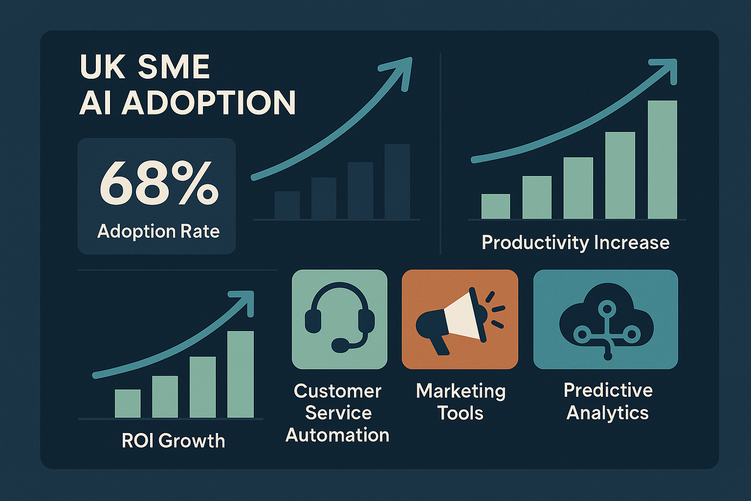
Recent data reveals a remarkable shift in SME technology trends across the United Kingdom. According to Office for National Statistics research, approximately 68% of UK SMEs now utilise some form of AI technology in their operations, up from just 34% in 2022. This dramatic increase signals not just adoption, but a fundamental recognition that AI is no longer optional for businesses seeking to remain competitive.
Current State of AI Adoption in UK SMEs
The landscape of business trends 2025 reveals that UK small businesses are deploying AI across multiple operational areas. Customer service automation leads the charge, with 42% of SMEs implementing AI-powered chatbots and virtual assistants. Marketing automation follows closely at 38%, whilst predictive analytics and inventory management systems account for 31% of implementations.
Research from British Chambers of Commerce indicates that SMEs investing in AI technologies report an average productivity increase of 27% within the first year. More impressively, these businesses experience cost reductions averaging 23% across operations, from reduced manual processing to optimised resource allocation.
The financial services sector leads AI adoption at 78%, followed by retail (71%), manufacturing (65%), and professional services (62%). However, traditional sectors such as hospitality and construction are rapidly catching up, with adoption rates increasing by 45% year-on-year as industry-specific AI solutions become more accessible and affordable.
Key AI Statistics Shaping the UK Business Landscape
Understanding the numbers behind AI adoption UK provides crucial context for business decision-makers. According to Department for Science, Innovation and Technology, UK businesses invested over £3.8 billion in AI technologies during 2024, representing a 62% increase from the previous year.
AI statistics reveal compelling trends:
Employee productivity in AI-enabled businesses has increased by an average of 31%, with workers reporting higher job satisfaction due to reduced repetitive tasks. Customer satisfaction scores have improved by 28% for businesses implementing AI-powered customer service solutions, whilst response times have decreased by an average of 76%.
Perhaps most significantly, 83% of UK SMEs now view AI as essential or very important to their competitive positioning, compared to just 41% three years ago. This shift in perception reflects growing awareness that AI capabilities directly impact market relevance and customer expectations.
The Federation of Small Businesses reports that 54% of SMEs plan to increase their AI investment by at least 30% over the next 18 months. Interestingly, businesses that have already implemented AI are 3.2 times more likely to expand their usage than those just beginning their journey, suggesting that successful early adoption breeds confidence and further investment.
Overcoming Barriers to AI Implementation
Whilst AI adoption UK continues to accelerate, SMEs still face significant challenges. Cost concerns top the list, with 47% of non-adopters citing expense as their primary barrier. Skills gaps follow at 39%, whilst 34% express uncertainty about which AI solutions would benefit their specific operations.
These challenges are substantial but surmountable. Many successful UK SMEs have discovered that partnering with specialists like Kaizen AI Consulting dramatically reduces implementation complexity and risk. Professional guidance helps businesses identify high-impact AI applications, avoid costly mistakes, and accelerate time-to-value.
Data security and privacy concerns affect 42% of SMEs considering AI adoption, particularly given stringent UK GDPR requirements. However, modern AI solutions increasingly incorporate robust security frameworks, and expert consultants ensure compliance whilst maximising functionality.
Integration with existing systems presents technical challenges for 36% of businesses. Legacy software, disparate data sources, and workflow disruption can complicate AI implementation. Strategic planning and phased rollouts, guided by experienced professionals, transform these potential obstacles into manageable steps toward digital transformation.
UK Market Insights: Industry-Specific Trends
UK market insights reveal fascinating industry variations in AI adoption and application. Retail SMEs increasingly leverage AI for demand forecasting, achieving inventory accuracy improvements of up to 43%. Personalised recommendation engines drive average order value increases of 31%, whilst automated pricing optimisation systems boost margins by an average of 18%.
Manufacturing SMEs utilise predictive maintenance AI to reduce equipment downtime by up to 52%, saving thousands in repair costs and lost production. Quality control systems powered by computer vision detect defects with 97% accuracy, surpassing human inspection whilst maintaining consistent standards across shifts.
Professional services firms deploy AI for document analysis, contract review, and research, reducing billable hours spent on routine tasks by an average of 34%. This efficiency gain allows firms to handle more clients without proportional staff increases, or to redirect expertise toward higher-value advisory services.
Healthcare and wellness SMEs benefit from AI-powered appointment scheduling, patient communication, and preliminary diagnostic support. Administrative burden reductions of up to 40% allow practitioners to focus more time on patient care whilst improving service accessibility.
The Competitive Advantage of Early AI Adoption
SME technology trends demonstrate clear competitive advantages for early AI adopters. Businesses implementing AI before competitors in their sector report market share gains averaging 12% within 24 months. Customer acquisition costs decrease by an average of 28%, whilst customer lifetime value increases by 34%.
These advantages compound over time. AI systems continuously learn and improve, creating expanding performance gaps between adopters and non-adopters. Businesses that delay implementation face increasingly steep catch-up challenges as customer expectations evolve around AI-enabled experiences.
Data advantages further separate leaders from followers. AI systems require data to function effectively, and early adopters accumulate valuable datasets that improve model accuracy and predictive capabilities. This creates a virtuous cycle where better data produces better insights, which generate better results and more data.
Employee attraction and retention benefits also emerge. According to Chartered Institute of Personnel and Development research, 67% of professionals under 35 prefer working for technology-forward employers. AI-enabled businesses report 31% lower employee turnover in roles where AI handles routine tasks, allowing staff to focus on more engaging, valuable work.
Looking Forward: Business Trends 2025 and Beyond
Business trends 2025 point toward accelerating AI integration across all business functions. Generative AI applications are expanding beyond content creation into product design, strategic planning, and scenario modelling. Small language models optimised for specific industries offer SMEs powerful capabilities without enterprise-scale computing requirements.
AI-powered financial forecasting is becoming standard practice, with 58% of UK SMEs now using predictive analytics for cash flow management and planning. These tools provide early warning of potential challenges and identify growth opportunities with unprecedented precision.
Voice AI and conversational interfaces are revolutionising customer interactions. By late 2025, industry analysts project that 72% of customer service interactions will involve AI at some stage, with seamless handoffs to human agents only when necessary. This hybrid approach optimises both efficiency and customer satisfaction.
Sustainability applications represent an emerging AI frontier. SMEs increasingly deploy AI to optimise energy usage, reduce waste, and improve supply chain efficiency. These applications deliver both environmental benefits and cost savings, averaging 19% reduction in energy costs and 24% decrease in material waste.
Strategic Implementation: Getting AI Right
Successful AI adoption UK follows consistent patterns. The most successful implementations begin with clear problem definition rather than technology selection. Businesses identify specific operational challenges or opportunities, then select AI tools designed to address those precise needs.
Pilot projects allow testing and refinement before full-scale deployment. Leading SMEs start with focused applications in single departments, measure results rigorously, and expand systematically based on demonstrated value. This approach manages risk whilst building internal expertise and confidence.
Staff engagement proves crucial for success. Change management, training, and clear communication about how AI will augment rather than replace human capabilities ensures team buy-in. Businesses that involve staff in AI selection and implementation report 54% higher satisfaction with results compared to top-down mandates.
Many UK SMEs find that partnering with specialists accelerates success whilst avoiding expensive missteps. Kaizen AI Consulting offers comprehensive support from strategy development through implementation and optimisation, ensuring businesses maximise return on AI investment whilst minimising disruption to ongoing operations.
Investment Returns and ROI Considerations
UK market insights reveal impressive returns on AI investment for SMEs. Businesses report average ROI of 287% over three years, with payback periods typically ranging from 8 to 18 months depending on application scope and implementation approach.
Cost savings deliver immediate visible impact. Process automation reduces labour costs by 15-35% in targeted areas, whilst error reduction saves money previously lost to mistakes, rework, and customer compensation. Improved inventory management and demand forecasting reduce carrying costs and minimise stock-outs or overstocks.
Revenue enhancement opportunities often exceed cost savings. Personalisation increases conversion rates by 20-40%, whilst improved customer service drives retention improvements worth 5-7 times customer acquisition costs. Better forecasting enables businesses to capitalise on demand spikes and avoid lost sales opportunities.
Strategic value proves hardest to quantify but potentially most significant. AI-enabled businesses make faster, more informed decisions based on comprehensive data analysis. They identify market trends earlier, respond to competitive threats more effectively, and innovate more successfully than technology-lagging competitors.
Taking Action: Your AI Journey Starts Now
The data clearly demonstrates that AI adoption UK represents not future consideration but present imperative. SME technology trends indicate that competitive businesses are already leveraging AI advantages, and the gap between adopters and non-adopters continues widening.
Starting your AI journey need not feel overwhelming. Begin by assessing which operational areas would benefit most from automation, enhanced analytics, or improved customer interaction. Consider where bottlenecks occur, where errors happen most frequently, or where customer feedback suggests improvement opportunities.
Research available solutions designed specifically for your industry and business size. Cloud-based AI platforms offer SME-friendly pricing and implementation models, eliminating the need for massive upfront investment or specialised technical infrastructure.
Most importantly, seek expert guidance to navigate the complex AI landscape. Professional consultants help businesses avoid expensive mistakes, accelerate implementation, and ensure maximum value from AI investment. Kaizen AI Consulting specialises in helping UK SMEs identify optimal AI applications, select appropriate solutions, and implement them effectively for measurable business improvement.
Conclusion: Embracing the AI-Powered Future
Business trends 2025 make one fact abundantly clear: artificial intelligence has moved from emerging technology to business essential. UK small businesses embracing AI capabilities position themselves for growth, efficiency, and competitive advantage in an increasingly technology-driven marketplace.
The statistics speak compellingly. Higher productivity, reduced costs, improved customer satisfaction, and better strategic decision-making await businesses that implement AI thoughtfully and strategically. The barriers that once prevented SME adoption continue falling as solutions become more accessible, affordable, and user-friendly.
The question facing UK business owners is no longer whether to adopt AI, but how quickly and effectively to implement it. With the right approach, supported by expert guidance when needed, even the smallest businesses can harness AI capabilities that were unimaginable just a few years ago.
Your competitors are already exploring these opportunities. Your customers increasingly expect AI-enabled experiences. The time to act is now. Contact Kaizen AI Consulting today to discover how AI can transform your business operations, delight your customers, and drive sustainable growth in 2025 and beyond.