In today’s fast-paced digital landscape, maintaining consistent brand messaging across multiple channels has become increasingly challenging for UK businesses. With customers interacting with brands through websites, social media, email, and various other touchpoints, the demand for high-quality content has never been greater. Enter artificial intelligence: a transformative technology that’s revolutionising how organisations approach content creation whilst maintaining brand consistency.
According to recent research from Gartner, by 2025, 30% of outbound marketing messages from large organisations will be synthetically generated. This shift towards AI content strategy isn’t just about efficiency; it’s about creating scalable, consistent messaging that resonates with your audience whilst staying true to your brand values.
Understanding AI-Powered Content Creation
AI writing technology has evolved dramatically over recent years. Modern AI content tools leverage natural language processing and machine learning algorithms to generate human-quality text that can match your brand’s tone, style, and messaging guidelines. However, successful implementation requires more than simply feeding prompts into an AI system and publishing the results.
The key to effective AI content strategy lies in understanding how these tools complement human creativity rather than replace it. Research from the Content Marketing Institute reveals that 73% of B2B marketers are now using generative AI tools in their content creation process, yet the most successful implementations maintain strong human oversight and strategic direction.
Building Your AI Content Strategy Framework
Establishing Brand Guidelines for AI Tools
Before implementing content automation, you must create comprehensive brand guidelines that AI systems can follow. This includes documenting your brand voice, preferred terminology, forbidden phrases, and stylistic preferences. UK businesses need to pay particular attention to regional spelling conventions, local terminology, and cultural nuances that AI tools trained primarily on American English might miss.
Your brand guidelines should include specific examples of approved and disapproved content styles, tone variations for different platforms, and clear instructions about how to address your target audience. These guidelines become the foundation for training and prompting AI systems effectively.
Creating Templated Prompts for Consistency
One of the most effective strategies for maintaining brand consistency with AI writing is developing templated prompts that encode your brand standards. Rather than creating ad-hoc prompts for each piece of content, establish prompt libraries that include your brand voice, target audience details, and specific messaging requirements.
For example, a templated prompt might specify: “Write in a professional yet approachable tone suitable for UK business decision-makers, using British English spelling, focusing on practical implementation rather than theory, and incorporating relevant statistics with sources.” This approach ensures every piece of AI-generated content starts from the same foundational brand parameters.
Implementing Quality Control Processes
Even the most sophisticated AI content strategy requires robust quality control. Establish a multi-stage review process where AI-generated content is evaluated for brand alignment, factual accuracy, and audience appropriateness. According to McKinsey research, organisations with structured governance around AI content creation see 40% better results in terms of audience engagement and brand perception.
Leveraging Content Automation for Scale
Content automation extends beyond simply generating text. It encompasses the entire content lifecycle, from ideation and creation to distribution and performance analysis. Smart automation allows you to maintain consistent messaging across all channels whilst freeing your team to focus on strategy and creative direction.
Multi-Channel Content Distribution
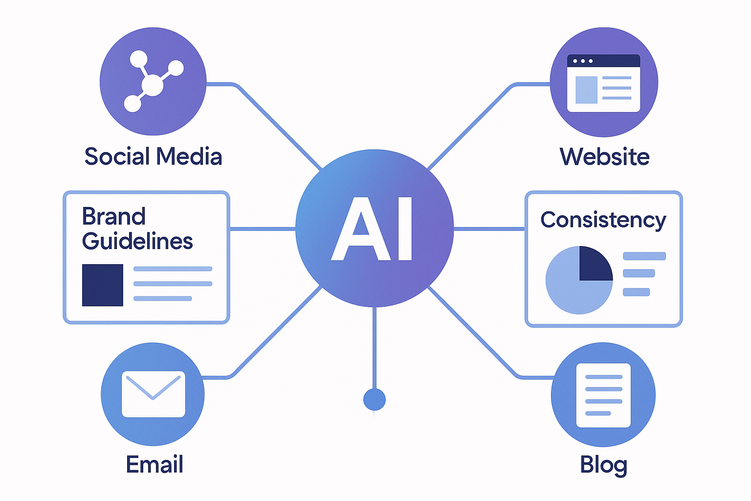
Modern consumers interact with brands across numerous touchpoints. Your AI content strategy should include automated processes for adapting core messages to different platforms whilst maintaining brand consistency. A single piece of long-form content can be automatically transformed into social media posts, email newsletters, and website copy, each optimised for its specific channel whilst maintaining consistent messaging.
This is where Kaizen AI Consulting’s integration services prove invaluable. By implementing sophisticated AI workflows tailored to your specific needs, we help businesses automate content distribution without sacrificing the human touch that makes branded content creation effective.
Personalisation at Scale
AI writing tools excel at creating personalised content variations that maintain brand consistency whilst addressing different audience segments. By analysing customer data and behaviour patterns, AI systems can generate tailored messaging that speaks directly to specific demographics, industries, or buyer journey stages.
Research from Salesforce indicates that 73% of customers expect companies to understand their unique needs. AI-powered personalisation enables this level of customisation without requiring exponentially more resources from your marketing team.
Maintaining Brand Consistency Across Teams
One of the greatest challenges in content creation is ensuring consistency when multiple team members, freelancers, or agencies contribute to your content output. AI tools serve as a centralising force, ensuring that everyone works from the same brand foundations regardless of individual writing styles or interpretations.
Centralised Brand Voice Management
By training AI systems on your approved content library, you create a dynamic brand voice reference that every content creator can access. This living system learns from your best-performing content and helps maintain consistency even as your brand evolves. New team members can produce on-brand content more quickly, and the risk of off-brand messaging decreases significantly.
Version Control and Content Governance
AI-powered content management systems can track changes, flag potential brand inconsistencies, and ensure that all content meets your standards before publication. This automated governance reduces the burden on senior marketers whilst protecting brand integrity across all channels.
Measuring Success and Continuous Improvement
Implementing an AI content strategy isn’t a set-and-forget proposition. Successful organisations continuously monitor performance metrics and refine their approaches based on data-driven insights.
Key Performance Indicators for AI Content
Track metrics such as content production velocity, engagement rates, brand sentiment analysis, and conversion performance. Compare AI-assisted content against traditional content creation methods to understand where AI provides the greatest value. UK businesses should pay particular attention to regional engagement patterns and local search performance to ensure their content automation strategies resonate with British audiences.
Iterative Refinement Process
Use performance data to continuously refine your AI prompts, brand guidelines, and content strategies. The most effective AI content strategy evolves based on real-world results, incorporating learnings from successful campaigns and adjusting approaches that underperform.
Overcoming Common Challenges
Despite its potential, AI-powered content creation presents challenges that organisations must address proactively. Understanding these obstacles and implementing strategies to overcome them separates successful implementations from disappointing ones.
Avoiding Generic, Robotic Content
The primary concern with AI writing is producing generic content that lacks personality and fails to connect with audiences. Combat this by injecting human creativity at strategic points, using AI for drafting and structure whilst adding unique insights, stories, and perspectives manually. Your brand’s distinctive voice should shine through, with AI serving as an accelerant rather than a replacement for human creativity.
Ensuring Factual Accuracy
AI systems can generate plausible-sounding but factually incorrect information. Implement rigorous fact-checking processes and train content creators to verify all claims, statistics, and assertions before publication. This quality control step is non-negotiable for maintaining brand credibility.
Navigating SEO Considerations
Search engines increasingly prioritise helpful, original content that demonstrates expertise and authority. Whilst AI can assist with optimisation, avoid over-relying on AI-generated content without adding unique value. Professional SEO and content services ensure that your AI-powered content strategy aligns with current best practices and search engine guidelines.
The Human-AI Partnership
The future of branded content creation lies not in choosing between human creativity and AI efficiency, but in strategically combining both. AI handles repetitive tasks, generates first drafts, and ensures consistency, whilst human creators provide strategic direction, emotional intelligence, and creative spark.
This partnership model allows content teams to achieve unprecedented scale whilst maintaining the authentic, engaging messaging that builds lasting customer relationships. By automating routine tasks, your team gains bandwidth to focus on high-impact activities like strategy development, creative campaign concepts, and relationship building.
Getting Started with AI Content Strategy
For UK businesses looking to implement AI-powered content creation, start with a pilot project focused on a specific content type or channel. This contained approach allows you to learn, refine processes, and demonstrate value before scaling across your entire content operation.
Begin by auditing your current content creation processes to identify bottlenecks and opportunities for automation. Document your brand voice thoroughly, establish clear guidelines, and select AI tools that align with your specific needs. Most importantly, maintain realistic expectations: AI is powerful but requires thoughtful implementation and ongoing management.
The investment in developing a robust AI content strategy pays dividends through increased content velocity, improved consistency, and freed resources for strategic initiatives. However, success requires more than adopting new technology; it demands rethinking how your organisation approaches content creation at a fundamental level.
Partner with Experts for Successful Implementation
Implementing an effective AI content strategy requires technical expertise, marketing knowledge, and strategic thinking. Many organisations benefit from partnering with specialists who understand both the technology and the business outcomes you’re trying to achieve.
Kaizen AI Consulting helps UK businesses navigate the complexities of AI-powered content creation, from strategy development and tool selection to implementation and team training. Our approach ensures that AI enhances rather than compromises your brand consistency, creating scalable content systems that drive real business results.
Whether you’re just beginning to explore content automation or looking to optimise existing AI implementations, professional guidance can accelerate your success and help avoid costly missteps. We work alongside your team to develop customised solutions that align with your brand, audience, and business objectives.
Ready to transform your content creation process whilst maintaining unwavering brand consistency? Contact Kaizen AI Consulting today to discuss how we can help you develop and implement an AI content strategy that delivers measurable results for your business.