In today’s rapidly evolving business landscape, UK companies are increasingly turning to artificial intelligence to streamline operations and boost efficiency. From small startups to established enterprises, organisations across the country are discovering that operational efficiency AI solutions can deliver substantial improvements in productivity, cost savings, and competitive advantage.
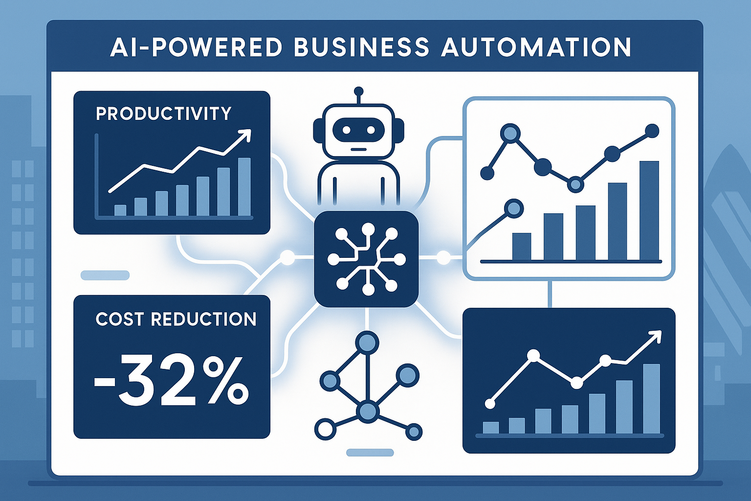
According to research from TechUK, businesses implementing AI-driven automation see an average productivity increase of 40%, whilst reducing operational costs by up to 30%. These impressive figures demonstrate why business optimization through AI is no longer optional but essential for companies wanting to thrive in competitive markets.
Understanding AI’s Role in Business Operations
Artificial intelligence encompasses a range of technologies designed to replicate human intelligence and decision-making. When applied to business operations, AI can analyse vast amounts of data, identify patterns, automate repetitive tasks, and provide actionable insights that drive better business outcomes.
The beauty of process automation lies in its ability to handle routine tasks with precision and consistency, freeing your team to focus on strategic activities that require human creativity and judgement. Whether it’s processing invoices, managing customer enquiries, or optimising supply chains, AI tools can transform how your business operates on a fundamental level.
Key Areas Where AI Drives Operational Efficiency
Customer Service and Support
AI-powered chatbots and virtual assistants are revolutionising customer service across UK businesses. These intelligent systems can handle multiple customer enquiries simultaneously, providing instant responses 24/7. Research from Forbes indicates that businesses using AI chatbots resolve up to 80% of routine customer queries without human intervention, significantly reducing response times and improving customer satisfaction.
Beyond basic chatbots, advanced natural language processing enables AI systems to understand context, sentiment, and intent, delivering personalised responses that feel genuinely helpful rather than robotic. This level of workflow improvement means your customer service team can dedicate their expertise to complex issues requiring empathy and nuanced problem-solving.
Data Analysis and Business Intelligence
Modern businesses generate enormous volumes of data daily, but raw data alone provides little value. AI excels at transforming this data into actionable intelligence. Machine learning algorithms can identify trends, predict customer behaviour, forecast demand, and highlight operational inefficiencies that might otherwise go unnoticed.
For instance, productivity AI tools can analyse your sales data to identify which products perform best during specific seasons, which marketing channels deliver the highest ROI, and which customer segments offer the greatest growth potential. This intelligence enables data-driven decision-making that significantly improves business outcomes.
Supply Chain and Inventory Management
AI-driven supply chain management represents a game-changer for businesses dealing with physical products. According to McKinsey, companies implementing AI in their supply chains have reduced forecasting errors by 50% and decreased inventory holdings by 20-30% whilst simultaneously improving product availability.
Predictive analytics can forecast demand with remarkable accuracy, helping you maintain optimal stock levels, reduce waste, and avoid costly stockouts. AI systems can also identify the most efficient delivery routes, predict potential disruptions, and automatically reorder supplies when needed.
Financial Operations and Accounting
Financial departments across the UK are embracing AI for tasks like invoice processing, expense management, and financial reporting. Automated systems can extract data from invoices, match them to purchase orders, flag discrepancies, and process payments – all without manual intervention.
This process automation not only accelerates financial operations but also improves accuracy by eliminating human errors. AI can also detect fraudulent transactions, ensure compliance with regulations, and provide real-time financial insights that support better cash flow management.
Implementing AI in Your Business: A Practical Approach
Start with Clear Objectives
Before implementing any AI solution, identify specific operational challenges you want to address. Are you struggling with customer response times? Is inventory management causing problems? Do you need better insights from your data? Clear objectives ensure you select the right AI tools and measure success effectively.
At Kaizen AI Consulting, we help UK businesses identify high-impact opportunities where AI can deliver immediate improvements to operational efficiency. Our consultative approach ensures AI implementations align perfectly with your strategic goals and deliver measurable ROI.
Assess Your Current Infrastructure
Successful AI implementation requires adequate data infrastructure and quality. Audit your current systems to understand what data you’re collecting, how it’s stored, and whether it’s accessible for AI applications. Many businesses discover they need to improve data collection practices before AI can deliver its full potential.
Choose the Right AI Tools
The AI landscape offers countless tools and platforms, each designed for specific purposes. For business optimization, consider:
- Robotic Process Automation (RPA): Software robots that automate repetitive, rule-based tasks across multiple applications
- Machine Learning Platforms: Tools that learn from data patterns to make predictions and recommendations
- Natural Language Processing: Technology that understands and generates human language for chatbots, sentiment analysis, and document processing
- Computer Vision: AI that interprets visual information for quality control, inventory management, and security
Selecting appropriate tools requires understanding both your business needs and the technical capabilities of different AI solutions. Professional guidance can prevent costly mistakes and accelerate time-to-value.
Pilot Before Scaling
Rather than attempting organisation-wide AI transformation immediately, start with pilot projects in specific departments or processes. This approach allows you to test effectiveness, refine implementations, and build internal expertise before scaling successful initiatives across the business.
Pilot projects also help build organisational buy-in by demonstrating tangible benefits, addressing concerns, and creating internal champions who understand AI’s value proposition.
Overcoming Common Implementation Challenges
Managing Change and Building Skills
Introducing AI often raises concerns amongst employees who fear job displacement. Effective change management is crucial. Communicate clearly that AI aims to augment human capabilities rather than replace people, emphasising how automation frees employees to focus on more engaging, strategic work.
Invest in training programmes that help your team understand AI tools and develop complementary skills. According to research from CIPD, organisations that prioritise employee development during digital transformation see 25% higher success rates than those that don’t.
Ensuring Data Quality and Security
AI systems are only as good as the data they’re trained on. Poor quality data leads to unreliable insights and flawed automation. Establish robust data governance practices that ensure accuracy, consistency, and compliance with UK data protection regulations including GDPR.
Security is equally critical. AI systems often access sensitive business and customer information, requiring strong cybersecurity measures to prevent breaches and maintain trust.
Measuring ROI and Continuous Improvement
Define clear metrics for evaluating AI’s impact on operational efficiency AI initiatives. These might include time saved, error reduction, cost savings, revenue increase, or customer satisfaction improvements. Regular measurement enables you to optimise implementations and demonstrate value to stakeholders.
AI isn’t a set-and-forget solution. Machine learning models require ongoing training with fresh data, and business needs evolve. Establish processes for continuous monitoring, refinement, and improvement of your AI systems.
Real-World Success Stories
UK businesses across sectors are achieving remarkable results through AI implementation. A Manchester-based logistics company reduced delivery times by 22% using AI-powered route optimization. A London financial services firm cut invoice processing time from days to hours through intelligent automation. A Birmingham manufacturer decreased defect rates by 35% using computer vision quality control.
These success stories share common elements: clear objectives, appropriate technology selection, effective change management, and commitment to continuous improvement. They demonstrate that workflow improvement through AI isn’t theoretical but practically achievable for businesses of all sizes.
The Future of AI in Business Operations
AI technology continues advancing rapidly, with new capabilities emerging regularly. Generative AI, like the systems powering advanced content creation and analysis, represents the latest frontier. These tools can draft documents, generate reports, create marketing content, and provide sophisticated analytical insights.
Edge AI brings processing power closer to data sources, enabling real-time decision-making in manufacturing, retail, and logistics. Meanwhile, explainable AI addresses the “black box” challenge, making AI decision-making more transparent and trustworthy.
UK businesses that establish AI capabilities now position themselves advantageously for future developments, building organisational competence that compounds over time.
Partner with Experts for Successful Implementation
Whilst AI offers tremendous potential for business optimization, successful implementation requires expertise spanning technology, business strategy, and change management. Many organisations benefit from partnering with specialists who understand both AI capabilities and practical business applications.
Kaizen AI Consulting specialises in helping UK businesses harness AI to improve operational efficiency and drive growth. Our team brings deep expertise in AI technologies combined with practical understanding of business operations across industries. We don’t just recommend technology – we partner with you to implement solutions that deliver measurable results.
Take the Next Step Towards AI-Powered Efficiency
The question isn’t whether AI will transform business operations, but how quickly your organisation will embrace this transformation. Every day without AI-driven efficiency represents missed opportunities for cost savings, productivity gains, and competitive advantage.
Start your journey by assessing where AI could deliver the greatest impact in your operations. Identify processes that are repetitive, time-consuming, or prone to errors. Consider areas where better data insights could improve decision-making. Think about customer experiences that could be enhanced through automation and personalisation.
Whether you’re just beginning to explore AI possibilities or ready to implement specific solutions, expert guidance accelerates success and prevents costly missteps. Contact Kaizen AI Consulting today to discuss how we can help optimise your business operations through strategic AI implementation. Our initial consultation will identify specific opportunities for productivity AI improvements tailored to your unique business needs.
The future of business operations is intelligent, automated, and efficient. With the right approach and expert support, your organisation can harness AI’s transformative power to achieve unprecedented levels of operational excellence. Don’t let competitors gain the advantage – embrace AI-driven efficiency today and position your business for sustainable success in the digital age.