SEO vs PPC: Which Strategy is Right for Your Small Business?
In the competitive landscape of UK digital marketing, small business owners face a crucial decision: should they invest in search engine optimisation (SEO) or pay-per-click (PPC) advertising? Both strategies offer unique advantages for increasing online visibility, but choosing the right approach can significantly impact your marketing budget and long-term success.
According to BrightEdge research, organic search drives 53% of all website traffic, whilst paid search accounts for approximately 15%. However, these figures don’t tell the complete story. The reality is that the most effective search marketing strategy often involves a balanced combination of both paid and organic approaches, tailored to your specific business goals and resources.
Understanding SEO: The Long-Term Investment
Search engine optimisation focuses on improving your website’s visibility in organic search results through strategic content creation, technical optimisation, and building authority. Unlike PPC, you don’t pay for each click, but SEO requires significant time and expertise to execute effectively.
Key Benefits of SEO for Small Businesses
Cost-Effectiveness Over Time: Whilst initial SEO investment can be substantial, the long-term cost per acquisition often decreases significantly. Search Engine Journal reports that SEO leads have a 14.6% close rate, compared to just 1.7% for outbound leads like direct mail or print advertising.
Sustainable Traffic: Once your website ranks well, it can maintain those positions with ongoing maintenance, providing consistent traffic without continuous ad spend. Many UK small businesses find that SEO delivers compounding returns over months and years.
Trust and Credibility: Research from Search Engine Watch indicates that 70-80% of users ignore paid advertisements and focus on organic results. Ranking organically signals authority and trustworthiness to potential customers.
Comprehensive Online Presence: Effective SEO improves your entire digital footprint, including local listings, Google Business Profile, and content marketing efforts. This holistic approach benefits your overall business strategy beyond just search rankings.
SEO Challenges for Small Businesses
The primary challenge with SEO is patience. Results typically take 3-6 months to materialise, and competitive industries may require even longer. Additionally, Google’s algorithm updates can impact rankings, requiring continuous adaptation and monitoring.
Many small business owners also find SEO technically complex, covering areas like site speed optimisation, mobile responsiveness, schema markup, and content strategy. This is where partnering with specialists like Kaizen AI Consulting can accelerate results whilst avoiding costly mistakes that could harm your online visibility.
Understanding PPC: The Immediate Impact Strategy
Pay-per-click advertising, primarily through Google Ads, allows businesses to appear at the top of search results almost immediately by bidding on relevant keywords. You only pay when someone clicks your advertisement, making it a performance-based advertising strategy.
Key Benefits of PPC for Small Businesses
Immediate Visibility: Unlike SEO, PPC campaigns can drive qualified traffic within hours of launch. This makes it ideal for product launches, seasonal promotions, or businesses needing quick revenue generation.
Precise Targeting: PPC platforms offer sophisticated targeting options including location, demographics, device type, time of day, and even remarketing to previous visitors. For UK businesses targeting specific regions or postcodes, this precision is invaluable.
Predictable Budgeting: You maintain complete control over daily and monthly spending, making cash flow management straightforward. According to WordStream data, the average small business spends between £1,500 and £10,000 monthly on PPC campaigns.
Measurable ROI: Every aspect of PPC is trackable, from impressions and clicks to conversions and revenue. This transparency allows for data-driven optimisation and clear ROI calculations.
Testing Ground: PPC campaigns provide immediate feedback on which keywords, offers, and messaging resonate with your target audience. These insights can inform your broader marketing strategy and even your SEO content approach.
PPC Challenges for Small Businesses
The most significant drawback of PPC is ongoing cost. Traffic stops immediately when you pause campaigns, creating a perpetual expense. In competitive industries, cost-per-click (CPC) can become prohibitively expensive, with some UK sectors seeing CPCs exceeding £5-10 per click.
Google’s UK data shows that click-through rates for search ads average around 3-5%, meaning 95-97% of users scroll past advertisements. Additionally, poorly managed PPC campaigns can quickly deplete budgets without delivering meaningful returns, requiring expertise to optimise effectively.
SEO vs PPC: Direct Comparison
Cost Analysis: Paid vs Organic
SEO Costs: Initial investment ranges from £500-£2,500 monthly for professional services, with ongoing maintenance from £300-£1,000 monthly. However, cost-per-click effectively decreases over time as organic rankings improve.
PPC Costs: Entirely variable based on competition and budget, with management fees typically 10-20% of ad spend. A competitive keyword might cost £3-8 per click, meaning a £1,000 monthly budget could deliver just 125-330 visitors.
Timeline Expectations
SEO Timeline: Initial results in 3-4 months, significant traction in 6-12 months, and compounding returns over years. Ideal for businesses with stable cash flow and long-term vision.
PPC Timeline: Immediate traffic and results, with optimisation improving performance over 2-3 months. Perfect for businesses needing quick wins or testing market demand.
Traffic Quality Considerations
Both strategies can deliver high-quality traffic when properly executed. SEO often attracts users earlier in the research phase, whilst PPC can target users with high purchase intent through specific keyword selection and ad copy.
Which Strategy Suits Your Small Business?
Choose SEO as Your Priority If:
Your business operates in a moderately competitive niche where organic rankings are achievable within 6-12 months. You have limited monthly marketing budget but can commit to consistent investment over time. Your products or services have long sales cycles requiring multiple touchpoints. You want to build sustainable, long-term traffic that continues growing with minimal ongoing investment.
Local businesses, professional services, and content-driven businesses often see exceptional SEO returns. For example, a Manchester-based accountancy firm might invest £1,500 monthly in SEO and, after 12 months, consistently attract 20-30 qualified leads monthly without ongoing ad spend.
Choose PPC as Your Priority If:
You need immediate revenue and have products with proven conversion rates. Your business is new with no existing organic visibility and you need traction quickly. You’re launching time-sensitive campaigns or seasonal products. You operate in highly competitive industries where organic rankings would take years to achieve.
E-commerce businesses, event-based services, and businesses with high customer lifetime value often maximise PPC effectively. A London-based event company might spend £3,000 monthly on PPC during peak season, generating £30,000+ in immediate bookings.
The Integrated Approach: Best of Both Worlds
Most successful UK small businesses eventually adopt an integrated search marketing strategy that leverages both SEO and PPC synergistically. Research from Google indicates that businesses using both strategies together see up to 25% more clicks than using either alone.
Here’s how integration works practically: Use PPC to gain immediate visibility whilst building SEO foundations. Test keyword performance and messaging through PPC, then create SEO content around high-converting terms. Deploy PPC to dominate page one for your most valuable keywords whilst organic rankings develop. Use remarketing to recapture organic visitors who didn’t convert on first visit.
A Birmingham retailer might allocate 60% of their budget to SEO for sustainable growth whilst using 40% for PPC targeting high-intent keywords and seasonal opportunities. This balanced approach delivers both immediate results and long-term asset building.
Making Your Decision: Practical Steps
Assess Your Current Position
Evaluate your existing website’s technical health, content quality, and current search visibility. Analyse your competitors’ strategies and market positioning. Review your available marketing budget and timeline expectations. Determine your customer acquisition cost targets and lifetime value.
Start with a Pilot Programme
Rather than committing fully to one strategy, consider a 3-month pilot testing both approaches with smaller budgets. This provides real data specific to your business and market, enabling informed decisions about future investment allocation.
Monitor and Optimise Continuously
Regardless of your chosen strategy, success requires ongoing monitoring, testing, and refinement. Track metrics like cost per acquisition, conversion rates, organic ranking progress, and overall ROI. Adjust your approach based on performance data rather than assumptions.
How Kaizen AI Consulting Can Help Your Business Succeed
Navigating the complexities of SEO vs PPC requires expertise, time, and strategic thinking. At Kaizen AI Consulting, we help UK small businesses develop customised search marketing strategies that align with their specific goals, budgets, and growth timelines.
Our approach combines comprehensive SEO audits and implementation with intelligent PPC campaign management, ensuring your marketing budget delivers maximum returns. We leverage AI-powered analytics to identify opportunities your competitors miss and continuously optimise your campaigns for better performance.
Whether you need help establishing your organic presence, launching profitable PPC campaigns, or creating an integrated strategy that leverages both channels, our team provides the expertise and support to drive measurable business growth. We work with small businesses across the UK, from London to Edinburgh, delivering strategies tailored to local markets and competitive landscapes.
Ready to develop a search marketing strategy that actually works for your small business? Contact Kaizen AI Consulting today for a complimentary consultation. We’ll analyse your current situation, identify opportunities, and recommend the optimal approach for achieving your business objectives. Let’s transform your online visibility and drive sustainable growth together.
Conclusion: Your Path Forward
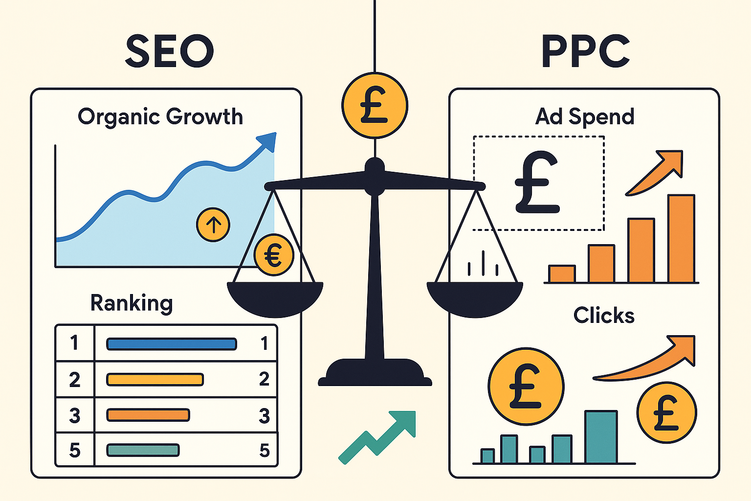
The SEO vs PPC debate doesn’t have a universal answer. The right strategy depends entirely on your business circumstances, goals, and resources. SEO offers sustainable, cost-effective long-term growth, whilst PPC delivers immediate visibility and precise targeting. Many successful businesses ultimately adopt an integrated approach, leveraging the strengths of both strategies.
The most important decision is to start somewhere. Delaying your search marketing investment means losing ground to competitors who are capturing your potential customers right now. Whether you begin with SEO, PPC, or a combination of both, taking action today positions your business for greater success tomorrow.
Remember that search marketing is not a set-and-forget activity. It requires ongoing commitment, optimisation, and adaptation to changing algorithms, competitive landscapes, and customer behaviours. With the right strategy and expert guidance, your small business can compete effectively against larger competitors and build a sustainable pipeline of qualified leads and customers through search.