Building an AI Customer Service Bot That Actually Helps Customers
There is a significant difference between deploying an AI customer service bot and deploying one that genuinely helps customers. The former is increasingly common; the latter remains frustratingly rare. With the UK chatbots market valued at USD 276.2 million in 2025 and projected to grow at an 18.89% compound annual growth rate through to 2034, British businesses are investing heavily in support automation. Yet many are still getting it spectacularly wrong.
This guide cuts through the noise. Whether you are a small business owner dipping your toes into AI for the first time or a customer experience manager tasked with overhauling your support infrastructure, this article will walk you through what it takes to build a customer service bot that customers actually want to use.
Why Most Customer Service Bots Frustrate Rather Than Help
Before building something better, it is worth understanding why so many AI chatbot deployments fall short. According to research compiled for UK business leaders, 61% of UK consumers still prefer human interaction over chatbots for customer service queries. That is not an argument against chatbots; it is an argument against poorly built ones.
The most common failure points identified by practitioners in 2026 include:
- No clear objective: Many businesses deploy a customer service bot simply because competitors are doing so, without defining what success actually looks like.
- Weak data foundations: An AI chatbot trained on incomplete, outdated, or poorly structured company information will produce inaccurate answers that erode customer trust rapidly.
- No escalation pathway: When a bot cannot resolve an issue, customers need a frictionless route to a human agent. Without this, frustration compounds quickly.
- Treating the bot as a smart FAQ: The most effective customer service bots are integrated into real business workflows, connecting to CRM systems, order management tools, and ticketing platforms rather than simply regurgitating static information.
- Rushing deployment: Launching without thorough scenario testing, stress testing, and edge case evaluation is one of the most cited reasons for early chatbot failure.
Understanding these pitfalls is the foundation of building something that works. The good news is that when businesses get it right, the results are compelling. Industry data suggests AI chatbots can reduce customer support costs by up to 30%, with global savings from AI customer service projected to reach 80 billion US dollars by 2026.
Defining the Scope: What Should Your Bot Actually Do?
The most important decision you will make before writing a single line of code or configuring a single workflow is defining the scope of your customer service bot. Trying to build a bot that handles everything is a recipe for a bot that handles nothing particularly well.
Start by auditing your current support volume. Look at your most frequently asked questions, your highest-volume support ticket categories, and the queries where response time has the greatest impact on customer satisfaction. These are your primary candidates for automation.
A practical starting framework is to categorise queries into three buckets:
- Automate fully: Order status checks, account balance enquiries, password resets, opening hours, returns policy explanations. These are high-volume, low-complexity interactions where an AI chatbot business tool delivers maximum ROI.
- Automate with oversight: Product recommendations, complaint triage, subscription changes. The bot handles the initial interaction and data gathering, but a human reviews or approves the outcome.
- Route directly to humans: Complex complaints, legal queries, emotionally sensitive interactions, and high-value customer negotiations. No bot should be attempting these without a human in the loop.
This scoping exercise alone will prevent the majority of common deployment failures. If you are unsure how to map your existing processes to these categories, working with an experienced AI consultancy at the outset can save considerable time and money. At Kaizen AI Consulting, we help UK businesses conduct exactly this kind of structured process audit before any technical build begins, ensuring that automation efforts are targeted at the interactions where they will have the greatest positive impact on customer experience.
Choosing the Right Technology Foundation
The technical landscape for AI chatbot business tools has matured considerably. You are no longer choosing between a rigid decision-tree chatbot and an expensive bespoke AI model. Today there is a rich middle ground of large language model (LLM) powered platforms that can be configured, fine-tuned, and integrated without requiring a team of data scientists.
Rule-Based vs. AI-Powered Bots
Rule-based bots follow predefined decision trees and are excellent for highly structured, predictable interactions. They are transparent, auditable, and unlikely to produce unexpected outputs. Their limitation is brittleness: any query that falls outside the predefined paths will result in a dead end for the customer.
AI-powered bots using natural language processing (NLP) and generative AI can understand intent, handle variation in how questions are phrased, and produce contextually appropriate responses even for queries they have not been explicitly trained on. Natural language processing now powers 85% of UK chatbot deployments, reflecting a clear industry preference for this approach.
For most UK businesses, the optimal solution is a hybrid: an AI-powered conversational layer backed by structured escalation rules that ensure reliability and accountability.
The Role of Retrieval-Augmented Generation (RAG)
One of the most impactful advances in practical AI deployment for customer service is retrieval-augmented generation, or RAG. Rather than relying solely on what a language model was trained on, RAG systems dynamically pull relevant information from your own knowledge base, product documentation, and internal resources to construct accurate, up-to-date responses.
This is particularly valuable for businesses with complex product catalogues, frequently updated policies, or industry-specific terminology. A RAG-based customer service bot can answer questions about your specific products, current pricing, and live stock availability in a way that a generic AI model simply cannot. It also significantly reduces the risk of the bot producing plausible-sounding but incorrect information, a problem sometimes referred to as hallucination.
Designing Conversations That Feel Human
Even the most technically capable AI chatbot will underperform if the conversation design is poor. Customers interact with bots through language, and the quality of that linguistic experience shapes their entire perception of your brand.
Effective conversation design for a customer service bot involves several disciplines:
- Tone and voice consistency: Your bot should sound like your brand, not like a generic AI assistant. Define a tone of voice guide for your bot just as you would for any other customer-facing communication.
- Clear capability signposting: Be upfront about what the bot can and cannot do. Customers who know what to expect are far more forgiving when limitations arise.
- Transparent AI disclosure: UK businesses should be aware that failing to disclose to customers that they are interacting with an AI rather than a human carries both ethical and emerging legal implications. Transparency builds trust rather than undermining it.
- Graceful failure handling: When the bot does not understand a query, it should acknowledge this clearly and offer a constructive next step, whether that is rephrasing the question, browsing the help centre, or speaking to a human agent.
- Proactive conversation steering: Well-designed bots guide customers towards resolution rather than waiting passively for the right keywords to trigger a response.
Integrating Your Bot with Existing Systems
A customer service bot that exists in isolation from your business systems will quickly reach the limits of what it can do for customers. True support automation comes from deep integration with the platforms your business already relies on.
The integrations that deliver the greatest customer experience improvements typically include:
- CRM integration: Allowing the bot to access customer history, previous interactions, and account status enables personalised responses and eliminates the frustration of customers having to repeat themselves.
- Order management systems: For e-commerce businesses, the ability to pull real-time order status, trigger returns, and update delivery preferences autonomously handles a vast proportion of inbound queries.
- Ticketing platforms: Automatic ticket creation with properly categorised and prioritised data means that when a query does reach a human agent, they have full context from the outset.
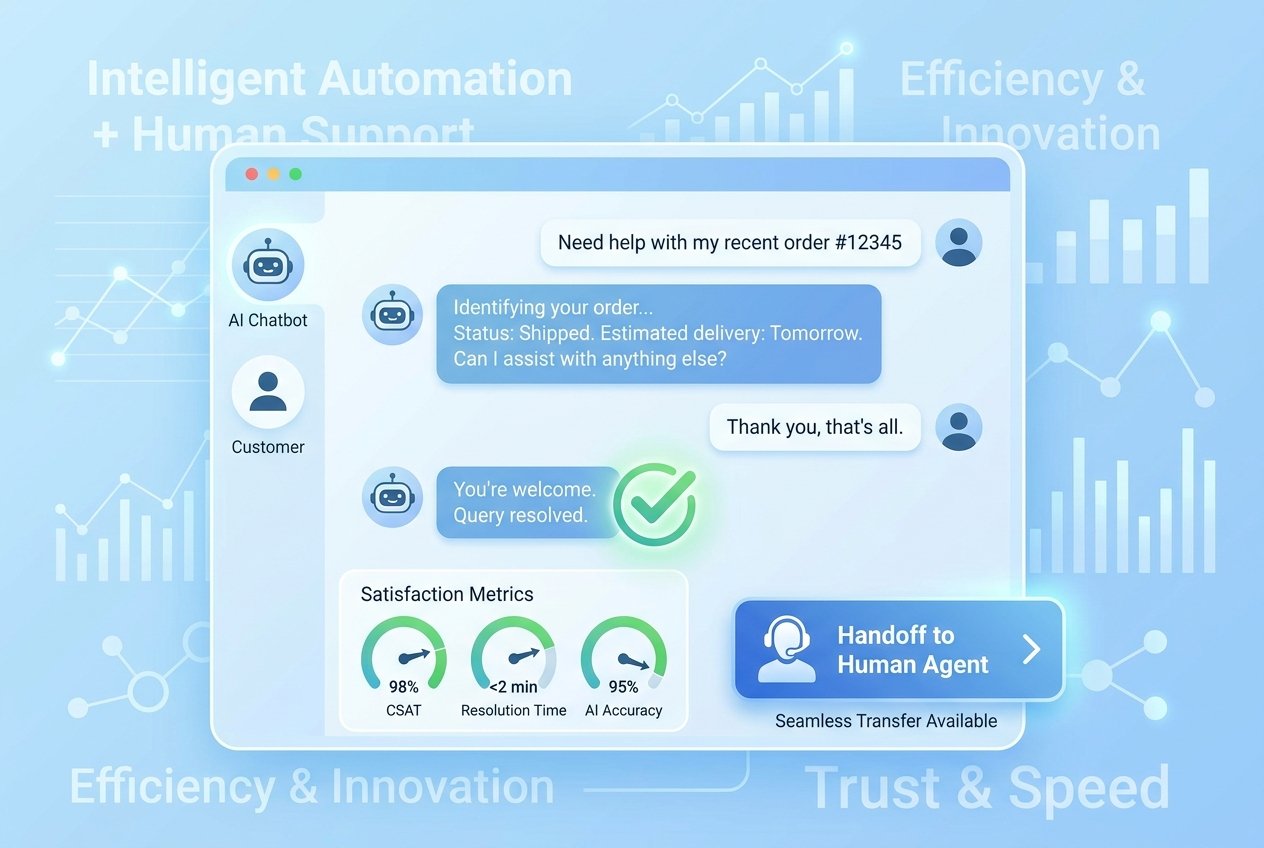
- Live chat handover: Seamless transition from bot to human agent, with full conversation history passed across, is essential for maintaining customer experience quality at the escalation point.
It is worth noting that UK government research published in February 2026 found that only around one in six UK businesses are currently using AI in any meaningful capacity. For businesses that invest in properly integrated customer experience AI now, the competitive advantage is substantial.
Testing, Launching, and Continuously Improving
One of the most consistent themes in AI chatbot failure is inadequate pre-launch testing. A structured testing protocol should include:
- Scenario-based testing: Map out every customer journey your bot is designed to handle and test each one exhaustively, including edge cases and unusual phrasings.
- Stress testing: Simulate high-volume interaction periods to ensure performance does not degrade under load.
- Red team testing: Deliberately attempt to confuse or break the bot to surface vulnerabilities before customers encounter them.
- Beta deployment: Consider a soft launch to a subset of users before full deployment, using real interaction data to refine responses and flows.
Post-launch, the work does not stop. The most effective customer service bots are treated as living products that are regularly reviewed and updated. Monitor key metrics including containment rate (the percentage of queries resolved without human intervention), customer satisfaction scores, average handling time, and escalation rate. Review conversation logs regularly to identify recurring gaps in the bot’s knowledge or capability.
Research from Master of Code indicates that optimised AI chatbots can reach 92% customer satisfaction scores, matching or even exceeding human agents for routine queries. That benchmark is achievable, but only through ongoing refinement rather than a one-time deployment.
The Human Layer: Why AI and People Work Best Together
The most successful customer service AI implementations do not attempt to replace human agents; they empower them. When AI handles the high volume of routine, repeatable enquiries, your human team can focus their energy and expertise on the complex, high-stakes interactions where empathy, judgement, and relationship-building genuinely matter.
This human-AI collaboration model also protects customer trust. As noted in research tracking UK consumer attitudes, 74% of consumers maintain trust in businesses that use AI as a support layer rather than a complete replacement for human contact. The framing of customer experience AI as a tool that enhances rather than eliminates human service is not just good ethics; it is good business strategy.
Compliance and Data Privacy Considerations for UK Businesses
Any business deploying a customer service bot in the UK must take data protection seriously. Conversations captured by your bot are likely to contain personal data, triggering obligations under the UK General Data Protection Regulation (UK GDPR). Key considerations include:
- Clear privacy notices informing users how their conversation data will be stored and used
- Data minimisation practices ensuring the bot does not collect more information than is necessary
- Defined data retention periods and secure deletion processes
- Processes for handling subject access requests relating to chatbot conversation data
For regulated sectors including financial services, healthcare, and legal services, additional sector-specific compliance requirements will apply to any AI-powered customer interaction tool.
Building Your Bot the Right Way
Building a customer service bot that actually helps customers is not a quick project. It requires strategic clarity, thoughtful conversation design, robust technical integration, rigorous testing, and an ongoing commitment to improvement. When these elements come together, the results justify the investment many times over.
The businesses that will gain the most from customer experience AI in the coming years are not those that rush to deploy the first chatbot they can find, but those that take the time to build something genuinely useful. If you are ready to explore what a properly built AI customer service bot could do for your business, the team at Kaizen AI Consulting would love to help. We work with UK businesses of all sizes to design, build, and optimise AI-powered customer service solutions that deliver measurable results. Get in touch today for a no-obligation conversation about your customer service automation goals.