Customer enquiries no longer wait politely in an email inbox for a reply the next working day. In 2026, your customers expect answers in seconds, on the channel they already use to message friends and family. That channel, for the vast majority of UK consumers, is WhatsApp. With more than 41 million people in the UK using WhatsApp, building an AI-powered WhatsApp bot is one of the highest-impact moves a business can make this year.
This playbook walks you through everything you need to know about deploying a WhatsApp AI bot in 2026, from the latest Meta policy changes to practical build steps, compliance considerations and the results you can realistically expect. Whether you run a busy ecommerce store, a professional services firm or a local trade business, customer enquiry automation through WhatsApp can transform how you serve and convert your audience.
Why WhatsApp Is the Channel That Matters in 2026
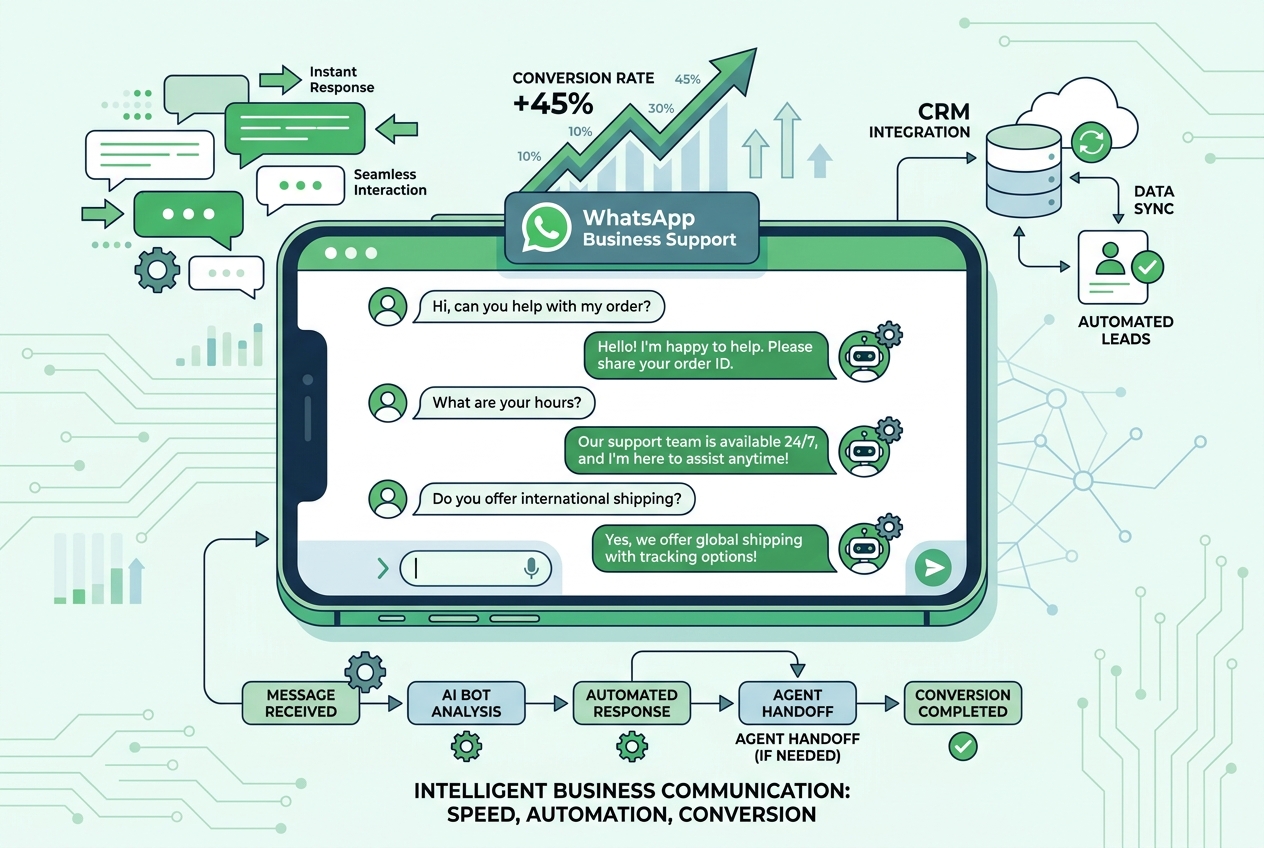
The case for WhatsApp Business AI is no longer theoretical. The numbers are striking. WhatsApp messages enjoy a 98 per cent open rate compared with roughly 20 per cent for email, and businesses report conversion rates of 45 to 60 per cent through WhatsApp conversations versus just 2 to 5 per cent for traditional email and SMS campaigns.
UK consumers are particularly receptive. According to recent research, the UK population is the most likely in the world to engage with an AI chatbot on a brand’s website, at 57 per cent, ahead of the global average of 54 per cent. That cultural comfort with conversational AI, combined with WhatsApp’s reach, creates the perfect environment for a messaging bot builder strategy.
The commercial upside is real. Companies that deploy AI agents on WhatsApp achieve conversion rates up to 21 times higher than businesses that take more than 30 minutes to respond. Speed wins, and AI delivers speed at scale.
The 2026 WhatsApp AI Policy: What Changed and Why It Matters
Before you build anything, you need to understand the single most important development of the year. From 15 January 2026, Meta introduced a new AI policy that reshapes how AI can operate on the WhatsApp Business Platform.
The headline news that worried many business owners was misleading. WhatsApp did not ban AI chatbots. It banned general-purpose AI assistants, meaning companies whose core product is an open-ended AI model distributed through WhatsApp, such as a public ChatGPT-style assistant. Meta created a new category called “AI Provider” precisely to restrict that activity.
What Is Allowed Under the New Rules
If your WhatsApp AI bot answers customer questions, qualifies leads, handles support, sends order updates and learns only from your own business documents, you are fully compliant. Meta explicitly supports structured, task-oriented use cases including customer service, order management, appointment booking, transaction notifications and security verification.
What Is Not Allowed
You cannot distribute a general-purpose assistant, sell access to an AI model through WhatsApp, train a commercial model using WhatsApp conversations, or build behavioural marketing profiles from chats. In short, the bot must serve a clearly defined business purpose for each individual customer conversation. For most UK businesses focused on customer enquiry automation, these rules are easy to meet and actually encourage better, more reliable bots.
The Customer Enquiry Automation Playbook: Building Your Bot
Here is the practical, step-by-step approach we recommend for building an effective WhatsApp AI bot in 2026.
Step 1: Secure API Access Through a Business Solution Provider
You will need the WhatsApp Business API, accessed through a certified Business Solution Provider. You must complete Meta Business Verification to earn the green tick Official Business Account status, which builds instant trust with customers. New API users registering from October 2025 onward fall under the updated policy framework, so getting your setup right from the start is essential.
Step 2: Build a Robust Knowledge Base
Modern WhatsApp AI bots use Retrieval-Augmented Generation, or RAG, to answer questions accurately. This means the bot draws answers only from verified content you provide. Upload your product catalogues, pricing guides, FAQs, return policies and shipping information. The richer and more accurate your knowledge base, the better your bot performs. Industry experts note that full ROI typically materialises within 60 to 90 days once the knowledge base is mature.
Step 3: Design the Bot Persona and Guardrails
Create a clear system prompt that defines tone, behaviour and boundaries. Set the AI temperature low, around 0.2, so the bot sticks strictly to the facts rather than improvising. Add negative prompts such as instructions never to discuss competitor pricing or promise delivery dates it cannot verify. These guardrails prevent hallucinations and protect your brand reputation.
Step 4: Map Conversation Flows and Interactive Menus
Start with the top five questions your customers ask and design flows that resolve them cleanly. Use WhatsApp’s native buttons, list menus and quick replies to reduce typing friction and guide users towards clear actions. A strong welcome message that explains what the bot can do sets expectations and improves completion rates. Keep responses brief, ideally under three sentences, because WhatsApp is a messaging app, not a blog.
Step 5: Configure Seamless Human Handoff
Never trap a customer in an AI loop. Configure triggers that escalate to a human agent when sentiment analysis detects frustration, when a customer asks for a person twice, or when a query falls outside the knowledge base. Crucially, ensure the human agent inherits the full conversation history so the customer never has to repeat themselves.
Step 6: Connect Your Systems and Test Relentlessly
Integrate your CRM, helpdesk and order management systems via webhooks so the bot can pull real-time customer data and personalise every conversation. Then test exhaustively. Have multiple team members attempt to break the bot before your customers do, checking edge cases, fallbacks and handoffs.
This is precisely the kind of end-to-end build where working with specialists pays for itself. At Kaizen AI Consulting, we design, deploy and optimise compliant WhatsApp AI bots tailored to your customer journeys, so you skip the trial and error and go live with a system that actually converts.
Staying GDPR Compliant in the UK
For UK businesses, data protection is non-negotiable. A well-built WhatsApp AI bot should follow a few clear principles. Practice data minimisation by never requesting sensitive information such as health data or card details in the chat, linking instead to secure web forms. Be transparent by labelling the bot as a digital assistant rather than pretending to be human, which can fall foul of consumer protection law. Obtain appropriate end-customer consent, store conversation data securely, and always offer an easy opt-out and data deletion route.
Getting compliance right is not just about avoiding penalties. It builds the customer trust that makes people comfortable transacting through chat in the first place. Our team at Kaizen AI Consulting bakes UK GDPR best practice into every deployment, giving you peace of mind alongside performance.
The Results You Can Expect
The pressure to act is mounting. 91 per cent of customer service leaders report executive pressure to implement AI in 2026, and 85 per cent piloted conversational generative AI during 2025. The exploration phase is over and scaled implementation is the priority.
The payoff is measurable. Generative AI has delivered a 14 per cent increase in query resolution per hour and a 9 per cent reduction in handling time, with potential cost reductions per function of 30 to 45 per cent. By 2027, half of all incoming customer support queries are expected to be handled by AI chatbots, up from 30 per cent in 2025. Businesses that move now will own a significant head start.
Where to Start
A WhatsApp AI bot is no longer a nice-to-have experiment. It is fast becoming the front door to your business, available around the clock, answering enquiries in seconds and converting interest into revenue while you sleep. The technology is mature, the policy framework is clear, and UK consumers are more ready than anyone to engage.
The question is not whether to build a chat automation strategy on WhatsApp, but how quickly you can do it well. If you would like a compliant, high-converting WhatsApp AI bot built around your specific customer enquiries, get in touch with Kaizen AI Consulting today. Book a no-obligation consultation and we will map out a practical roadmap to take your customer enquiry automation live, often within weeks. To explore more ways AI can transform your operations, browse our AI consulting services and discover what is possible for your business in 2026.