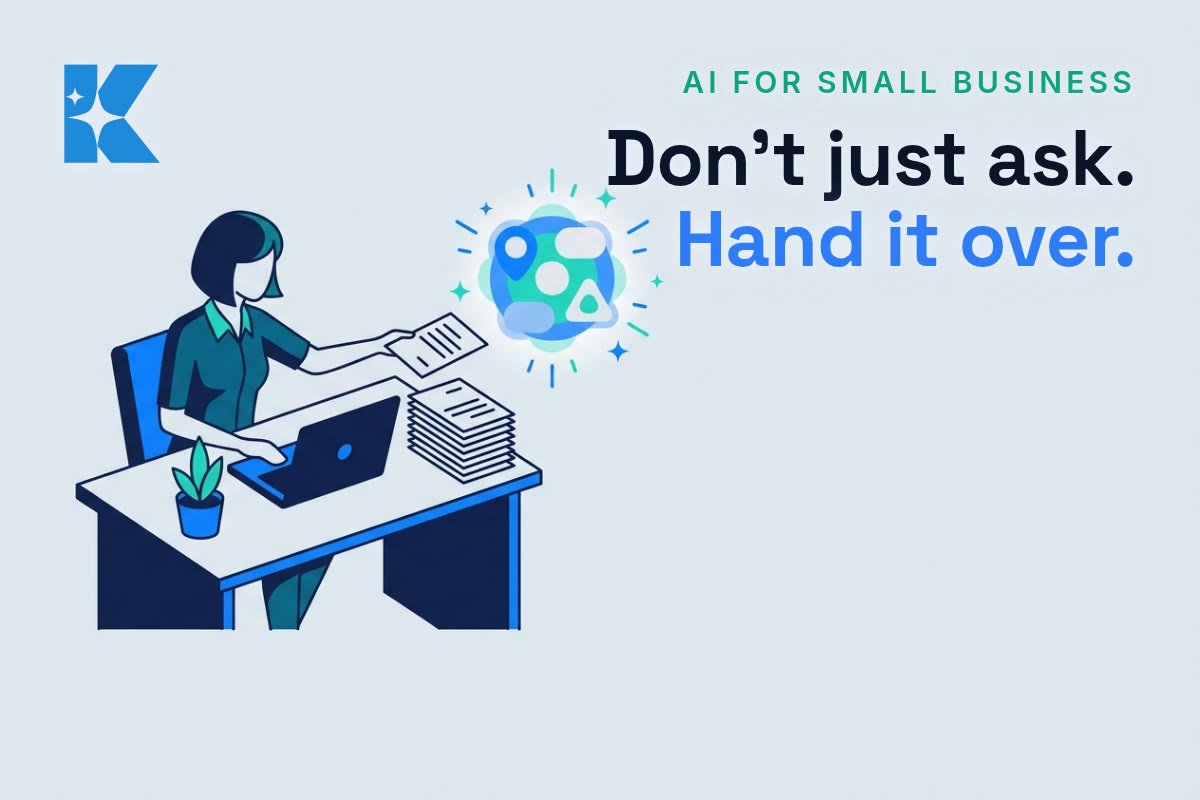
Most small businesses now use AI. Almost none of them have let it actually do anything.
That is the gap sitting underneath a lot of the AI conversation this year. Goldman Sachs’ 10,000 Small Businesses survey found that 76% of small firms now report using AI in some form, yet only 14% say it is properly embedded in how they run the business day to day. The rest is people opening a chat window, asking a question, copying the answer out, and closing it again. Useful, but it is a search box with better manners. It is not a colleague.
The 76% habit that isn’t actually changing much
We see this constantly with the businesses we work with. Someone on the team uses AI to draft an email, tidy up a product description, or summarise a long document. It saves a few minutes here and there. What it does not do, in most businesses, is remove a job from someone’s plate. The UK government’s own Department for Science, Innovation and Technology found that while 85% of business AI adopters are using natural language tools like this, only 7% have moved to agentic AI, the kind that carries out a task from start to finish rather than just answering a prompt (Hoursback, UK Small Business AI Statistics 2026).
That 7% figure is the one worth sitting with. It is the difference between “AI helped me write this” and “AI did this, and I checked it afterwards.” Most small businesses are stuck on the first side of that line, not because agentic tools do not exist, but because nobody has shown them what handing over a real job actually looks like in practice.
What changed on 3 September
OpenAI’s release of GPT-6 Astra on 3 September 2026 is a useful marker for why this matters right now. Astra is not primarily being sold on being a better chatbot. OpenAI has pitched it as its strongest model yet for sustained, multi-step agentic and engineering work, the kind of task that used to need constant human steering (OpenAI, GPT-6 Astra). It is also the first OpenAI model to reach the company’s own “Critical” internal cybersecurity threshold, serious enough that access is rolling out in phases to vetted organisations first rather than switching on for everyone at once (CNBC, OpenAI announces rollout of GPT-6 Astra).
We are not suggesting every small business needs frontier-model access from day one. Most will reach these capabilities through the everyday tools they already use, once those tools update underneath them. The point is simpler: the model layer has quietly moved from “answer the question” to “finish the job”, and that shift is what makes handing over real work possible for the first time, not just faster typing.
What “handing over a job” actually looks like
Agentic does not have to mean an autonomous back office running your whole business unsupervised. In practice, for the businesses we build with, it means picking one weekly task and giving it a defined, checkable outcome. A few examples we use with clients:
An agent that reads every new enquiry email overnight, drafts a reply with pricing and availability pulled from your own documents, and leaves it in a folder for a five-second glance before it sends. A system that checks supplier invoices against your last three months of prices and flags anything that has crept up, instead of a bookkeeper cross-checking by eye once a quarter. A tool that turns a finished job’s before-and-after photos into a social media post draft automatically, so marketing stops being the thing that never quite happens.
None of these need a frontier model running loose with your bank details. They need one job, a clear boundary on what the AI is allowed to decide versus what a person checks, and a way to see when it gets something wrong. That is what “agentic” means at small business scale: fewer prompts, more finished tasks, with a person still holding the steering wheel.
Readiness comes before autonomy
The DSIT figures also carry a warning worth repeating: businesses that are not yet using basic AI tools confidently and regularly are not ready to hand a task over completely. Agentic systems amplify whatever process sits underneath them. Hand over a messy, undocumented process and you get a faster, messier result, not a better one.
The businesses making real progress did three things in order. First, they spent a few weeks getting the whole team comfortable with everyday AI tools, not just one enthusiast in the corner. Second, they wrote down exactly what “done correctly” looks like for one specific task, in enough detail that someone new could follow it. Only then did they let a system run that task without a person typing every step. That sequencing matters more than which model sits behind it. A five-person trades business and a fifty-person agency will pick different first tasks to hand over, but the order stays the same: use it, document it, then delegate it.
Where to start this week
You do not need to decide whether to adopt agentic AI in the abstract, and you do not need a big-bang rollout to get anything out of it. Pick one job that happens every week, that follows roughly the same steps each time, and that someone on your team could describe in five sentences. That is the one worth handing over first, because it is also the one you can check easily if something goes wrong.
We built our own systems the same way, one task at a time, watching each one closely before trusting it with the next. Cost is the other thing worth being realistic about: the tools behind this kind of automation are typically a monthly subscription in the tens of pounds, not a big software project, though the exact figure depends on the task and the volume running through it. If you want a second pair of eyes on which job in your business is the right one to start with, that is exactly what our free 30-minute AI audit is for.