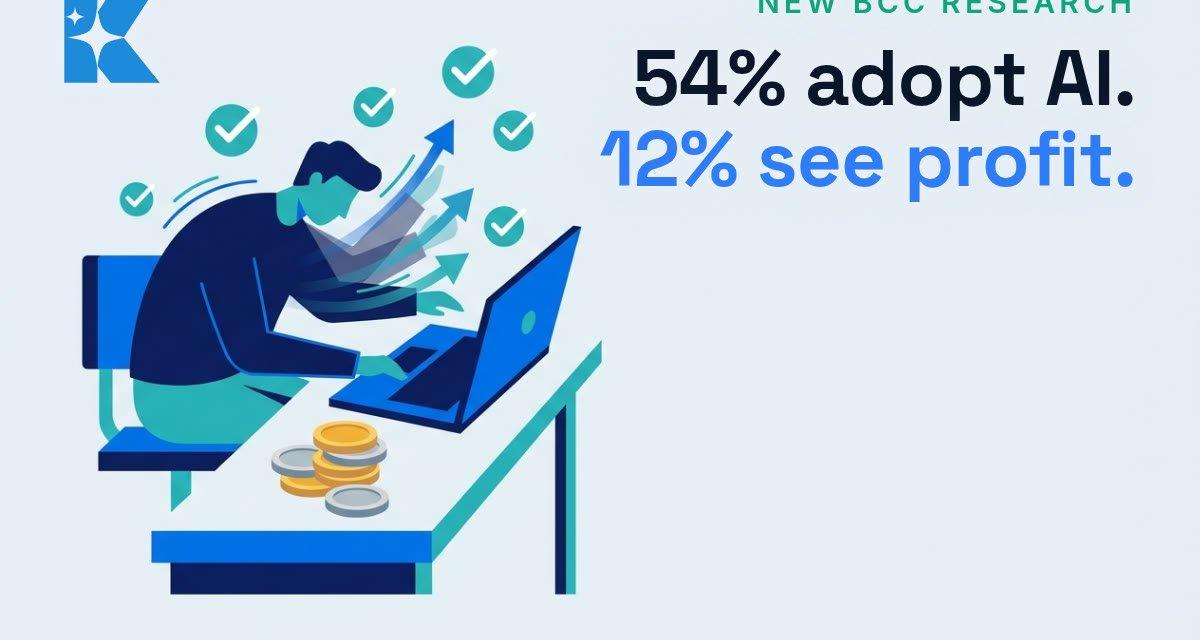
54% of UK firms now use AI. Only 12% have anything to show for it on the bottom line
The British Chambers of Commerce, working with Atos and the University of Essex, published a number in March that we think every small business owner in the country should sit with for a moment: 54% of UK firms are now using AI in some form, up from 35% last year and just 23% two years before that. Adoption has more than doubled in two years. That is the fast part of the story.
The slow part is this. Of the businesses now using AI, 75% report a real productivity gain, staff getting through more work, faster turnaround, less time lost to admin. But only 12% report any increase in revenue because of it. Roughly 77% see no change in the top line at all. We have built AI systems for small businesses long enough to know exactly why that gap exists, and it is not because AI does not work. It is because most firms are using it to do the same job slightly faster, rather than using it to change what the job actually is.
Where all that saved time is actually going
The BCC’s full report is specific about where the adoption is concentrated. Marketing and general administration both sit at 72%, the two most common uses by far, followed by IT tasks at 64%. That tells its own story. Most UK small businesses have handed a chatbot the job of drafting social posts, summarising emails and tidying spreadsheets, then stopped there. Those are genuinely useful tasks to automate. They are also, almost by definition, tasks that sit next to the business rather than inside the part that makes money.
The workforce numbers back this up from a different angle. 95% of SMEs using AI say it has had no effect on headcount over the past year, and 86% say job roles have stayed exactly the same. When a tool changes nothing about who does what or how a role is structured, it is very hard for it to change what a business earns. Time gets saved, then gets absorbed back into the working day rather than redirected at growth.
What separates the 12% from everyone else
Here is the detail we find most useful in the whole report. Around one in ten of the businesses surveyed have gone further than off-the-shelf chatbots and built or commissioned bespoke AI systems tailored to their own operations, rather than relying only on generic tools like ChatGPT or Copilot. Among that smaller group, roughly one in five report a real structural change, staffing reductions directly attributable to AI, against just 3% of the businesses using generic tools alone. We would put it more positively than “staffing reductions”: what is really happening is that a bespoke system is doing a job that used to need a person, freeing that person’s time for something the business could not previously afford to do at all. That is the difference between AI as a faster typewriter and AI as a new member of the team.
This is the pattern we see directly in our own client work. A generic chatbot bolted onto an existing process saves minutes here and there. A system built around one specific bottleneck, the missed call, the unanswered enquiry, the quote that takes three days to go out, changes what the business can actually take on. The productivity gain and the revenue gain are the same gain, once the AI is pointed at something that touches a customer rather than something that only touches a to-do list.
Three moves that convert productivity into profit
None of this needs an enterprise budget or a data science team. From what we have built for UK small businesses and trades, three shifts consistently turn generic time-saving into measurable revenue:
Move it from admin to acquisition. If your AI use is entirely internal, drafting, summarising, tidying, pick one customer-facing gap instead: missed calls, slow quote turnaround, or enquiries that go cold overnight. That is where 88% of adopters are currently not looking.
Make it specific to your operation, not generic to the internet. A tool trained on your own price list, your own service area and your own past jobs will always outperform a general chatbot answering from nothing. This is the single biggest difference the BCC data shows between the 12% and everyone else.
Measure the thing that pays the bills, not the thing that is easy to measure. Hours saved is a comfortable metric because it always goes up. Enquiries converted, calls answered, quotes sent same-day, that is the metric that tells you whether the AI has actually reached the revenue line yet.
Where to start this week
We are not going to pretend a tool costs nothing. Most of the AI platforms behind a well-built small business system run somewhere between £20 and £100 a month depending on volume, and that is a cost worth naming honestly rather than glossing over. Separately, the Office for National Statistics puts overall business AI use lower using a different, broader survey methodology, but shows the same direction of travel: adoption climbing fast while depth of use lags behind. What the BCC’s report makes clear is that the cost was never really the barrier for the 88% who are stuck on productivity alone. The barrier is that a general-purpose assistant, however capable, cannot see your business the way a system built around it can.
If you are one of the 54% already using AI and wondering why the numbers on your accounts have not moved yet, that is worth taking seriously rather than a sign you have done something wrong. The data says you have plenty of company. The move now is to point what you have built at the part of the business that actually brings money in the door, rather than the part that is easiest to hand over first.
We run a free 30 minute AI audit for UK small businesses and trades who want a straight answer on where their current AI use sits versus where the revenue actually is. No obligation, no sales pitch, just a look at the gap.


