Adoption just went through the roof
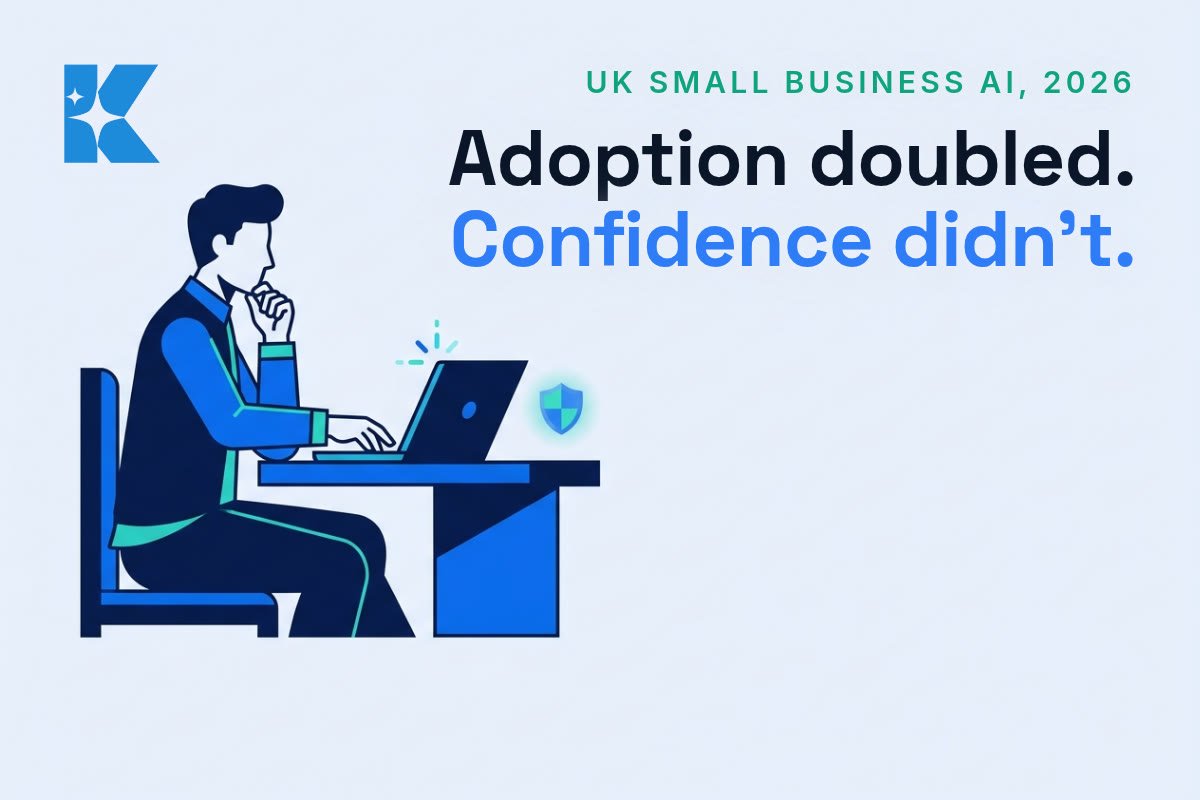
Something shifted this year. Simply Business’s 2026 SME Insights Report, a survey of 1,842 UK small businesses, found that 47% of small firms now use AI, more than double the 22% recorded a year earlier. Another 13% say they plan to start within the next six to twelve months, which puts 61% of the UK’s small business owners either using AI or about to.
We built this business on the bet that AI adoption among small firms was coming fast. We didn’t expect it to double in twelve months. That is a genuine step change, not a slow drift, and it means the “wait and see” owners are now a shrinking minority.
The confidence gap nobody talks about
Here is the uncomfortable number underneath the good one. Of the businesses now using AI, only 19% describe themselves as “very confident” using it day to day. A third, 33%, say they only use it for routine administrative tasks, the safest possible use case, according to a separate write-up of the same data. Content creation (63%), problem solving (53%) and generating ideas (50%) top the list of what small firms actually do with the tools, all low-stakes, easily-reversible work.
Put plainly: half of UK small business has picked up AI, and most of that half is using it the way you’d use a new power tool you don’t fully trust yet, carefully, on the safest job, with a hand ready to switch it off. That caution is not irrational. It is a business owner who has correctly identified that they do not yet understand where the tool can hurt them.
Why security and privacy top the list of fears
We asked why, and the survey has an answer. Among owners who are hesitant or hold back, 44% cite security and privacy concerns as their biggest barrier, ahead of not seeing a clear use case (39%), not knowing how to use the tools (37%) and doubts about accuracy (36%), a breakdown also reported in Business Matters.
Security and privacy concern topping that list should be taken seriously rather than talked around. Pasting client data, invoices or contracts into a public chatbot with no idea where that text goes next is a real risk, not a hypothetical one. The businesses holding back are not being technophobic. They are pointing at a genuine gap between what AI tools can do and what most owners have been shown about how to use them safely, and for a UK business handling customer data that gap sits directly under UK GDPR and data protection obligations, not just general good practice.
Most consumer AI chatbots are built to improve the underlying model, which can mean the words a business owner types are retained somewhere on a server they have no visibility of and no contract with. That is a perfectly reasonable thing to be cautious about, and it is a different question entirely from whether AI itself is safe to use. A tool wired into a business’s own systems, with its own access controls and its own data boundary, does not carry that same risk, but almost none of the 44% will have been shown the difference.
What the 33% stuck on admin are missing
The businesses parked on “content and admin only” are leaving the more valuable work on the table. The tasks with the biggest return, chasing leads faster, drafting quotes automatically, spotting which customers are about to leave, all sit one step further into the business than a first-draft social post. That step is exactly where the confidence gap bites, because it is where a mistake would actually cost something.
The fix is not to push cautious owners to move faster. It is to remove the reason for the caution: build the AI use case around a specific, well-defined job, connect it to the business’s own data through a proper, permissioned link rather than copy-paste into a public tool, and test it on real work before it touches a real customer. Confidence follows competence, not the other way round.
Take a trades business as a plain example, even though this shift is not limited to trades. A tradesperson using AI to write a friendlier version of a quote is in the low-stakes 63% bucket. The same tradesperson using AI to read every incoming enquiry, check the calendar and draft a reply with an accurate price and a real available slot is doing something with far more upside, and far more room to get wrong if it is bolted together carelessly. The gap between those two uses is exactly the 19% confidence gap in the survey, and it is closed with proper setup, not bravado.
Closing the gap without cutting corners
None of this argues against the 44% who are worried about security and privacy. It argues for them. The right response to “I don’t trust this with sensitive data” is not “trust it anyway,” it is to set the tool up so that concern no longer applies: proper access controls, data handled inside systems the business already controls, and a clear line drawn around what the AI is and is not allowed to touch.
We have watched this pattern enough times now to say it plainly: the small businesses getting real value from AI are not the ones who adopted first, they are the ones who adopted deliberately. A single well-built automation that a business owner actually trusts, because they understand exactly what it does and where the data goes, beats five tools bolted on and half-used out of caution.
Where to start this week
If 47% now use AI and only 19% feel confident doing it, the honest next step for most small business owners is not to add another tool. It is to sit down with the one or two tools already in use and work out, properly, what they can be trusted with and what they cannot. That single hour of clarity is usually worth more than another sign-up.
That is exactly the gap a free 30 minute AI audit is built to close: not another tool to add to the pile, but a clear, honest look at where AI can safely take work off your plate, and where it genuinely shouldn’t yet.