We get shown a lot of AI tools. Founders forward us the ones that caught their eye, vendors pitch us directly, and almost every one of them opens with what the tool can do. Write this. Summarise that. Answer the phone, draft the proposal, chase the invoice. The demo always looks good. The list of what it can do is never the problem.
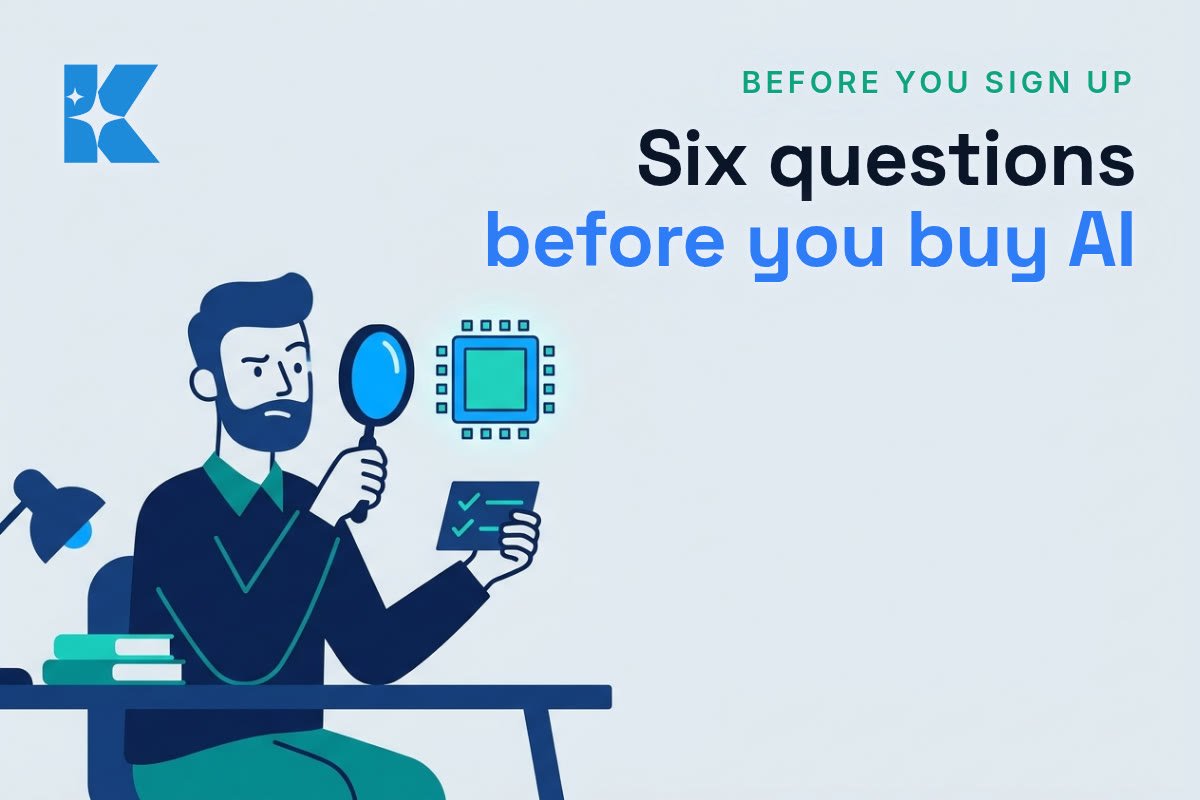
What we actually ask before recommending anything to a client is a shorter, less exciting list. Six questions, and if a tool cannot answer all six comfortably, we do not buy it yet, however good the demo was.
None of these six are about the technology itself. Almost every AI tool on the market today genuinely does roughly what it promises. The failures we see are hardly ever a model getting something wrong in the demo room. They are a business signing up for something nobody had actually thought through, then quietly abandoning it three months later once the novelty wore off and the bill turned up. These six questions are the difference between the two.
1. What job does this replace?
Not what it can do in general. The one specific task it takes off somebody’s desk. If you cannot finish the sentence “before, we did this by hand, now this tool does it,” you do not have a use case yet, you have a subscription waiting to become a habit nobody kept. A tool that promises to help with everything is usually the one that gets opened least, because there is no single moment in anyone’s day that reminds them to use it.
Start with: write that one sentence before you look at a single feature list. If it takes more than a minute to write, that is the answer, and it is worth trusting.
2. Where does our data actually go?
This is the question small businesses skip most often, and it shows. Recent reporting found that half of UK founders have put sensitive business data, client details, pricing, contracts, into a public AI tool without checking where it goes. Most tools have a setting that decides whether your inputs get used to train the model going forward. Almost nobody reads it before they start typing.
Start with: find that tool’s own privacy page and check the training-data setting before your first real prompt, not after.
3. What does it cost once we actually use it?
The demo price and the real price are rarely the same number. Free tiers are built around light, occasional use, ten requests a day, one document a week, and usage-based pricing looks generous right up until a working team actually starts relying on the thing. The bill that surprises people is never the one on the pricing page, it is the one three months in, once the tool has become part of how the team actually works.
Start with: run the free trial hard for a week and project the bill at your real volume, not the demo volume.
4. Can someone here run it without you?
Only 24% of UK organisations already using AI have any process in place to manage it properly. In a small business that gap usually has a name, and it is the owner. The tool works brilliantly as long as you are the one running it, which means it is not a system yet, it is a habit that walks out of the building the day you are on holiday, ill, or simply busy with something else.
Start with: hand it to the newest person on the team for a day and watch exactly where they get stuck.
5. What happens when it gets it wrong?
Every AI tool is wrong sometimes. That is not a red flag on its own, it is a normal property of the technology. The question that actually separates a good tool from a risky one is what happens next. Does a person see the output before a customer does, or does it go straight out under your name? A vendor who has a clear, specific answer to this has thought about it properly. A vendor who says it “rarely happens” has not.
Start with: ask the vendor for one real example of a wrong output and exactly what their product does about it.
6. Would we still want this in six months?
The share of companies abandoning most of their AI tools jumped from 17% to 42% in a single year, according to S&P Global’s own research. Talking to the businesses behind that number, the tool itself was rarely the reason. Almost nobody had actually planned to keep checking whether it was still earning its place, so it quietly stopped being used and nobody noticed for months.
Start with: put an actual date in the calendar right now, three months out, to review whether it is still worth what it costs.
Ask all six. Buy none until you can.
The businesses getting real value out of AI right now are not the ones that moved fastest or bought the most tools. They are the ones that could answer all six of these about every tool they kept, and were honest enough to quietly stop using the ones they could not. That second part matters as much as the first. Keeping a tool nobody can defend on all six counts costs more than the subscription, it costs the time everyone spends working around it.
Run through this list against whatever you already pay for before you buy anything new. Most owners find at least one tool already running in the business that would not survive its own six questions, and cutting that one loose is usually worth more than the next purchase.
So, honestly, which of the six above would you struggle to answer about a tool you are already using right now?