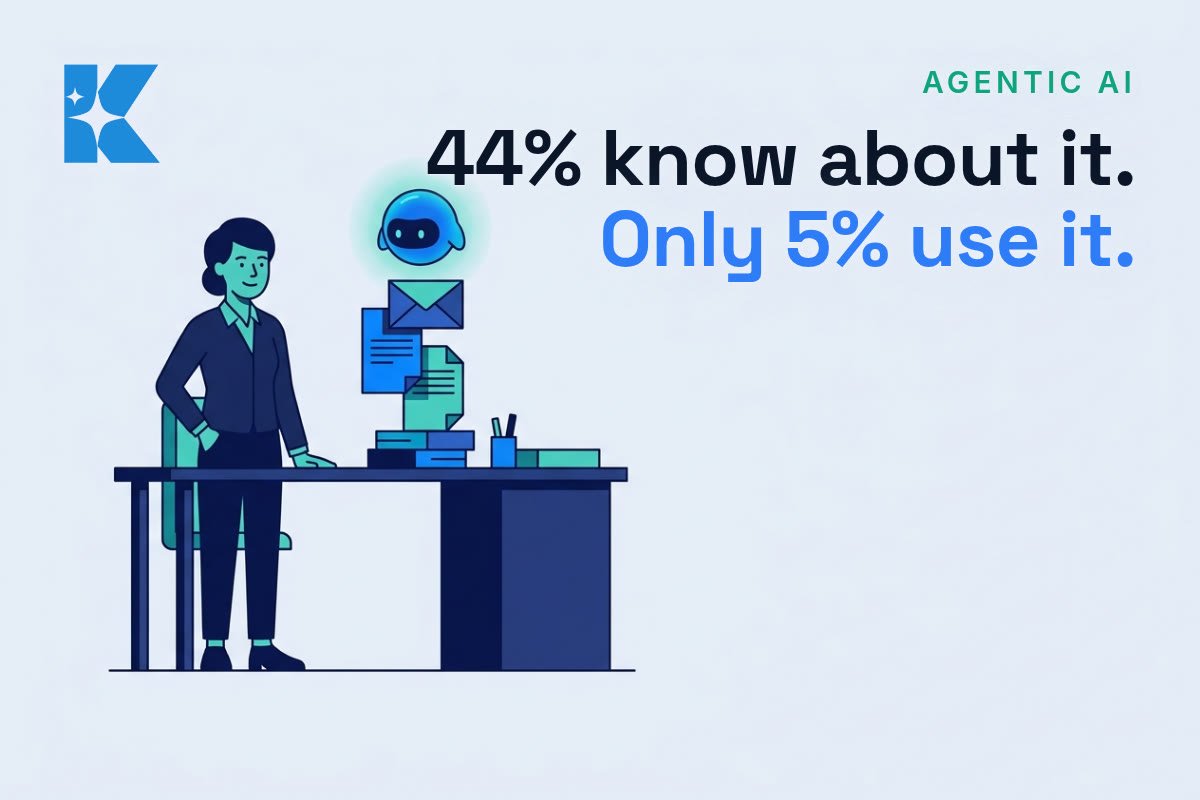
Everyone has heard of agentic AI. Almost nobody is using it.
New research from the Small Business Institute and Accio, surveying 1,000 UK small business owners in August 2026, found that 44% have heard of agentic AI, the kind that does not just answer a question but goes off and completes a task on its own. Only 5% actually use it regularly. That is not a small gap. Nine out of every ten people who know the tool exists still are not touching it.
We build these systems for small businesses every week, so that gap does not surprise us. We also know exactly what closes it.
What “Agentic” Actually Means
Most of the AI a small business has met so far is a chat window. You type a question, it writes an answer, you copy it somewhere. That is generative AI, and it is genuinely useful for drafting a post or tidying up an email.
Agentic AI is a different shape of tool. Instead of waiting for you to ask, it is given a goal and a set of steps it is allowed to take, and it carries them out on its own: checking an inbox, chasing a payment, updating a spreadsheet, replying to a routine enquiry, then reporting back on what it did. The difference is not how clever the model is. It is whether a human has to be in the loop for every single step. The Office for National Statistics has tracked UK business AI adoption climbing steadily since 2023, but almost all of that growth so far sits on the chat side of the line, not the agentic side.
Curiosity Is High. Action Is Not.
The survey’s other numbers explain why the 44%-to-5% gap matters. 68% of UK small business owners want to find out more about what agentic AI can do. 60% think it could improve their work-life balance, and half believe it could free up time to go and win new customers instead of doing admin.
But look at what the small businesses already using AI are actually doing with it. 74% use it only for content and marketing. Roughly a third use it for any kind of data analysis or reporting. Just 5% have pointed it at anything touching their supply chain. The appetite for something more capable is there, as trade coverage of the same survey also picked up on. The follow-through is not, and that mismatch is the uncomfortable part of this story: most small businesses are still using a £20-a-month chatbot to do the one thing it is weakest at, being creative on demand, while leaving the repetitive, rules-based work that AI genuinely excels at completely untouched.
Why Small Businesses Get Stuck at Chat
In our own conversations with owners, three reasons come up again and again. The first is trust: handing a task to something that acts without asking first feels riskier than reading its draft before you hit send. The second is not knowing where the edge of “safe to automate” actually sits, so people default to the lowest-risk use case, which is drafting text a human reviews anyway. The third is simply not knowing where to start, because “agentic AI” is a broad label covering everything from a five-minute Zapier tweak to a fully custom booking agent.
None of those reasons are irrational. They are also all solvable with a narrow first project rather than a leap into the deep end.
What an Agent Can Actually Take Off Your Plate Today
The tasks that make the best first agent are the ones that are repetitive, rules-based, and low-stakes if something needs correcting afterwards. In the businesses we have worked with, three keep coming up:
Chasing unpaid invoices. An agent can check which invoices are overdue, send a polite reminder in your own tone of voice, and escalate to you only once a client has ignored two follow-ups.
Replying to the first message from a new enquiry. Answering the same three questions about pricing, availability and next steps is exactly the kind of task an agent can do in seconds, day or night, while you are on a job or asleep.
Booking and rebooking. An agent that reads a calendar, proposes three slots and confirms a booking removes an entire back-and-forth thread that would otherwise sit in someone’s inbox for two days.
None of these need a six-figure system. Most run on tools that cost a small business somewhere between £20 and £100 a month once set up properly, the same tier of software already being used to send that first draft email.
Where to Start This Week
Pick one task you or your team do the same way, every single time, at least a few times a week. Write down the exact steps a competent new hire would need to be told to do it correctly. If you can write that list without a single “it depends”, you have found your first agent project.
Then measure it. Track how long the task used to take and how often it went wrong before you automated it, and check both numbers again a month later. That single before-and-after is what turns “we heard AI could help” into a decision you can actually stand behind, and it is the difference between the 44% who have heard of agentic AI and the 5% who are getting something out of it.