UK small businesses are adopting AI faster than ever. The British Chambers of Commerce puts adoption at 54% of SMEs this year, up from 35% in 2025. At the same time, Gartner predicts that over 40% of agentic AI projects will be cancelled by the end of 2027. Both of those things are true at once, and the gap between them is where a lot of money is about to be wasted.
We build AI agents for UK small businesses, so we watch the failures closely. The uncomfortable part of Gartner’s research is that projects are not dying because the technology is weak. They are dying because of escalating costs, unclear business value and inadequate risk controls. In other words, they fail for reasons that are entirely avoidable before a single line of code is written.
What the 40% figure actually says
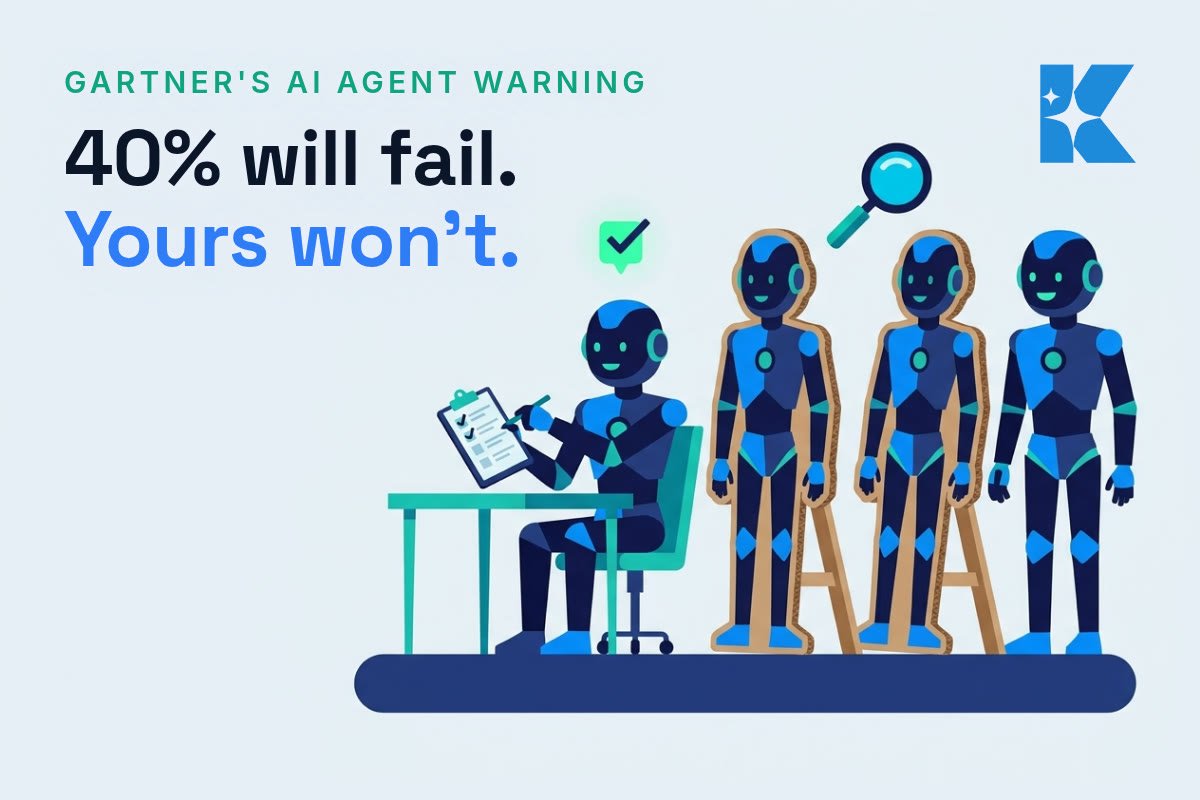
The headline number comes from Gartner’s forecast on agentic AI: more than 40% of agentic AI projects will be scrapped by the end of 2027. When Gartner polled 3,412 webinar attendees, only 19% had made significant investments in agentic AI, 42% were investing conservatively, and nearly a third were sitting on the fence.
That caution is rational. Most agentic AI propositions, in Gartner’s words, lack significant value or return on investment. The models are capable, but capability in a demo is not the same as a system that reliably completes a task in your business, with your data, every day.
Here is the part we quote to clients most often: Gartner estimates that of the thousands of vendors claiming to sell AI agents, only about 130 are the real thing. The rest are doing what the industry now calls agent washing, which means rebadging chatbots, RPA scripts and assistants as autonomous agents. If four in ten projects fail, a large share of those failures were sold a chatbot in an agent costume.
The three failure patterns we actually see
A recent Forbes analysis of the Gartner prediction lands on the same causes we see in the field. First, no governance: agents get deployed with no named owner, no success metric and no way to roll back when something goes wrong. Second, no data access: the agent is asked to chase invoices or book jobs but cannot actually reach the accounts package or the calendar, so a human ends up ferrying data to it, which defeats the point. Third, no defined value: nobody wrote down what the agent was supposed to save or earn, so six months later nobody can say whether it worked, and the project quietly dies in a budget review.
There is a fourth pattern that deserves its own line, because Forbes gives it a name we like: the capability-deployment verification gap. The agent performs beautifully in a controlled pilot, then meets real customers, messy data and edge cases, and falls over. A pilot that only sees clean data is not a pilot. It is a rehearsal with the difficult scenes cut out.
Why this matters more for small businesses, not less
It is tempting to read the 40% figure as an enterprise problem. We would argue the opposite. The BCC research with Atos shows UK SME adoption climbing steeply, and it also shows something encouraging: 95% of AI-using SMEs report no impact on workforce size. Small firms are using AI to support their people, not replace them.
But a 20-person firm cannot absorb a failed project the way a bank can. If an enterprise cancels an agent pilot, it writes off a line item. If a small business spends months of the owner’s attention and a five-figure sum on an agent that never ships, that is the year’s improvement budget gone. The smaller you are, the more the avoidable failures hurt, and the more it matters that the first project is scoped to succeed.
How to be in the 60%
The good news is that the fixes are boring, and boring is buildable. This is the checklist we run before we agree to build anything for a client.
Pick one process, not a transformation. The agents that survive do one job with a clear boundary: answering the phone out of hours, drafting quotes from job notes, chasing unpaid invoices. Gartner expects 15% of routine work decisions to run autonomously through agents by 2028, and routine is the operative word. Start where the work is repetitive and the rules are known.
Write the success metric down before you start. Not “save time” but a number: response time under two minutes, quotes out the same day, debtor days down by a week. If the metric cannot be written down, the project is not ready, and no vendor should be paid until it can be.
Check the agent can reach your systems. Before signing anything, list the systems the agent must touch, then confirm access actually exists. Half the failures we get called in to rescue stall exactly here.
Interrogate the vendor. Ask what the agent decides autonomously, what happens when it is wrong, and who can switch it off. If the honest answer is that it follows a script, you are buying a chatbot, which is fine, as long as you are paying chatbot prices.
Give it an owner and a kill switch. Someone in the business should be able to see what the agent did this week and stop it in one step. Autonomy without oversight is how a small error becomes a big one.
The real lesson in the number
Gartner’s same research says that by 2028, a third of enterprise software will have agentic capabilities built in, up from under 1% in 2024. The technology is not going away, and the firms that learn to deploy it well in the next two years will compound that advantage. The 40% figure is not a reason to wait. It is a map of the mistakes to avoid, published in advance.
We built our own business on this principle: one process at a time, a number attached to each one, and nothing goes live without an owner and a rollback plan. It is less exciting than the demos. It is also why the things we ship stay shipped.