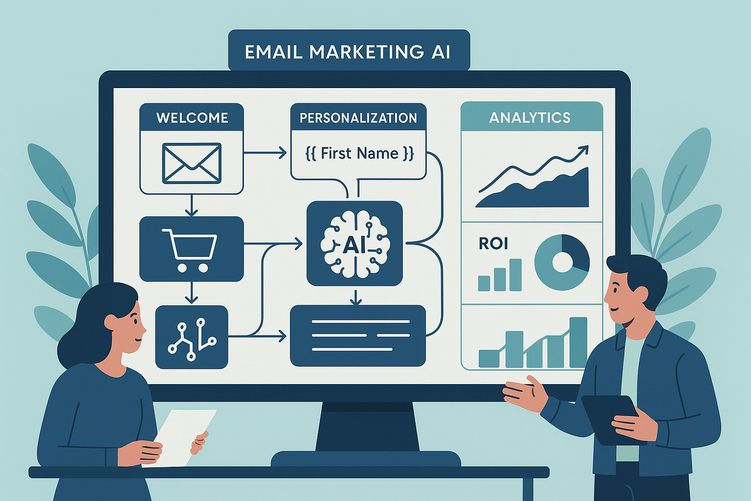
Email marketing remains one of the most cost-effective digital marketing channels for small businesses, with an average return on investment of £42 for every £1 spent. However, managing effective email campaigns can be time-consuming and complex for resource-constrained small businesses. This is where email marketing AI transforms the landscape, enabling automated emails that are personalised, timely, and highly effective without requiring extensive manual effort.
Artificial intelligence is revolutionising how small businesses approach their email campaigns, making sophisticated marketing automation accessible to companies of all sizes. Whether you’re just starting with email marketing or looking to optimise your existing strategy, understanding these best practices will help you leverage AI to drive better results and sustainable growth.
Why AI-Powered Email Marketing Matters for Small Businesses
Small businesses face unique challenges when it comes to marketing: limited budgets, small teams, and the need to compete with larger competitors who have dedicated marketing departments. Traditional email marketing requires constant attention, from segmenting audiences to crafting personalised messages and determining optimal send times.
Email marketing AI addresses these challenges by automating repetitive tasks whilst simultaneously improving campaign performance. According to McKinsey research, personalisation can reduce acquisition costs by up to 50% and increase revenues by 5-15%. AI makes this level of personalisation achievable for businesses without large marketing teams.
Marketing automation powered by AI can analyse customer behaviour, predict preferences, and deliver the right message at precisely the right moment. This level of sophistication was once only available to enterprises with substantial budgets, but modern email AI strategy tools have democratised access to these capabilities.
Essential Best Practices for AI Email Marketing Success
1. Start with Clean, Segmented Data
The foundation of any successful email AI strategy begins with quality data. AI algorithms are only as effective as the data they analyse. Before implementing automated emails, ensure your contact database is clean, up-to-date, and properly segmented.
Remove inactive subscribers, correct formatting errors, and organise contacts based on relevant criteria such as purchase history, engagement levels, geographic location, and demographic information. Research from HubSpot shows that segmented email campaigns can lead to a 760% increase in revenue.
For small businesses looking to implement these strategies effectively, working with specialists like Kaizen AI Consulting can help ensure your data infrastructure is properly configured from the start, avoiding costly mistakes and maximising the effectiveness of your AI-powered campaigns.
2. Implement Behavioural Triggers
One of the most powerful applications of email marketing AI is behavioural trigger automation. Instead of sending generic mass emails, AI systems can automatically dispatch personalised messages based on specific customer actions or inactions.
Common behavioural triggers include welcome sequences for new subscribers, abandoned cart reminders, post-purchase follow-ups, re-engagement campaigns for inactive customers, and browsing behaviour responses. These automated emails consistently outperform traditional broadcast emails, with Epsilon research indicating that 80% of consumers are more likely to make a purchase when brands offer personalised experiences.
3. Optimise Send Times with AI Predictions
When you send your email campaigns can be just as important as what you send. Email marketing AI can analyse historical engagement data to predict the optimal send time for each individual subscriber, dramatically improving open and click-through rates.
Rather than using generic best practices that suggest Tuesday mornings or Thursday afternoons, AI systems learn your specific audience’s behaviour patterns. One subscriber might consistently engage with emails during their morning commute, while another prefers evening reading. Marketing automation platforms with AI capabilities can automatically schedule delivery to match these individual preferences.
4. Craft AI-Assisted Subject Lines and Content
Subject lines determine whether your emails get opened, and AI can significantly improve their effectiveness. Advanced email AI strategy tools can analyse thousands of successful subject lines to identify patterns that resonate with your audience, suggesting optimisations for length, personalisation elements, and emotional triggers.
Similarly, AI can assist with email content creation by suggesting product recommendations based on purchase history, dynamically inserting personalised content blocks, and even generating variations for A/B testing. However, it’s crucial to maintain your brand voice and ensure all AI-generated content is reviewed and refined to align with your business values.
5. Implement Progressive Profiling
Rather than overwhelming new subscribers with lengthy forms, progressive profiling uses AI to gradually build detailed customer profiles over time. Each interaction provides additional data points that inform future email campaigns without creating friction in the customer experience.
This approach respects your subscribers’ time whilst steadily enhancing your ability to deliver relevant content. The AI analyses engagement patterns, click behaviour, and other signals to build a comprehensive understanding of each contact’s interests and preferences.
Advanced AI Email Marketing Techniques
Predictive Analytics for Customer Lifetime Value
Sophisticated email marketing AI can predict which customers are most likely to become high-value, long-term clients. By analysing patterns in engagement, purchase frequency, and other behaviours, AI identifies subscribers who warrant special attention and targeted nurturing campaigns.
This predictive capability allows small businesses to allocate their limited resources more effectively, focusing premium offers and personalised attention on contacts with the highest potential lifetime value.
Churn Prevention and Re-engagement
AI excels at identifying early warning signs that a customer may be losing interest. By monitoring engagement metrics and comparing them to baseline behaviour, automated emails can be triggered before customers fully disengage.
These re-engagement campaigns might offer special incentives, request feedback, or simply remind customers of your value proposition. According to Invesp research, increasing customer retention rates by just 5% can increase profits by 25-95%, making AI-powered churn prevention a valuable strategy for small businesses.
Dynamic Content Personalisation
Beyond simple name personalisation, advanced marketing automation uses AI to dynamically alter email content based on numerous variables including location, weather, browsing history, past purchases, and predicted interests. A clothing retailer, for example, might automatically showcase different products based on local weather conditions and individual style preferences.
This level of personalisation creates email experiences that feel uniquely relevant to each recipient, significantly improving engagement and conversion rates.
Choosing the Right AI Email Marketing Platform
The market offers numerous email marketing AI platforms, each with different capabilities and price points. When selecting a solution for your small business, consider factors such as ease of use and learning curve, integration with your existing systems (CRM, e-commerce platform, etc.), scalability as your business grows, quality of AI features and automation capabilities, pricing structure and total cost of ownership, and customer support and training resources.
Popular platforms with strong AI capabilities include Mailchimp, HubSpot, ActiveCampaign, Klaviyo for e-commerce businesses, and Omnisend for retail-focused companies. Each offers different strengths, and the right choice depends on your specific business needs, technical expertise, and budget.
Implementing a new marketing automation system can be complex, particularly when configuring AI features to align with your business goals. Many small businesses benefit from working with experienced consultants who can guide platform selection, implementation, and optimisation to ensure you’re maximising your investment from day one.
Measuring Success: Key Metrics for AI Email Campaigns
To ensure your email AI strategy delivers results, establish clear metrics and monitoring processes. Key performance indicators for AI-powered email marketing include open rate trends over time, click-through rates by segment and campaign type, conversion rates and revenue attribution, list growth rate and subscriber quality, engagement scores and behavioural metrics, unsubscribe rates and spam complaints, and predictive accuracy of AI recommendations.
Modern email marketing AI platforms provide sophisticated analytics dashboards, but interpreting this data and translating insights into action requires expertise. Regular performance reviews should compare AI-automated campaigns against your baseline metrics to quantify the impact of your marketing automation investment.
Common Pitfalls to Avoid
Whilst AI offers tremendous potential, several common mistakes can undermine your automated emails’ effectiveness. Avoid over-automation that removes the human touch entirely; subscribers can detect purely robotic communications. Always review and refine AI-generated content to ensure it aligns with your brand voice.
Don’t neglect data privacy and compliance. With GDPR and UK data protection regulations, ensure your email marketing AI practices include proper consent mechanisms, clear privacy policies, and easy opt-out processes. Non-compliance can result in significant fines and reputational damage.
Avoid the temptation to email too frequently. Just because marketing automation makes it easy to send numerous campaigns doesn’t mean you should. AI can help determine optimal frequency, but always prioritise subscriber experience over short-term gains.
Finally, don’t implement AI as a ‘set it and forget it’ solution. Whilst automated emails reduce manual effort, they still require monitoring, testing, and optimisation. Customer preferences evolve, market conditions change, and your email AI strategy must adapt accordingly.
Getting Started with Your AI Email Marketing Journey
For small businesses new to email marketing AI, the prospect of implementation can feel overwhelming. Start with these practical steps to begin your journey towards more effective automated emails.
First, audit your current email marketing efforts. Identify which tasks consume the most time and which campaigns generate the best results. This baseline understanding helps prioritise which AI features will deliver the most immediate value.
Next, define clear objectives. Are you primarily seeking to reduce manual workload, improve conversion rates, increase customer retention, or achieve a combination of goals? Your objectives will guide platform selection and implementation priorities.
Begin with one or two high-impact automation workflows rather than attempting to automate everything simultaneously. A welcome series for new subscribers or an abandoned cart sequence often delivers quick wins that build confidence and demonstrate ROI.
Invest time in learning your chosen platform’s capabilities. Most email marketing AI solutions offer extensive training resources, and dedicating time upfront to understand the tools will pay dividends in long-term effectiveness.
Transform Your Email Marketing with Expert Guidance
AI-powered email marketing represents a significant opportunity for small businesses to compete effectively in crowded markets, build stronger customer relationships, and drive sustainable growth. By implementing these best practices for email campaigns, your business can achieve the personalisation and sophistication that today’s consumers expect without requiring a large marketing team or extensive budget.
However, navigating the complexities of marketing automation and email AI strategy requires expertise that many small businesses are still developing. From selecting the right platform to configuring automation workflows and interpreting performance data, numerous technical and strategic decisions impact your success.
This is where partnering with specialists makes a transformative difference. Kaizen AI Consulting helps small businesses across the UK implement and optimise AI-powered email marketing strategies that deliver measurable results. Our team combines technical AI expertise with practical marketing knowledge to ensure your automated emails don’t just work technically but drive genuine business outcomes.
Whether you’re just beginning to explore email marketing AI or looking to enhance existing campaigns, we provide the guidance, implementation support, and ongoing optimisation that turns marketing automation from a complex challenge into a competitive advantage.
Ready to transform your email marketing with AI? Contact Kaizen AI Consulting today to discuss how we can help your small business leverage email marketing AI to increase engagement, boost conversions, and accelerate growth. Let’s build an email AI strategy that works specifically for your business goals and audience.