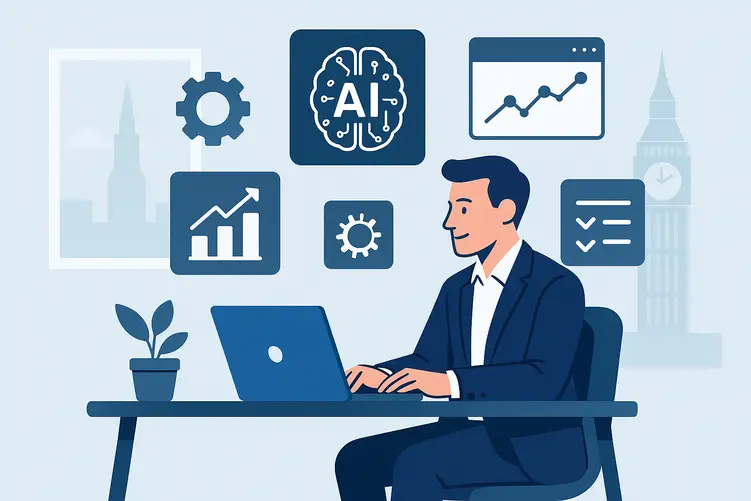
Running a one-person business in the UK can feel like juggling a dozen balls at once. You’re the CEO, the marketing department, the customer service team, and the finance director all rolled into one. The good news? Artificial intelligence has evolved from a futuristic concept into a practical toolkit that solo entrepreneurs can leverage to compete with larger organisations. In fact, recent data from the Office for National Statistics shows that small businesses adopting AI technologies report productivity increases of up to 40%.
If you’re feeling overwhelmed by the AI buzz, you’re not alone. The key isn’t to adopt every new tool that appears on your feed, but to strategically implement solutions that address your specific business challenges. This guide will help you navigate the AI landscape and identify where to begin your journey towards a more efficient, scalable solo operation.
Understanding What AI Can Actually Do for Your Business
Before diving into specific tools, it’s crucial to understand what AI realistically offers one-person businesses. Artificial intelligence excels at handling repetitive tasks, analysing large datasets, generating content drafts, and providing insights that would typically require hours of manual work. Think of AI as your tireless assistant who never sleeps, never takes holidays, and continuously learns to serve you better.
For solo entrepreneurs, the most impactful AI applications fall into several categories: content creation and marketing, customer communication, data analysis and decision-making, administrative automation, and financial management. According to research from the Federation of Small Businesses, 62% of UK micro-businesses that implemented AI tools reported significant time savings within the first three months.
Assessing Your Business Needs First
The biggest mistake one-person business owners make is adopting AI tools because they’re trendy rather than necessary. Start by conducting an honest audit of your daily operations. Where do you spend the most time? Which tasks feel repetitive and drain your energy? What activities prevent you from focusing on revenue-generating work?
Create a simple spreadsheet listing your weekly tasks, the time each consumes, and your skill level for each activity. This exercise reveals patterns. Perhaps you’re spending 10 hours weekly on social media content creation, or maybe customer email responses consume your mornings. These pain points become your priority areas for AI implementation.
At Kaizen AI Consulting, we often see solo entrepreneurs dramatically transform their operations by focusing on just two or three key areas rather than attempting wholesale digital transformation. The principle of continuous improvement applies perfectly here.
Starting with Content Creation and Marketing
For most one-person businesses, content marketing represents both an enormous opportunity and a significant time sink. AI writing assistants have matured considerably, offering genuine value beyond simple grammar checking. These tools can help generate blog post outlines, social media captions, email newsletters, and even draft website copy.
However, maintaining your authentic voice remains crucial. Use AI tools to overcome blank page syndrome and speed up first drafts, but always add your personal expertise and perspective. Your audience connects with your unique viewpoint, not generic AI-generated content. Think of these tools as collaborators rather than replacements.
Social media management represents another area where AI delivers immediate returns. Tools that suggest optimal posting times, generate caption variations, and even create simple graphics can reduce your social media workload by 60-70%. Research from Google indicates that businesses using AI for social media see engagement rates increase by an average of 35%.
Revolutionising Customer Communication
Customer service can consume disproportionate time for solo operators, especially as your business grows. AI-powered chatbots have evolved far beyond the frustrating automated systems of the past. Modern solutions can handle common queries, schedule appointments, provide product information, and escalate complex issues to you seamlessly.
The key lies in proper setup and training. Invest time upfront to programme your chatbot with comprehensive FAQs, your brand voice, and clear escalation protocols. Many UK-based one-person businesses report handling 70% of customer queries automatically after implementing well-configured chatbot systems.
Email management tools using AI can also transform your inbox experience. Smart filtering, automated categorisation, and suggested responses save precious hours weekly. These systems learn from your behaviour, becoming more accurate over time. Our consulting services often help solo entrepreneurs establish these systems effectively.
Automating Administrative Tasks
Administrative work rarely generates revenue but demands significant attention. AI-powered tools for scheduling, invoicing, expense tracking, and document management can reclaim 10-15 hours weekly. Calendar management AI can coordinate meeting times across time zones, send reminders, and even reschedule when conflicts arise.
Expense tracking applications using AI can photograph receipts, extract relevant information, categorise spending, and prepare data for your accountant. According to Accountancy Daily, UK small businesses using AI accounting tools reduce month-end closing time by an average of 8 hours.
Document management systems with AI capabilities can search through files using natural language queries, automatically tag and organise documents, and even extract key information from PDFs and scans. This becomes particularly valuable when you need to find specific contracts, invoices, or correspondence quickly.
Data-Driven Decision Making
One advantage larger companies have traditionally held is access to data analysts. AI democratises this capability. Business intelligence tools powered by AI can analyse your sales data, website analytics, customer behaviour, and market trends, presenting insights in plain English rather than complex charts.
These systems identify patterns you might miss manually. Perhaps certain products sell better on specific days, or particular marketing channels deliver disproportionate returns. AI can detect these trends and provide actionable recommendations. For UK businesses, tools that integrate with HMRC systems and understand British tax regulations prove particularly valuable.
Predictive analytics helps forecast cash flow, inventory needs, and seasonal demand variations. This forward-looking capability enables better planning and reduces the stress of financial uncertainty that many solo entrepreneurs experience.
Practical Steps to Begin Your AI Journey
Starting with AI doesn’t require a massive budget or technical expertise. Begin with one or two free or low-cost tools addressing your biggest pain points. Most quality AI services offer free trials, allowing experimentation without financial commitment.
Select tools that integrate with your existing systems. Seamless integration between your CRM, accounting software, email platform, and other business tools maximises efficiency and reduces manual data entry. Many AI solutions now offer native UK banking and payment integrations, simplifying financial management.
Allocate time for learning and setup. While AI promises time savings, initial configuration requires investment. Block out dedicated time to properly set up each tool, understanding its capabilities and limitations. This upfront investment pays dividends through months and years of automated efficiency.
Our team at Kaizen AI recommends the phased approach: implement one tool, master it, measure results, then expand. This prevents overwhelm and ensures each AI addition genuinely improves your operations.
Avoiding Common Pitfalls
Many solo entrepreneurs stumble by expecting AI to work perfectly immediately. Machine learning systems improve over time, requiring patience and regular refinement. If a chatbot provides incorrect information or an AI writing assistant misses your brand voice, view it as a training opportunity rather than a failure.
Over-automation represents another trap. Some tasks benefit from your personal touch. High-value client communications, strategic planning, and creative direction still require human judgment. AI handles the groundwork, allowing you to focus on these crucial human-centric activities.
Data privacy and security demand attention, especially with GDPR regulations in the UK. Ensure any AI tools you adopt comply with UK data protection laws and clearly understand where your data is stored and processed. Reputable providers transparently address these concerns.
Measuring Success and Iterating
Track specific metrics before and after implementing AI tools. Time saved, revenue generated, customer satisfaction scores, and your personal stress levels all matter. British Chambers of Commerce research shows that businesses measuring AI implementation success are 3 times more likely to expand their use of these technologies.
Schedule monthly reviews of your AI toolkit. Are you actually using all the tools you’ve adopted? Which deliver the most value? Technology evolves rapidly, and better solutions constantly emerge. Remain flexible and willing to switch tools when superior options appear.
Connect with other UK solo entrepreneurs experimenting with AI. Online communities, local business groups, and networking events provide valuable insights into what works. Learning from others’ experiences accelerates your own progress while avoiding expensive mistakes.
The Future is Accessible
AI technology continues democratising capabilities once exclusive to large corporations. For UK one-person businesses, this levels the playing field dramatically. You can now deliver customer experiences, marketing sophistication, and operational efficiency that rival much larger competitors.
The question isn’t whether to adopt AI, but how to do so strategically. Start small, focus on genuine pain points, and gradually expand your AI toolkit as you grow comfortable and see results. Remember that AI serves as your tool, not your replacement. Your expertise, creativity, and personal connection with customers remain irreplaceable.
Running a successful one-person business requires wearing many hats, but AI ensures none of those hats feel too heavy. By thoughtfully implementing the right tools, you create space for the strategic thinking and creative work that attracted you to entrepreneurship in the first place. The technology exists and is accessible. Your journey begins with that first small step.
Whether you’re just starting to explore AI possibilities or looking to optimise your existing systems, the right guidance makes all the difference. At Kaizen AI Consulting, we specialise in helping solo entrepreneurs and small businesses navigate the AI landscape effectively, ensuring technology serves your unique business goals rather than complicating them.