Winning new business has never been more competitive. Whether you are responding to a formal tender, submitting a sales proposal, or bidding for a public sector contract, the quality of your written submission can be the single biggest factor that separates a win from a loss. Yet for many UK businesses, proposal writing remains one of the most time-consuming, resource-intensive, and inconsistent parts of the sales process.
That is changing rapidly. Artificial intelligence is transforming the way businesses approach proposal writing, bid automation, and tender writing, giving teams the ability to produce higher-quality submissions in a fraction of the time. In this guide, we explore how AI for proposal writing works, the tangible benefits it delivers, and how UK businesses can start using it to win more contracts.
The Scale of the UK Tender and Proposals Market
The opportunity for UK businesses in the procurement market is enormous. Public sector procurement alone represents a £400 billion annual market, with over 21,000 public sector contracts awarded in 2025 through frameworks, dynamic markets, and Dynamic Purchasing Systems. The Procurement Act 2023 continues to reshape the landscape in 2026, with a growing emphasis on transparency, competition, and opening opportunities to smaller and specialist providers.
However, the challenge is clear: without professional support, UK businesses typically achieve bid success rates of just 15 to 25 per cent, according to research from the Chartered Institute of Procurement and Supply. Meanwhile, businesses that invest in structured bid processes, content libraries, and AI-assisted writing are consistently achieving win rates of 60 per cent or more.
The gap between these two groups is widening, and AI is a significant reason why.
What Is AI Proposal Writing and Bid Automation?
AI proposal writing refers to the use of artificial intelligence tools to help businesses draft, refine, and optimise written proposals, bids, and tenders. These tools go far beyond basic grammar checking or text prediction. Modern AI proposal platforms use large language models, trained on your historical proposals, case studies, and company data, to generate tailored, compliant, and persuasive responses to tender questions at speed.
Bid automation takes this a step further, automating entire workflows such as extracting requirements from an RFP document, populating answers from a content library, flagging compliance gaps, and managing review cycles across a team. The result is a faster, more consistent, and more scalable proposal process.
Leading tools in this space include AutogenAI, Inventive AI, Loopio, DeepRFP, and Bidara, each offering different strengths depending on whether your focus is public sector tenders, commercial RFPs, or sales proposals. AutogenAI, for example, is specifically built for enterprise-grade UK government and corporate bids, while PandaDoc and GetAccept are better suited to commercial sales proposals and lighter document automation.
Key Features to Look for in an AI Proposal Writing Tool
Not all AI writing tools are equal. For UK businesses bidding on tenders or writing complex sales proposals, the following capabilities are essential:
- Training on your own data: The most effective tools learn from your past proposals, certifications, case studies, and approved content. Generic AI tools like ChatGPT lack the context to produce submission-ready tender responses without significant customisation.
- Compliance checking: Automated tools should be able to extract and cross-reference requirements from tender documents to ensure your response addresses every criterion.
- Content libraries: A centralised repository of pre-approved answers, evidence, and boilerplate content dramatically accelerates response times.
- Collaboration features: Cloud-based platforms that allow multiple contributors to work on a submission simultaneously are critical for larger bids.
- Analytics and win rate tracking: The best platforms analyse your historical performance to identify patterns in what wins and what loses, feeding those insights back into future bids.
The Real-World Benefits of AI for Tender Writing
The benefits of integrating AI into your proposal and tender writing process are well documented and increasingly measurable.
Speed and Efficiency
One of the most immediate gains is speed. Agentic AI workflows, where an AI system autonomously drafts, checks, and revises content based on a set of rules and past data, can cut response times by 50 to 70 per cent compared to manual drafting. For businesses that respond to multiple tenders per month, this is a transformative productivity gain that frees bid teams to focus on strategy, client insight, and relationship building rather than repetitive writing tasks.
Consistency and Quality
Inconsistent proposals are one of the most common reasons bids fail. When different team members write different sections without a unified approach, the result is often a disjointed submission that fails to tell a compelling story. AI tools enforce a consistent voice, structure, and standard of quality across every submission, ensuring that your best thinking is represented consistently whether you are responding to a small framework or a major government tender.
Higher Win Rates
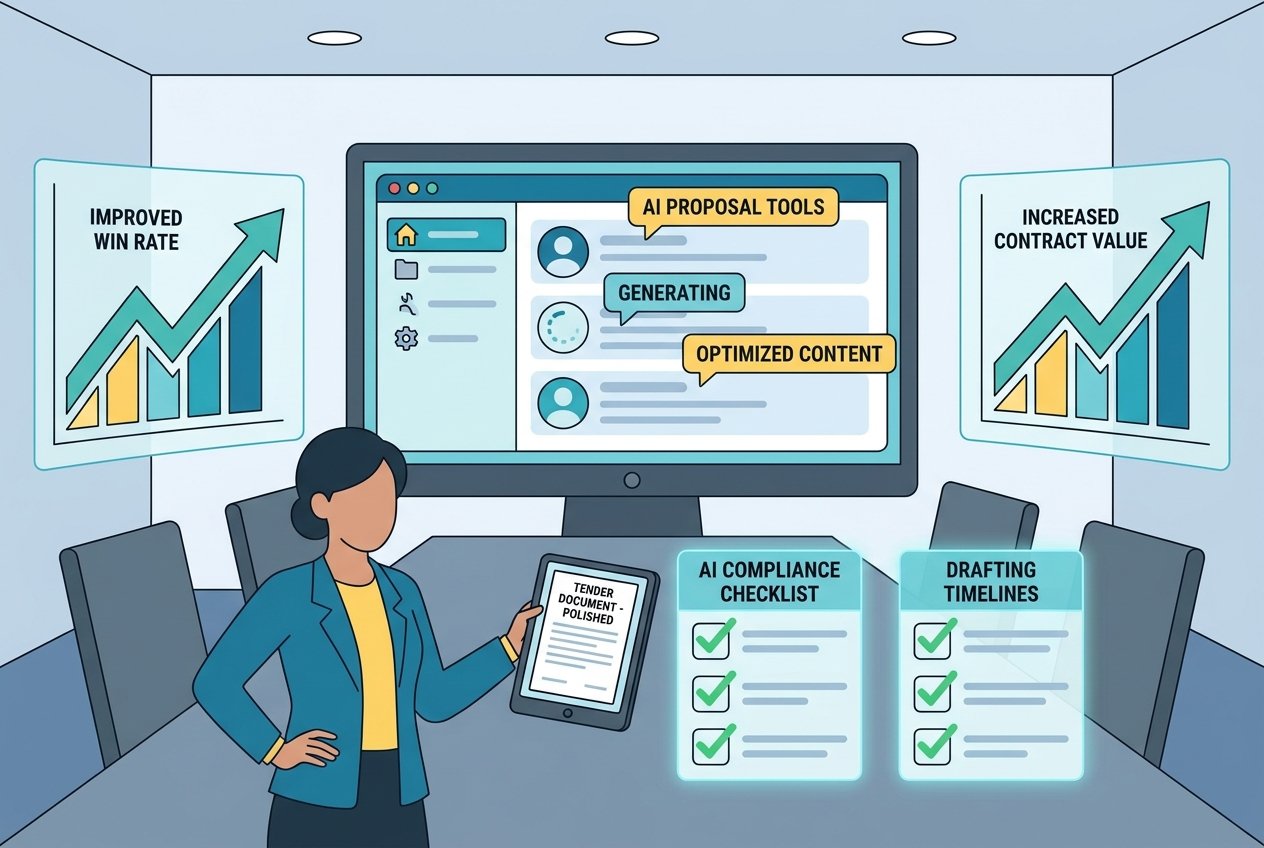
The overall average RFP win rate increased from 43 per cent in 2024 to 45 per cent in 2025, representing the largest year-on-year improvement in the past five years. Top-performing teams that combine AI tools with structured processes and content libraries are achieving win rates of 60 per cent or higher. In the public sector specifically, new bidders using AI and technological innovation to improve their submissions have collectively increased contract revenue by £3.5 billion.
Scalability
For growing businesses, AI removes one of the key barriers to scaling a bid function: headcount. Rather than hiring additional bid writers to handle increased tender volumes, AI allows your existing team to manage significantly more submissions without a corresponding increase in workload or cost.
How AI Is Transforming Sales Proposals
AI benefits extend well beyond formal public sector tenders. In the world of commercial sales, AI-powered proposal tools are helping businesses create more personalised, persuasive, and professional proposals faster than ever before.
Tools such as PandaDoc, Alai, and GetAccept integrate with CRM platforms like Salesforce and HubSpot to pull live deal data, client history, and pricing into proposal templates automatically. This means a sales representative can generate a fully tailored, branded proposal in minutes rather than hours, reducing the time between a client meeting and the formal proposal landing in their inbox.
Personalisation is a key driver of proposal success. A generic proposal template sends a clear signal to a prospective client that you have not truly understood their needs. AI tools that draw on CRM data, previous interactions, and sector-specific language allow businesses to produce proposals that feel bespoke even at scale.
At Kaizen AI Consulting, we work with UK businesses to implement AI-powered proposal and sales automation workflows that are tailored to your specific products, services, and target markets. Whether you need to automate your tender responses, streamline your sales proposal process, or build a centralised content library, our team can design and deploy the right solution for your business.
Practical Steps to Get Started with AI Proposal Writing
If you are considering introducing AI into your proposal writing process, here is a practical roadmap to get started.
Step 1: Audit Your Current Process
Before introducing any technology, map your current proposal and bid writing workflow. Identify where time is being lost, where quality is inconsistent, and where content is being recreated from scratch unnecessarily. This audit will inform which AI tools and features will deliver the greatest impact for your business.
Step 2: Build Your Content Library
The foundation of any effective AI proposal system is a well-organised content library. Collate your best previous proposals, case studies, capability statements, accreditations, and standard answers to common tender questions. The richer and more organised this library, the more effectively an AI tool can draw on it to produce high-quality, compliant submissions.
Step 3: Choose the Right Tool for Your Context
Match the tool to your use case. If your primary focus is public sector tenders and large RFPs, platforms such as AutogenAI, Inventive AI, or Loopio are well suited. If you are primarily focused on commercial sales proposals and document management, PandaDoc or GetAccept may be a better fit. For businesses that want a single platform to cover both, an enterprise stack combining an RFP-specialist tool with a document automation platform is the optimal approach.
Step 4: Train the AI on Your Data
Generic AI tools produce generic outputs. The most impactful implementations involve training the AI on your specific data, including your winning proposals, your brand voice guidelines, your sector-specific terminology, and your evidence base. This step is where specialist implementation support, such as that provided by Kaizen AI Consulting’s automation services, makes a significant difference to the quality of results you achieve.
Step 5: Keep the Human in the Loop
AI is a powerful tool, but it is not a replacement for human judgement, strategic thinking, or client relationships. The most successful approach is a human-AI hybrid model, where AI handles the drafting, formatting, and compliance checking, while experienced bid writers and sales professionals focus on strategy, differentiation, and the narrative that makes your submission stand out. APMP UK’s 2026 bid writing survey highlights that the businesses achieving the highest win rates are those that combine AI efficiency with human expertise, not those that attempt to replace one with the other.
The Procurement Act 2026 and What It Means for Bidders
The Procurement Act 2023, now fully embedded in 2026, is reshaping the UK tender landscape in ways that actually favour businesses that are well-prepared and agile. The Act’s increased transparency requirements mean more contracts are published and more data is available on how awards are made. For businesses using AI to analyse tender pipelines, identify the best opportunities, and respond quickly, this transparency creates a genuine competitive advantage.
The Act also places greater emphasis on social value, SME engagement, and innovation, areas where a well-crafted, evidence-rich proposal can differentiate you from larger, more established competitors. AI tools that help you quickly surface and articulate your social value credentials, local economic impact, and innovative approaches are increasingly valuable in this environment.
Is AI Proposal Writing Right for Your Business?
If your business regularly submits proposals, bids, or tenders and you are spending significant time on writing, reviewing, and formatting submissions, the answer is almost certainly yes. The question is not whether AI can help, but which approach is right for your specific context, volume, and objectives.
Businesses that benefit most from AI proposal writing tools include:
- Professional services firms responding to multiple RFPs or framework tenders each month
- SMEs bidding for public sector contracts who need to compete with larger, better-resourced suppliers
- Sales teams producing high volumes of commercial proposals and quotes
- Construction, IT, and consultancy businesses where detailed, evidence-based tender responses are required
- Any business that has lost bids due to inconsistent quality, missed criteria, or slow turnaround
If you recognise your business in this list, it is time to explore what AI can do for your proposal success rate. Our team at Kaizen AI Consulting is ready to help you design and implement an AI-powered proposal strategy that fits your business, your market, and your growth ambitions. Get in touch today for a no-obligation consultation and find out how we can help you win more business with better proposals.