AI Glossary: 20 Terms Every Small Business Owner Should Understand
Artificial intelligence is no longer the exclusive domain of tech giants and research laboratories. Today, AI adoption amongst UK businesses has increased by 52% since 2020, with small and medium-sized enterprises leading the charge in innovative implementations. Yet, many business owners find themselves bewildered by the technical jargon surrounding this transformative technology.
Understanding AI terminology is essential for making informed decisions about technology investments, communicating effectively with consultants, and identifying opportunities to enhance your operations. This comprehensive AI glossary demystifies 20 critical terms that every small business owner should know, enabling you to navigate the artificial intelligence landscape with confidence.
Core AI Concepts
1. Artificial Intelligence (AI)
Artificial intelligence refers to computer systems designed to perform tasks that typically require human intelligence. These tasks include learning, problem-solving, pattern recognition, and decision-making. For small businesses, AI manifests in practical applications like customer service chatbots, predictive analytics for inventory management, and automated marketing campaigns. According to the Federation of Small Businesses, 38% of UK small businesses now utilise some form of AI technology in their daily operations.
2. Machine Learning (ML)
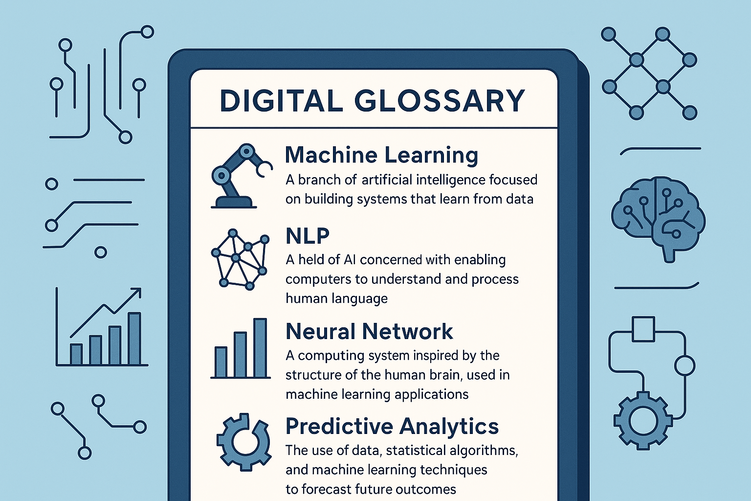
Machine learning is a subset of AI that enables systems to learn and improve from experience without explicit programming. Rather than following predetermined rules, ML algorithms identify patterns in data and make predictions or decisions based on those patterns. Small businesses use machine learning for customer segmentation, fraud detection, and demand forecasting. At Kaizen AI Consulting, we help businesses implement machine learning solutions that evolve alongside their growing data assets.
3. Natural Language Processing (NLP)
Natural Language Processing allows computers to understand, interpret, and generate human language. This technology powers virtual assistants, sentiment analysis tools, and automated email responses. For business applications, NLP enables efficient customer service, content creation, and document analysis. Understanding this AI terminology helps you recognise opportunities to automate communication-intensive tasks.
4. Deep Learning
Deep learning is an advanced machine learning technique inspired by the human brain’s neural networks. It excels at processing large volumes of unstructured data, including images, audio, and text. Whilst traditionally resource-intensive, modern cloud-based deep learning solutions have become accessible to smaller organisations for applications like quality control, visual product searches, and voice-enabled interfaces.
5. Algorithm
An algorithm is a set of step-by-step instructions that tells a computer how to solve a problem or complete a task. In AI contexts, algorithms process data to generate insights, make predictions, or automate decisions. Understanding how algorithms work helps business owners evaluate the transparency and fairness of AI systems they might adopt.
Data-Related AI Terms
6. Training Data
Training data is the information used to teach AI systems how to perform specific tasks. The quality, quantity, and diversity of training data directly impact an AI model’s accuracy and reliability. For small businesses implementing AI, ensuring high-quality training data aligned with your specific context is crucial for successful outcomes.
7. Data Mining
Data mining involves extracting valuable patterns and insights from large datasets. This process helps businesses identify trends, customer behaviours, and market opportunities that might otherwise remain hidden. Research from the Office for National Statistics shows that data-driven businesses grow 30% faster than competitors who rely solely on intuition.
8. Big Data
Big Data refers to datasets so large or complex that traditional data processing methods prove inadequate. For small businesses, big data might include customer transaction histories, website analytics, social media interactions, and IoT sensor readings. AI tools make big data analysis accessible and actionable, even for organisations without extensive technical resources.
9. Predictive Analytics
Predictive analytics uses historical data, statistical algorithms, and machine learning to forecast future outcomes. Small businesses apply predictive analytics to anticipate customer churn, optimise inventory levels, and identify high-value prospects. This business AI term represents one of the most immediately valuable applications for growing companies.
AI Implementation Terms
10. Neural Network
A neural network is an AI system modelled after the human brain, consisting of interconnected nodes that process information in layers. These networks excel at recognising complex patterns in images, speech, and text. Understanding neural networks helps business owners appreciate the sophistication of modern AI tools and their potential applications.
11. Chatbot
A chatbot is an AI-powered conversational interface that interacts with users through text or voice. Modern chatbots handle customer enquiries, schedule appointments, qualify leads, and provide personalised recommendations. UK business research indicates that chatbots can reduce customer service costs by up to 30% whilst improving response times significantly.
12. Computer Vision
Computer vision enables machines to interpret and understand visual information from the world. Applications include quality inspection, inventory management through image recognition, and security surveillance. Retailers use computer vision to analyse customer behaviour in physical spaces, whilst manufacturers deploy it for automated defect detection.
13. Robotic Process Automation (RPA)
RPA uses AI to automate repetitive, rule-based tasks typically performed by humans. Examples include data entry, invoice processing, report generation, and compliance checks. Small businesses implement RPA to free employees for higher-value activities whilst reducing errors and processing times. The team at Kaizen AI Consulting specialises in identifying RPA opportunities that deliver rapid returns on investment.
14. API (Application Programming Interface)
An API is a set of protocols that allows different software applications to communicate and share data. In AI contexts, APIs enable businesses to integrate powerful AI capabilities into existing systems without building complex infrastructure from scratch. Understanding APIs is essential when evaluating AI solutions for compatibility with your current technology stack.
Advanced AI Vocabulary
15. Sentiment Analysis
Sentiment analysis uses NLP to determine the emotional tone behind text communications. Businesses apply sentiment analysis to monitor brand reputation, analyse customer feedback, and prioritise service responses. This artificial intelligence vocabulary term represents a practical way to transform qualitative feedback into quantitative insights.
16. Reinforcement Learning
Reinforcement learning is a machine learning approach where AI systems learn through trial and error, receiving rewards for beneficial actions and penalties for mistakes. Whilst more experimental for small business applications, reinforcement learning shows promise for dynamic pricing, resource allocation, and personalised marketing strategies.
17. Transfer Learning
Transfer learning allows AI models trained on one task to be adapted for related tasks, reducing the time and data required for new implementations. This approach makes sophisticated AI accessible to smaller organisations by leveraging pre-trained models that can be customised for specific business needs.
18. Edge Computing
Edge computing processes data closer to where it’s generated rather than sending it to centralised cloud servers. For AI applications, this means faster response times and enhanced privacy. Small businesses with IoT devices or real-time processing needs benefit from understanding how edge AI differs from cloud-based solutions.
19. Generative AI
Generative AI creates new content, including text, images, audio, and code, based on patterns learned from existing data. Recent advances have made generative AI tools incredibly accessible, enabling small businesses to produce marketing content, product descriptions, design variations, and customer communications at scale. TechUK reports that 45% of UK businesses now use generative AI for content creation.
20. AI Ethics
AI ethics encompasses the moral principles governing AI development and deployment, including fairness, transparency, privacy, and accountability. For business owners, understanding AI ethics helps ensure responsible implementation that builds customer trust and complies with emerging regulations like the UK’s AI governance framework.
Putting AI Terminology into Practice
Mastering this AI glossary represents just the beginning of your artificial intelligence journey. The true value emerges when you apply these concepts to identify opportunities, evaluate solutions, and communicate effectively with technology partners.
As you encounter these business AI terms in proposals, demonstrations, and industry discussions, you’ll find yourself better equipped to ask meaningful questions, assess vendor claims, and make strategic decisions aligned with your business objectives. The language of AI is becoming the language of competitive advantage across virtually every sector.
Remember that AI implementation doesn’t require understanding every technical detail. Instead, focus on how these technologies solve specific business challenges, from reducing operational costs to enhancing customer experiences and identifying growth opportunities.
Your Next Steps with AI
Now that you’re familiar with essential AI definitions, consider conducting an AI readiness assessment for your business. Evaluate your current data collection practices, identify repetitive processes suitable for automation, and examine customer touchpoints where AI could enhance experiences.
Many small business owners find that partnering with experienced consultants accelerates their AI journey whilst avoiding costly missteps. Kaizen AI Consulting offers tailored guidance for UK businesses ready to explore artificial intelligence opportunities. Our team translates complex AI terminology into practical strategies that drive measurable results, ensuring your technology investments align with broader business goals.
Whether you’re taking your first steps into business AI or looking to expand existing implementations, understanding this artificial intelligence vocabulary provides the foundation for informed decision-making. The AI revolution isn’t coming; it’s already here, and small businesses that embrace these technologies position themselves for sustained competitive advantage.
Ready to transform your understanding of AI terminology into practical business outcomes? Contact our team today to discuss how artificial intelligence can address your specific challenges and opportunities. We’ll help you navigate the AI landscape with confidence, implementing solutions that deliver real value without unnecessary complexity.