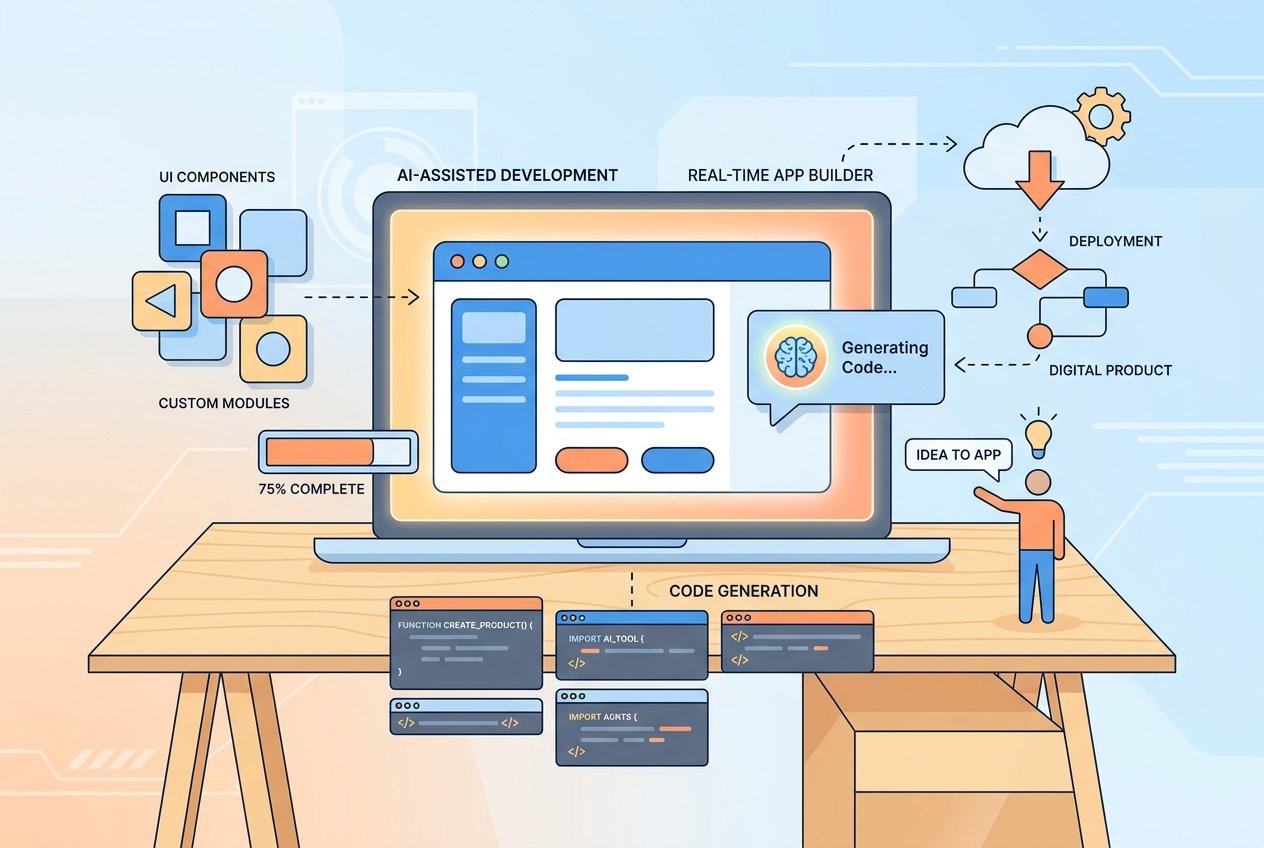
There has never been a better time to be a founder with an idea. In 2026, the barriers between a brilliant concept and a working digital product have all but disappeared. Thanks to a wave of AI-powered development tools, it is now entirely possible to build an app without a developer, launching a functional MVP for under £100. Welcome to the age of vibe coding in the UK, where your idea, not your technical skill, is the currency that matters.
Whether you are a solo entrepreneur, a small business owner looking to digitise a service, or a side-hustler testing a concept on evenings and weekends, this guide will walk you through exactly how to go from napkin sketch to working product on a shoestring budget.
What Is Vibe Coding and Why Should UK Small Businesses Care?
The term “vibe coding” was coined by AI researcher Andrej Karpathy in early 2025 to describe a new way of building software: you describe what you want in plain English, and AI writes the code for you. By 2026, it has evolved from a novelty into a legitimate development methodology. Collins Dictionary even named it Word of the Year, and searches for the term spiked by 6,700%.
The statistics tell a compelling story. According to Hostinger’s 2026 research, 84% of developers worldwide now use or plan to use AI coding tools, and a remarkable 63% of vibe coding users are non-developers. Gartner predicts that 40% of new enterprise production software will be created using vibe coding techniques by 2028. This is not a fringe movement; it is the future of software development.
For UK small businesses, this shift is transformative. The Office for National Statistics reports that 25% of UK businesses were using some form of AI by late 2025, with 15% planning to adopt within three months. Yet according to Aristral’s 2026 analysis, only 11% of UK SMEs are using AI extensively. The opportunity gap is enormous, and founders who act now stand to gain a significant competitive advantage.
The Traditional Route: Why Hiring a Developer Is No Longer the Only Option
Let us be clear about what you are saving. In the UK, hiring a freelance developer costs between £45 and £90 per hour, with the median contract day rate sitting at £500 per day as of April 2026. A simple MVP built by a UK agency typically costs £20,000 to £60,000 over 8 to 12 weeks. Even a freelancer working on a basic project will charge £5,000 to £15,000.
For most small businesses and early-stage founders, these figures are prohibitive. You might have a brilliant idea for a booking platform, a customer portal, or an internal workflow tool, but spending £20,000 before you have even validated whether customers want it is a gamble few can afford.
This is precisely where AI app building for small business changes the equation entirely.
The Toolkit: Claude Code, Lovable, Cursor, and Friends
The 2026 AI development landscape splits into two categories: AI code editors for people comfortable in a development environment, and AI app builders for non-technical founders who want to describe their app and have it built for them. Here is your starter toolkit for building an MVP under £100.
For Non-Technical Founders
Lovable (from £21/month) is widely regarded as the best tool for non-technical MVP builders in 2026. Formerly known as GPT Engineer, it lets you describe your app in plain English and generates a fully functional web application. The Pro plan at £25/month gives you 100 credits, custom domains, and full code export. According to vibecoding.app’s 2026 rankings, Lovable scores 8.5 out of 10 for MVP development.
Bolt.new (from £21/month) is ideal for rapid prototyping and hackathon-style builds. The Pro plan offers 10 million tokens per month with no daily cap. It is slightly less polished than Lovable for complete applications but excels at getting a working prototype up quickly.
For Technical Founders and Tinkerers
Cursor (£17/month) is the leading AI pair-programming IDE. If you have some coding experience or are willing to learn the basics, Cursor supercharges your productivity with 500 AI completions per month, including access to Claude and GPT-4 models. It is rated the best AI IDE for full-time development in 2026.
Claude Code (bundled with Claude Pro at £17/month annually) is the strongest option for terminal-native, codebase-wide reasoning. It excels at understanding entire projects and making intelligent changes across multiple files. For founders who want to direct AI agents rather than write code themselves, Claude Code is a revelation.
Your Step-by-Step Guide: From Idea to MVP for Under £100
Here is a practical roadmap to building your first working app without breaking the bank.
Step 1: Define Your Specification (Cost: £0)
Before you touch any tool, write a clear specification. The biggest mistake non-technical founders make is jumping straight into prompting without a plan. As Appwrite’s 2026 trends report notes, the shift to spec-driven development is one of the most important vibe coding trends this year. Use a free tool like Google Docs or Notion to outline your core features, target user, and the single problem your app solves.
Step 2: Choose Your Primary Tool (Cost: £20-25/month)
If you have zero coding experience, start with Lovable. If you have some technical background, consider Cursor paired with Claude Code. For your first month of building, you will spend no more than £25.
Step 3: Build Iteratively, Not All at Once (Cost: £0)
Treat your MVP as a series of small tasks, not one massive build. The 2026 best practice is to generate a task list from your specification and tackle each item with fresh context. This approach, known as context engineering, minimises errors and produces far better results than trying to build everything in a single conversation.
Step 4: Add a Database and Authentication (Cost: £0-25/month)
Most AI app builders integrate with Supabase, which offers a generous free tier perfect for MVPs. You get a PostgreSQL database, authentication, and file storage at no cost. Only upgrade if you exceed the free tier limits, which is unlikely during the validation phase.
Step 5: Deploy and Host (Cost: £0-20/month)
Platforms like Vercel and Netlify offer free hosting tiers that are more than sufficient for an MVP. Lovable includes cloud hosting in its plans. Your total first-month spend: between £20 and £50.
Step 6: Test with Real Users (Cost: £0)
Share your MVP with 10 to 20 potential users. Gather feedback. Iterate. This is the entire point of an MVP: to learn before you invest heavily.
Over a two-month build and validation cycle, your total costs come in comfortably under £100. Compare that to the £20,000 minimum for a UK agency, and the value proposition becomes undeniable.
What You Can Realistically Build
To set expectations correctly, here are examples of MVPs that UK founders are successfully building with AI tools in 2026:
- Customer booking portals for service businesses such as salons, clinics, and consultancies
- Internal dashboards that pull data from spreadsheets and display key metrics
- Landing pages with waitlists to validate demand before building a full product
- Simple marketplace apps connecting local buyers and sellers
- Client onboarding flows with forms, document uploads, and automated emails
- Membership and subscription portals with payment integration via Stripe
What you cannot yet build easily with vibe coding: complex real-time applications, apps requiring regulatory compliance such as financial trading platforms, or products that need native mobile performance. For these, professional development remains the better path.
The Mindset Shift: Persistence Over Perfection
One crucial lesson from the vibe coding community in 2026 is that your first attempt will not be perfect. Developer trust in AI code accuracy actually dropped from 40% in 2024 to 29% in 2025, highlighting that AI-generated code requires review and iteration. The founders who succeed are those who treat the process as craft, not magic.
Expect to spend time debugging, refining prompts, and running through alpha and beta testing phases. The tools are extraordinary, but software that people will pay for still requires care, attention, and persistence across multiple iterations.
When to Bring in Expert Help
While vibe coding democratises the initial build, there comes a point where professional guidance accelerates your journey dramatically. Common moments when founders benefit from expert support include:
- Choosing the right tool stack for your specific use case
- Structuring your app specification for optimal AI output
- Integrating AI automation into existing business workflows
- Scaling from MVP to production-ready product
- Developing an AI strategy that extends beyond a single app
This is where working with a specialist consultancy like Kaizen AI Consulting can make a significant difference. Rather than spending weeks figuring out which tools suit your business, their team helps UK small businesses implement practical, affordable AI solutions that save time and accelerate growth. From selecting the right vibe coding platform to building a broader AI automation strategy, having experienced guidance means fewer costly mistakes and faster results.
The Bigger Picture: AI as a Business Strategy
Building an MVP is just the beginning. The British Chambers of Commerce reports that 54% of UK firms are now actively using AI in 2026, up from 35% in 2025. The businesses pulling ahead are not just using AI for one-off projects; they are weaving it into every aspect of their operations, from customer service and marketing to product development and internal processes.
If you are a UK small business owner looking to understand how AI fits into your broader growth strategy, not just for building apps but for transforming how your business operates, get in touch with Kaizen AI Consulting. Their team specialises in helping service businesses across the UK navigate the AI landscape with clear, jargon-free guidance and hands-on implementation support. Whether you need help with your first vibe-coded MVP or a comprehensive business growth strategy powered by AI, they are ready to help you take that next step.
Key Takeaways
- Vibe coding in the UK has matured into a legitimate way to build software, with 63% of users being non-developers
- Tools like Claude Code, Lovable, Cursor, and Bolt.new cost between £17 and £25 per month
- You can build a working MVP under £100 over a two-month cycle, compared to £20,000 or more via traditional routes
- The key to success is specification-driven development, iterative building, and persistence
- AI app building for small business is not about replacing developers permanently; it is about validating ideas affordably before committing serious resources
- Expert guidance from consultancies like Kaizen AI Consulting helps you avoid common pitfalls and build smarter from the start
The age of the idea is here. The only question is: what will you build first?