How a Cardiff Restaurant Reduced Food Waste by 30% Using AI
In the heart of Cardiff’s bustling city centre, a family-owned restaurant was facing a challenge all too familiar to hospitality businesses across the UK: mounting food waste costs and the environmental guilt that comes with it. According to WRAP (Waste and Resources Action Programme), the UK hospitality sector generates approximately 920,000 tonnes of food waste annually, costing the industry around £3.2 billion. For this Cardiff establishment, the solution came from an unexpected source: artificial intelligence.
This restaurant AI case study demonstrates how cutting-edge technology can transform traditional hospitality operations, delivering measurable results in food waste reduction whilst simultaneously improving profitability. The story offers valuable lessons for any Cardiff business in the hospitality sector looking to embrace innovation and sustainability.
The Challenge: Understanding the Scale of Restaurant Food Waste
Before implementing any AI solution, the restaurant’s management team needed to understand the full scope of their food waste problem. Like many establishments across Cardiff and Wales, they were experiencing several interconnected issues:
Over-ordering and inventory mismanagement: Without accurate demand forecasting, the restaurant regularly ordered excess ingredients that spoiled before use. Fresh produce, dairy products, and seafood were particularly problematic, with spoilage rates reaching 15-20% on certain items.
Inconsistent portion control: Kitchen staff, whilst skilled and well-intentioned, lacked standardised portioning guidelines. This led to plate waste when generous portions exceeded customer appetites, particularly during quieter periods when chefs had more time to plate elaborately.
Limited visibility into waste patterns: The restaurant tracked basic waste metrics but lacked the granular data needed to identify specific problem areas. Were certain menu items consistently over-portioned? Did waste spike on particular days? These questions remained unanswered.
Research from The Caterer reveals that restaurants waste between 4-10% of food purchased before it even reaches customers. For a typical Cardiff restaurant with annual food costs of £200,000, this represents £8,000-£20,000 literally thrown away each year.
The AI Solution: Implementing Smart Inventory Optimisation
After researching various options and consulting with technology specialists including Kaizen AI Consulting, the restaurant implemented a multi-layered AI system designed to address each aspect of their food waste challenge. The solution combined several technologies:
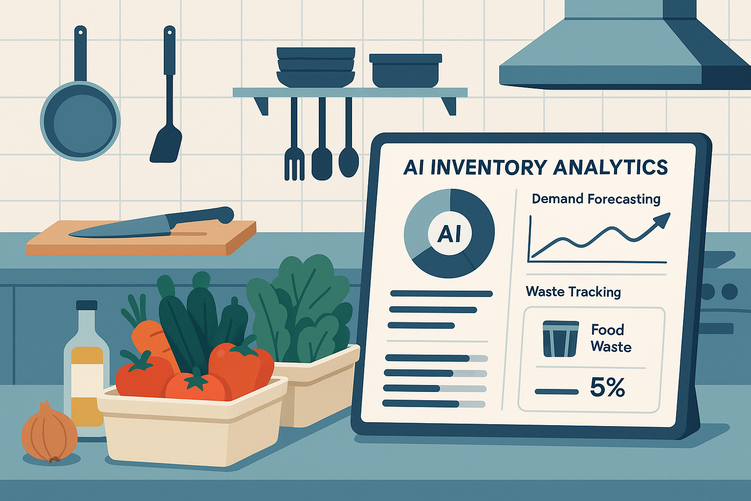
Predictive demand forecasting: Machine learning algorithms analysed two years of historical sales data, incorporating variables such as day of week, seasonality, local events, weather patterns, and even Cardiff City FC match schedules. The system learned that Saturday evenings following home football matches saw 35% higher demand for specific menu items, whilst rainy weekdays reduced foot traffic by an average of 18%.
Intelligent inventory management: Connected to the restaurant’s point-of-sale system, the AI platform automatically adjusted ordering quantities based on predicted demand. The system accounted for ingredient shelf life, supplier delivery schedules, and minimum order quantities, creating optimised purchasing recommendations that balanced waste reduction with the risk of stockouts.
Real-time waste tracking: Kitchen staff used tablet devices to quickly log waste incidents, categorising them by type (spoilage, preparation waste, plate waste) and associated menu items. The AI analysed these patterns, identifying opportunities for menu engineering and portion adjustments.
Recipe optimisation: Perhaps most innovatively, the system suggested recipe modifications that utilised ingredients with shorter shelf lives more efficiently. When the AI detected excess fresh herbs approaching their use-by date, it recommended daily specials that incorporated these ingredients, turning potential waste into profit.
The Implementation Journey: Lessons from Cardiff’s Hospitality AI Pioneer
The restaurant’s journey wasn’t without challenges. Initial staff resistance, technology integration hurdles, and the learning curve associated with new systems required careful change management. The owners worked closely with their technology partners to ensure smooth adoption.
Week 1-2: Data integration and baseline establishment
The first phase involved connecting the AI system to existing technology infrastructure. This included the point-of-sale system, supplier ordering platforms, and implementing new waste tracking protocols. Staff received training on the tablet-based waste logging system, and the restaurant established baseline metrics against which future improvements would be measured.
Week 3-6: Learning period and algorithm training
During this phase, the AI system operated in observation mode, learning patterns without making ordering decisions. Staff continued logging waste incidents, and the system began identifying patterns. The restaurant discovered that their Thursday lunch service generated 40% more food waste than other weekday lunches due to over-optimistic prep based on occasional large booking groups that didn’t always materialise.
Week 7-12: Gradual implementation and refinement
With sufficient data collected, the restaurant began implementing AI-generated ordering recommendations, initially at 50% adoption to maintain safety margins. As confidence grew and the system proved its accuracy, they increased reliance on the AI forecasts. By week 12, the restaurant was following AI recommendations for 90% of ingredient orders.
Month 4-6: Optimisation and expansion
After three months of operation, the restaurant expanded the system’s capabilities to include menu engineering recommendations and dynamic pricing suggestions for ingredients approaching their use-by dates. This phase saw the most dramatic waste reductions as the entire operation became optimised around the AI’s insights.
The Results: Quantifying Success in Food Waste Reduction
Six months after implementation, the Cardiff restaurant had achieved remarkable results that exceeded initial projections:
30% reduction in overall food waste: Food waste dropped from approximately 8.5% of purchased ingredients to just 5.9%, representing annual savings of approximately £12,000 based on their £200,000 food cost base. More importantly, this meant 6.2 tonnes less food sent to landfill each year.
22% improvement in inventory turnover: By ordering more accurately, the restaurant reduced the amount of capital tied up in excess inventory. Fresh ingredients moved through the kitchen more quickly, improving quality and reducing spoilage risk.
15% reduction in emergency supplier orders: Better forecasting meant fewer panic orders for ingredients running unexpectedly low, eliminating the premium costs associated with emergency deliveries.
Improved menu profitability: Data-driven insights revealed that three menu items consistently generated above-average waste due to ingredient spoilage. The restaurant reformulated these dishes using more stable ingredients, maintaining quality whilst improving margins by 8% on these items.
Enhanced sustainability credentials: The restaurant proudly communicates their waste reduction achievements to customers, appealing to environmentally conscious diners. According to recent research, 67% of UK consumers consider a restaurant’s environmental practices when choosing where to dine.
Key Success Factors: What Made This Restaurant AI Case Study Work
Several factors contributed to this Cardiff restaurant’s successful AI implementation:
Leadership commitment: The restaurant’s owners championed the initiative from day one, investing time and resources into proper implementation. They recognised that AI wasn’t a magic solution but a tool requiring ongoing attention and refinement.
Staff engagement: Rather than positioning AI as a replacement for human expertise, management framed it as a decision-support tool that made staff jobs easier. Chefs still made final decisions on daily specials and prep quantities, but with better data to inform those choices.
Expert guidance: Working with experienced consultants like Kaizen AI Consulting helped the restaurant avoid common implementation pitfalls and ensured the technology was properly configured for hospitality-specific challenges.
Phased approach: Rather than attempting a wholesale transformation overnight, the restaurant implemented changes gradually, building confidence and allowing staff to adapt.
Continuous monitoring: The management team reviewed AI performance weekly, identifying areas where the system needed refinement and celebrating wins with staff.
Broader Implications for Cardiff Business and UK Hospitality
This success story has implications far beyond one restaurant. Across Cardiff and the wider UK, hospitality businesses face increasing pressure to reduce waste, control costs, and operate sustainably. The Environment Act 2021 has introduced new requirements around food waste reporting for larger businesses, with expectations that these will eventually extend to smaller operators.
For restaurants, cafes, hotels, and catering companies, AI-driven inventory optimisation represents a practical solution to multiple challenges simultaneously. It addresses:
- Environmental concerns and regulatory compliance
- Cost pressures in an industry with notoriously tight margins
- Labour shortages by making existing staff more efficient
- Customer expectations around sustainability and responsible business practices
The technology has become increasingly accessible, with solutions available at various price points suitable for businesses of all sizes. Cloud-based platforms mean even small independent restaurants can access sophisticated AI capabilities without significant upfront technology investments.
Getting Started: How Your Restaurant Can Reduce Food Waste
If you operate a hospitality business in Cardiff, Wales, or anywhere in the UK, you don’t need to wait to start addressing food waste. Here are practical first steps:
Establish baseline metrics: Before implementing any technology, measure current waste levels accurately. Track waste by category (spoilage, preparation, plate waste) and associated menu items. This creates the benchmark against which you’ll measure improvement.
Identify quick wins: Review your current practices for obvious inefficiencies. Are you over-portioning certain items? Do specific ingredients regularly spoil before use? Simple operational changes can deliver immediate improvements.
Research AI solutions: Investigate platforms designed specifically for hospitality inventory optimisation. Look for systems that integrate with your existing point-of-sale technology and offer hospitality-specific features like recipe costing and menu engineering tools.
Consult with experts: Technology implementation succeeds or fails based on proper planning and execution. Speaking with specialists like Kaizen AI Consulting can help you avoid costly mistakes and identify the solution best suited to your specific circumstances.
Plan for change management: Technology alone won’t deliver results. Invest time in training staff, communicating the benefits, and creating processes that support the new systems.
The Future of Hospitality AI in Wales and Beyond
The Cardiff restaurant featured in this case study represents the vanguard of a broader transformation sweeping through UK hospitality. As AI technology becomes more sophisticated and accessible, we can expect to see additional applications:
Dynamic menu pricing: AI systems that adjust prices in real-time based on demand, ingredient costs, and competitor pricing, similar to airline yield management.
Automated supplier negotiation: AI agents that analyse market prices and negotiate with suppliers on behalf of restaurants, ensuring best value.
Predictive maintenance: Systems that monitor kitchen equipment and predict failures before they occur, preventing costly breakdowns and food safety incidents.
Personalised customer experiences: AI that remembers customer preferences and dietary requirements, enabling more personalised service and targeted marketing.
For forward-thinking hospitality businesses, the question isn’t whether to adopt AI, but how quickly they can implement these technologies to stay competitive.
Take Action: Transform Your Restaurant with AI
The success achieved by this Cardiff restaurant isn’t unique or unrepeatable. Food waste reduction, improved profitability, and enhanced sustainability are within reach for any hospitality business willing to embrace modern technology and expert guidance.
Whether you operate a single restaurant, manage multiple locations, or oversee hotel food and beverage operations, AI-driven inventory optimisation can deliver measurable results within months. The combination of environmental benefits, cost savings, and operational improvements creates a compelling business case that’s hard to ignore.
At Kaizen AI Consulting, we specialise in helping UK hospitality businesses implement AI solutions that deliver real-world results. Our team understands the unique challenges facing restaurants, hotels, and catering operations, and we provide end-to-end support from initial assessment through implementation and ongoing optimisation. If you’re ready to reduce waste, improve profitability, and position your business for a sustainable future, we’re here to help.
Contact Kaizen AI Consulting today to discuss how AI can transform your hospitality operation. Let’s create your own success story in food waste reduction and operational excellence.