The UK construction industry stands at a pivotal moment in its digital transformation journey. With tender document analysis traditionally consuming countless hours of professional time, forward-thinking construction firms are now turning to artificial intelligence to revolutionise their bidding processes. One technology making significant waves is Claude, Anthropic’s advanced AI assistant, which is proving instrumental in transforming how construction companies approach tender analysis and bid preparation.
The Challenge of Traditional Tender Document Analysis
Construction tendering in the UK is notoriously document-heavy. A typical tender package might include Employer’s Requirements, technical schedules, drawings, specifications, method statements, commercial terms, amendments, and numerous appendices. According to the RICS AI in Construction 2025 report, commercial teams spend substantial portions of their working week simply reading, cross-referencing, and extracting information from these complex document sets.
The challenges are manifold. Construction contracts frequently feature amended standard forms tailored to specific client requirements, creating unique risk profiles that must be carefully assessed. Missing a critical clause or misunderstanding a technical specification can result in costly errors during project delivery, or worse, submitting an uncompetitive bid that fails to account for hidden obligations.
Research from CECA’s AI in UK Construction report highlights that AI can analyse customer bid documents and wider policies to craft optimised bid submissions, allowing bid writers to focus on adding genuine value to the final submission rather than administrative document review.
How Claude Transforms Tender Document Review
Claude’s capabilities in construction AI and tender analysis stem from its exceptional document comprehension abilities. With a 200,000-token context window, Claude can process entire tender packages in a single conversation, maintaining awareness of how different documents interact and potentially conflict with one another.
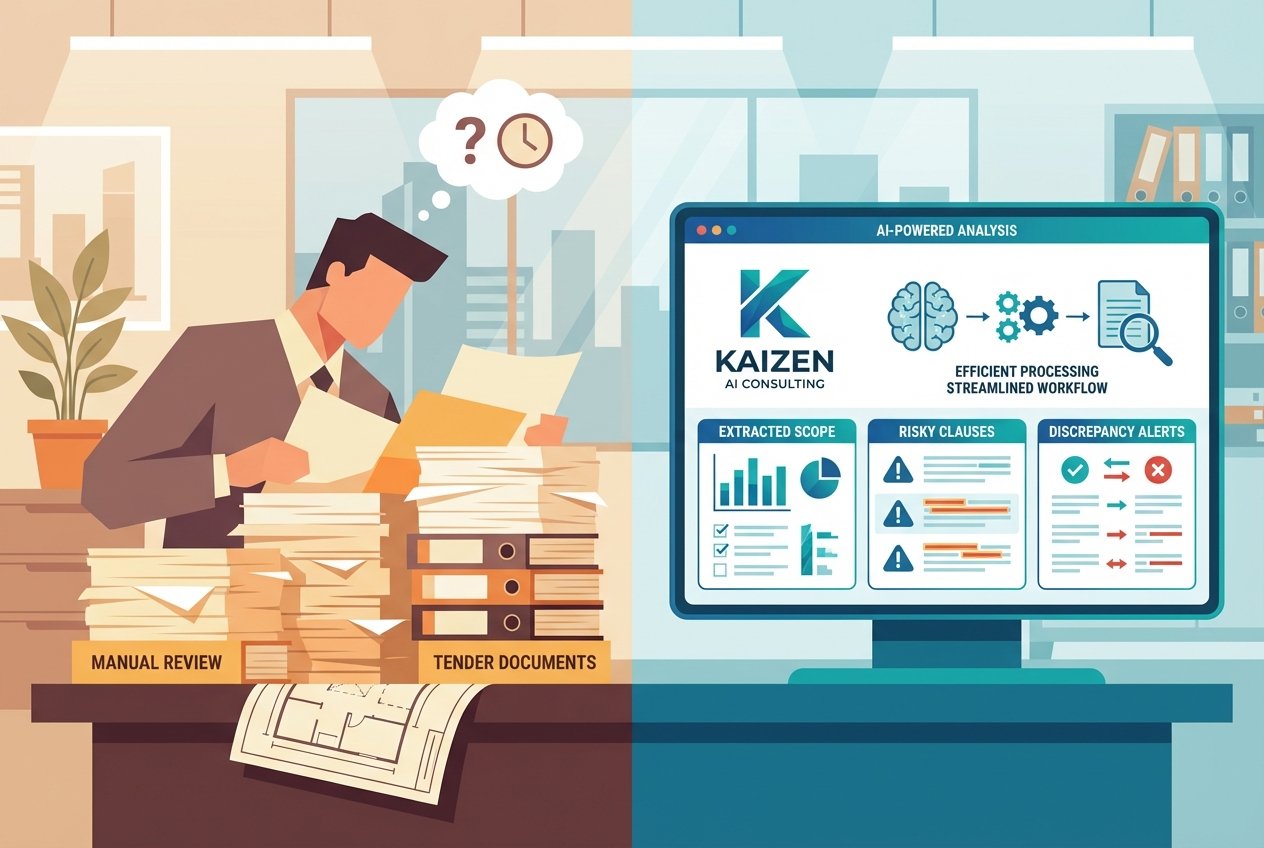
A mid-sized UK construction firm recently implemented Claude for their tender document review process, achieving remarkable results. Where their commercial team previously spent four to five hours manually reviewing a standard tender package, Claude now completes the initial analysis in under an hour, flagging key risks, unusual clauses, and areas requiring human attention.
Extracting and Organising Scope Requirements
One of Claude’s most valuable applications in construction technology UK settings is its ability to extract and organise scope requirements across multiple contract documents. When presented with specifications, drawings, and contract conditions, Claude can identify discrepancies between documents, highlight ambiguous scope items, and create structured summaries that commercial teams can immediately act upon.
According to a 2025 industry survey by ProcurePro, 30% of quantity surveyors identified scope and document analysis as a primary area where AI could deliver immediate value. The ability to align scope across contract documents and flag discrepancies between drawings and specifications represents a significant efficiency gain for busy bid teams.
Risk Identification and Clause Analysis
Claude document review capabilities extend to sophisticated risk identification. The AI can be trained to recognise potentially onerous contract clauses, unusual liability provisions, and payment terms that deviate from industry norms. For construction firms, this means faster identification of deal-breakers and a more strategic approach to contract negotiations.
One UK contractor reported that Claude identified a problematic indemnity clause in a tender that their team had initially overlooked. The clause would have exposed the firm to unlimited liability for consequential losses, a risk their insurance would not have covered. Early identification allowed them to negotiate amended terms before submission.
Practical Implementation: A Step-by-Step Approach
Implementing Claude for tender analysis requires thoughtful integration into existing workflows. Construction firms seeing the greatest success typically follow a structured approach that combines AI efficiency with human expertise.
Initial Document Ingestion
The process begins with uploading the complete tender package to Claude. Unlike traditional keyword searches, Claude reads documents contextually, understanding how different sections relate to each other. The AI can process PDFs, Word documents, and even scanned images with reasonable clarity, though cleaner digital documents yield better results.
For firms looking to implement this type of AI-powered workflow, Kaizen AI Consulting offers tailored implementation support that helps construction businesses integrate Claude and similar AI tools into their existing tender processes without disrupting established team dynamics.
Structured Query and Analysis
Rather than asking Claude to simply summarise a tender, experienced users develop structured prompts that extract specific information. Effective queries might include requests to identify all payment terms and highlight deviations from standard JCT or NEC provisions, extract health and safety requirements and list specific compliance obligations, or compare scope descriptions across specifications and bills of quantities to flag inconsistencies.
This structured approach ensures Claude’s analysis aligns with the firm’s specific evaluation criteria and risk appetite.
Human Review and Validation
Claude’s output serves as a comprehensive first draft that human reviewers can validate and refine. The AI excels at processing large volumes of information quickly, but final decisions on bid strategy, pricing adjustments for risk, and go/no-go recommendations remain firmly with experienced professionals.
This hybrid approach aligns with findings from the BSI 2025 Trust in AI report, which emphasises that AI should support decision-making without replacing human judgement in high-stakes construction scenarios.
Quantifiable Benefits for UK Construction Firms
The business case for AI-powered tender analysis is compelling. According to Autodesk’s 2026 AI Construction Trends report, organisations embedding AI into their workflows are seeing measurable improvements in bid accuracy, reduced administrative burden, and faster turnaround times.
Time Savings
Construction firms report reducing initial tender review time by 50 to 80 percent when using Claude for document analysis. For a busy bid team handling multiple tenders simultaneously, this translates to significant capacity gains. Time saved on document processing can be redirected to value-adding activities like supplier negotiations, site visits, and competitive analysis.
Improved Bid Quality
With Claude handling the comprehensive document review, bid teams produce more thorough submissions with fewer omissions. The AI’s ability to cross-reference requirements across multiple documents means fewer missed specifications and more accurate pricing that accounts for all identified obligations.
Risk Reduction
Early identification of problematic contract terms allows firms to either negotiate amendments or adjust their pricing to reflect actual risk exposure. One contractor estimated that Claude’s clause analysis had helped them avoid at least two potentially costly contract disputes in their first year of use.
Addressing Common Concerns
Construction firms considering AI adoption often raise legitimate concerns about data security, accuracy, and integration with existing processes. These concerns deserve thoughtful consideration.
Data Security and Confidentiality
Tender documents often contain commercially sensitive information. Claude’s enterprise deployment options include data handling policies that prevent uploaded content from being used for model training, addressing confidentiality concerns. Firms should establish clear protocols for which documents can be processed through AI systems and implement appropriate access controls.
Accuracy and Reliability
While Claude demonstrates exceptional document comprehension, it is not infallible. Construction firms should treat AI output as a sophisticated first draft requiring human validation rather than a final answer. This approach captures the efficiency benefits while maintaining appropriate quality controls.
For organisations seeking to implement robust AI governance frameworks alongside their tender analysis workflows, Kaizen AI Consulting’s strategy services provide structured approaches to AI adoption that balance innovation with appropriate risk management.
Integration with Existing Systems
Claude can be accessed through web interfaces, desktop applications, and APIs that enable integration with existing document management and bid tracking systems. Firms with established digital workflows can incorporate AI analysis without wholesale system replacements.
The Broader Context: AI Adoption in UK Construction
The adoption of construction AI for tender analysis reflects broader industry trends. According to the RICS 2025 survey, 67% of quantity surveying and construction professionals believe AI will help surveyors deliver greater value in the future.
However, the industry remains in early adoption phases. The CECA report notes that in March 2025, 85.6% of UK construction businesses reported they did not currently use AI, compared to almost 75% of businesses in other sectors. This gap represents both a challenge and an opportunity for early adopters to gain competitive advantage.
The Construction Magazine’s 2026 outlook notes that AI is becoming a background layer within many construction workflows, often invisible to those outside the process. The most meaningful shift has been away from retrospective reporting towards near real-time delivery intelligence.
Getting Started with AI-Powered Tender Analysis
For construction firms ready to explore AI-powered tender analysis, a phased approach typically yields the best results. Begin with less complex tender types like standard NDAs or straightforward scope packages to build team confidence and establish effective workflows.
Develop clear protocols for which tasks are delegated to AI and which remain with human reviewers. Invest in training to ensure team members understand both the capabilities and limitations of AI tools. Monitor results carefully, tracking time savings, error rates, and bid success to demonstrate return on investment.
Most importantly, view AI as an augmentation of existing expertise rather than a replacement. The most successful implementations combine Claude’s document processing capabilities with the commercial judgement and industry knowledge that experienced professionals bring to every tender.
Ready to Transform Your Tender Process?
The construction firms gaining competitive advantage in 2026 are those treating AI not as a future possibility but as a present reality. Claude’s document analysis capabilities offer immediate, practical benefits for tender review workflows, delivering time savings, improved accuracy, and better risk identification.
If you are ready to explore how AI can transform your construction firm’s approach to tender analysis, contact Kaizen AI Consulting today. Our team specialises in helping UK construction businesses implement AI solutions that deliver measurable results while maintaining the human expertise that successful project delivery demands.