Content Marketing and SEO: How They Work Together for Growth
In today’s digital landscape, businesses often treat content marketing and SEO as separate disciplines, managed by different teams with distinct objectives. However, this siloed approach leaves significant opportunities on the table. When content marketing SEO strategies are properly integrated, they create a powerful synergy that drives sustainable organic growth and delivers measurable business results.
According to HubSpot’s marketing research, companies that blog regularly receive 97% more links to their websites, whilst businesses with active content strategies see conversion rates six times higher than competitors who don’t prioritise content. Meanwhile, BrightEdge research indicates that organic search drives 53% of all website traffic, making it the single most important channel for digital growth.
The question isn’t whether to invest in content marketing or SEO, but rather how to leverage both together for maximum impact. At Kaizen AI Consulting, we help UK businesses develop integrated strategies that align content creation with search engine optimisation, ensuring every piece of content serves both user needs and business objectives.
Understanding the Marketing Synergy Between Content and SEO
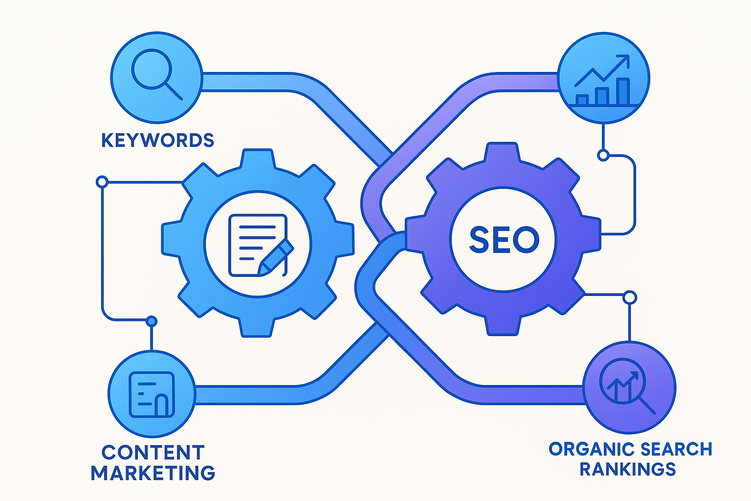
Content marketing and SEO are fundamentally interdependent. SEO without quality content is like having a shop window with nothing to display, whilst content marketing without SEO is like opening a brilliant store in a location nobody can find.
Why SEO Needs Content Marketing
Search engines have evolved dramatically over the past decade. Google’s algorithm updates, including BERT and the recent helpful content update, increasingly prioritise content that demonstrates expertise, experience, authority, and trustworthiness (E-E-A-T). This means SEO success now depends on creating genuinely valuable content that serves user intent.
Research from Backlinko analysing over 11 million Google search results found that the average first-page result contains 1,447 words, indicating that comprehensive, in-depth content ranks better. Furthermore, websites with blogs have 434% more indexed pages on average, providing significantly more opportunities to rank for relevant keywords.
Modern SEO requires:
- Fresh, regularly updated content that signals site activity
- Topic authority built through comprehensive content coverage
- Natural keyword integration that matches user search intent
- Internal linking structures that distribute page authority
- Engaging content that reduces bounce rates and increases dwell time
Why Content Marketing Needs SEO
Even the most brilliantly crafted content fails to deliver ROI if nobody discovers it. Content optimization through SEO principles ensures your valuable resources reach the right audience at the right time.
According to Semrush’s content marketing research, 69% of marketers actively invest in SEO, and 72% believe it’s more effective than PPC for generating sales. When content is optimised for search from the outset, it enjoys longer-lasting returns compared to paid advertising, which stops delivering the moment you stop paying.
Content marketing benefits from SEO through:
- Keyword research that identifies topics your audience actively searches for
- Technical optimisation that ensures content is crawlable and indexable
- Strategic internal linking that guides users through their journey
- Meta descriptions and title tags that improve click-through rates
- Performance data that informs future content decisions
Building an Integrated Strategy for Organic Growth
Creating marketing synergy between content and SEO requires strategic planning and consistent execution. Here’s how forward-thinking UK businesses are approaching this integration:
1. Start with Strategic Keyword Research
Effective content marketing SEO begins with understanding what your audience is searching for. Use tools like Google Keyword Planner, Semrush, or Ahrefs to identify:
- High-volume keywords relevant to your business
- Long-tail keywords with strong commercial intent
- Question-based queries that indicate information-seeking behaviour
- Topic clusters that allow you to build topical authority
Google research shows that 53% of shoppers say they always research before buying, making informational content crucial for capturing early-stage prospects. By mapping keywords to different stages of the buyer’s journey, you create content that attracts, engages, and converts.
2. Create Content Clusters Around Pillar Topics
Rather than creating isolated blog posts, develop comprehensive topic clusters. This involves creating a pillar page covering a broad topic, supported by multiple cluster pages exploring subtopics in detail. All pieces link to each other, creating a strong internal linking structure that signals expertise to search engines.
For example, a pillar page on “Digital Marketing for UK Businesses” might be supported by cluster content on social media marketing, email campaigns, PPC advertising, and content strategy. This approach helps you dominate search results for entire topic areas rather than individual keywords.
3. Optimise for User Intent, Not Just Keywords
Modern content optimization means understanding the intent behind searches. Google’s algorithm increasingly focuses on delivering results that match what users actually want to find, not just pages that contain certain words.
Search intent typically falls into four categories:
- Informational: Users seeking knowledge (“what is content marketing”)
- Navigational: Users looking for specific websites or pages
- Commercial: Users researching before purchasing (“best SEO tools UK”)
- Transactional: Users ready to buy or take action (“hire SEO consultant London”)
Your content should align with the specific intent of your target keywords. Informational content should educate and build trust, whilst commercial content should provide comparison and evaluation criteria.
4. Implement Technical SEO Best Practices
Even brilliant content won’t rank if technical issues prevent search engines from crawling and indexing it properly. Essential technical elements include:
- Fast page loading speeds (aim for under 3 seconds)
- Mobile-responsive design (over 60% of searches now occur on mobile)
- Proper heading hierarchy (H1, H2, H3 tags used correctly)
- Descriptive URL structures that include target keywords
- Schema markup that helps search engines understand your content
- XML sitemaps that facilitate crawling
Google’s Core Web Vitals have become ranking factors, making page experience a crucial component of SEO success. Kaizen AI Consulting helps businesses audit and optimise their technical SEO foundation, ensuring content has the best possible chance of ranking.
Measuring Success: KPIs for Integrated Content Marketing SEO
An integrated strategy requires unified measurement approaches that track both content engagement and SEO performance:
Traffic Metrics
- Organic traffic growth over time
- Rankings for target keywords
- Click-through rates from search results
- Featured snippet and “People Also Ask” visibility
Engagement Metrics
- Average time on page and scroll depth
- Bounce rate and pages per session
- Social shares and backlinks earned
- Comments and direct engagement
Conversion Metrics
- Lead generation from organic content
- Conversion rate by traffic source
- Customer acquisition cost for organic channels
- Revenue attributed to organic search
According to Content Marketing Institute research, 72% of successful content marketers measure content performance, compared to just 42% of unsuccessful ones. Regular monitoring allows you to identify what’s working and refine your approach continuously.
Common Mistakes to Avoid
Even with good intentions, businesses often make mistakes that undermine their integrated strategy:
Keyword Stuffing
Forcing keywords unnaturally into content damages readability and can trigger Google penalties. Focus on writing naturally for humans first, incorporating keywords where they fit contextually.
Ignoring Long-Form Content
Whilst short content has its place, comprehensive guides and in-depth articles tend to rank better and attract more backlinks. Aim for depth over frequency when resources are limited.
Neglecting Content Updates
Search engines favour fresh content. Regularly updating and improving existing pages can be more effective than constantly creating new ones.
Forgetting About Internal Linking
Many businesses focus on external backlinks whilst ignoring the power of strategic internal linking. Every new piece of content should link to relevant existing pages and be linked from them.
The Role of AI in Content Marketing and SEO
Artificial intelligence is transforming how businesses approach content marketing SEO. AI tools can now assist with keyword research, content ideation, competitor analysis, and performance prediction. However, the human element remains crucial for strategy, creativity, and ensuring content resonates with your specific audience.
At Kaizen AI Consulting, we help UK businesses leverage AI tools effectively whilst maintaining the authentic voice and strategic thinking that distinguishes great content from generic material. Our approach combines cutting-edge technology with deep marketing expertise to deliver sustainable organic growth.
Taking Action: Implementing Your Integrated Strategy
Understanding the theory behind content marketing and SEO integration is one thing, but implementation is where many businesses struggle. Here’s a practical roadmap to get started:
- Audit your current state: Analyse existing content performance and SEO health
- Define clear objectives: Set specific, measurable goals for organic growth
- Conduct comprehensive keyword research: Identify opportunities aligned with business goals
- Create a content calendar: Plan content that addresses keyword targets and user needs
- Optimise existing content: Update and improve pages that already have some authority
- Build new content systematically: Focus on topic clusters that establish authority
- Monitor and refine: Use analytics to understand what works and iterate
For many businesses, particularly small to medium enterprises, dedicating internal resources to this integrated approach can be challenging. This is where partnering with specialists who understand both content strategy and technical SEO delivers significant value.
Conclusion: Unified Approach for Sustainable Growth
The digital marketing landscape continues to evolve, but one truth remains constant: content marketing and SEO are stronger together than apart. An integrated strategy creates marketing synergy that drives organic growth, builds brand authority, and delivers measurable ROI.
Success requires treating content and SEO not as separate tactics, but as complementary elements of a unified growth strategy. Every piece of content should be optimised for discovery, and every SEO initiative should be supported by genuinely valuable content.
The businesses that will thrive in the coming years are those that embrace this integration, creating content ecosystems that serve both user needs and business objectives. Whether you’re a startup looking to establish your first foothold in organic search or an established business seeking to scale your digital presence, the principles remain the same: create exceptional content, optimise it strategically, and measure relentlessly.
Ready to develop an integrated content marketing SEO strategy that drives real business growth? Kaizen AI Consulting works with UK businesses to create and implement data-driven strategies that deliver sustainable organic growth. Our team combines deep expertise in content strategy, technical SEO, and AI-powered marketing to help you achieve your growth objectives. Contact us today to discuss how we can help your business thrive in the digital landscape.