Developing a Multi-Channel Digital Advertising Strategy
In today’s fragmented digital landscape, UK businesses can no longer rely on a single advertising channel to reach their target audience effectively. With consumers actively engaging across multiple platforms throughout their purchasing journey, developing a robust multi-channel advertising strategy has become essential for maximising reach, engagement, and return on investment.
Recent research from Google reveals that consumers now use an average of 6 touchpoints before making a purchase decision, with many using more than 10. This complex customer journey demands a sophisticated approach to advertising planning that coordinates messaging across various digital channels whilst maintaining consistency and relevance.
Understanding Multi-Channel Advertising
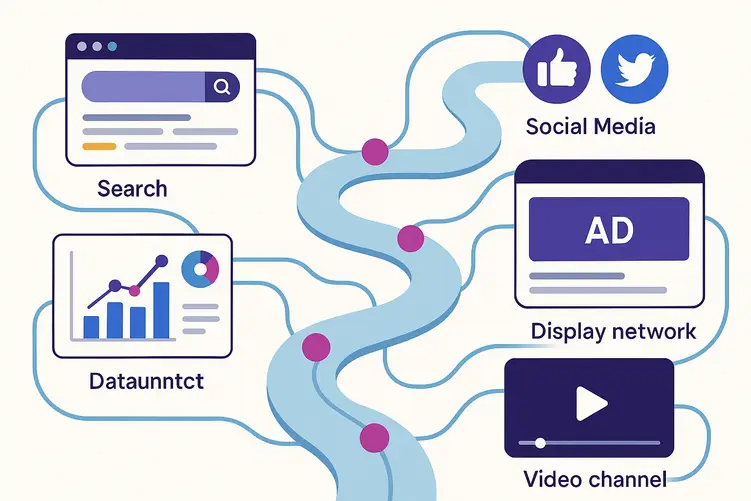
Multi-channel advertising refers to the practice of reaching customers through multiple digital platforms and channels, including search engines, social media, display networks, email, video platforms, and mobile apps. Unlike omnichannel marketing, which focuses on creating a seamless integrated experience, multi-channel approaches allow each channel to operate with some independence whilst working towards common business objectives.
The fundamental principle behind cross-channel marketing is meeting your audience where they already spend their time. According to Ofcom’s Communications Market Report, UK adults now spend an average of 4 hours and 20 minutes daily online, distributed across various platforms and devices. This fragmentation creates both opportunities and challenges for businesses attempting to maintain consistent visibility.
Building Your Foundation: Research and Planning
Audience Research and Segmentation
Effective advertising planning begins with comprehensive audience research. Before allocating budget across channels, you must understand who your customers are, where they spend time online, and how they prefer to consume content. Develop detailed buyer personas that include demographic information, psychographic characteristics, online behaviours, and preferred communication channels.
Use analytics tools to examine your existing customer data, identifying patterns in how different segments interact with your brand. Consider factors such as age, location within the UK, income levels, interests, and purchase behaviours. This segmentation enables you to tailor your media strategy to specific audience groups across appropriate channels.
Competitive Analysis
Examine how competitors in your sector are deploying their digital strategy across channels. Tools like SEMrush, Similarweb, and SpyFu can reveal where competitors are investing their advertising budgets and which keywords they’re targeting. This intelligence helps identify gaps in the market and opportunities to differentiate your approach.
Channel Selection and Budget Allocation
Not every channel deserves equal investment. Your media strategy should prioritise channels based on where your target audience is most active and receptive. Consider these primary digital advertising channels:
Search Engine Marketing (SEM): Google Ads remains crucial for UK businesses, capturing users with high purchase intent. Statista reports that Google holds over 90% of the UK search market, making it essential for most multi-channel advertising strategies.
Social Media Advertising: Platforms like Facebook, Instagram, LinkedIn, and TikTok offer sophisticated targeting options. According to recent data, 57 million people in the UK use social media, representing 84% of the population.
Display and Programmatic Advertising: Banner ads and programmatic platforms enable broad reach and retargeting capabilities across thousands of websites.
Video Advertising: YouTube and other video platforms continue growing, with video content generating higher engagement rates than static formats.
Email Marketing: Despite being one of the oldest digital channels, email consistently delivers strong ROI, with some studies showing returns of £42 for every £1 spent.
Developing Coordinated Messaging Across Channels
Whilst each channel operates differently, your core brand message must remain consistent across all touchpoints. This doesn’t mean using identical creative assets everywhere, rather adapting your message to suit each platform’s unique characteristics whilst maintaining brand voice and positioning.
Creating Channel-Specific Content
Successful cross-channel marketing recognises that each platform has its own content requirements and user expectations. LinkedIn audiences respond to professional thought leadership, Instagram users engage with visual storytelling, and search engine users want immediate answers to specific queries.
Develop a content matrix that maps your key messages across channels, specifying format, tone, and creative approach for each platform. This structured approach ensures consistency whilst respecting channel-specific best practices.
Establishing Attribution Models
Understanding which channels contribute to conversions is crucial for optimising your digital strategy. Attribution modelling assigns credit to touchpoints along the customer journey, helping you understand the true value of each channel.
Common attribution models include:
- Last-Click Attribution: Credits the final touchpoint before conversion
- First-Click Attribution: Attributes success to the initial interaction
- Linear Attribution: Distributes credit equally across all touchpoints
- Time-Decay Attribution: Gives more weight to recent interactions
- Data-Driven Attribution: Uses machine learning to assign credit based on actual contribution
For most UK businesses, data-driven attribution provides the most accurate picture, though it requires sufficient data volume to function effectively. Kaizen AI Consulting specialises in implementing sophisticated attribution models that help businesses understand their true advertising ROI across all channels, enabling more informed budget allocation decisions.
Implementation and Campaign Management
Campaign Structure and Organisation
Organise your campaigns logically across platforms, using consistent naming conventions that make cross-channel analysis easier. Structure campaigns by objective (awareness, consideration, conversion), product line, or customer segment, ensuring your organisation system works across all advertising platforms.
Implement tracking parameters like UTM codes consistently across all channels to enable accurate performance measurement in Google Analytics or your preferred analytics platform.
Testing and Optimisation
Multi-channel advertising demands continuous testing and refinement. Implement A/B testing across channels, examining variables like:
- Ad creative and messaging
- Targeting parameters
- Bidding strategies
- Landing page design
- Call-to-action wording
- Ad scheduling
Document your tests systematically, creating a knowledge base of what works for your business across different channels. This institutional knowledge becomes increasingly valuable over time, informing future advertising planning decisions.
Budget Management and Pacing
Distribute your budget strategically across channels based on performance data and business objectives. Start with a baseline allocation based on research and industry benchmarks, then adjust based on actual performance.
Monitor daily spend to ensure proper budget pacing throughout the month. Many platforms offer automated bidding that optimises spend, but human oversight remains essential for catching issues and identifying opportunities.
Measuring Success: Key Performance Indicators
Define clear KPIs for your media strategy before launching campaigns. Metrics should align with business objectives and vary by campaign goal:
Awareness Campaigns: Impressions, reach, brand lift, share of voice
Consideration Campaigns: Click-through rate, engagement rate, time on site, pages per session
Conversion Campaigns: Cost per acquisition, conversion rate, return on ad spend, customer lifetime value
Create dashboards that consolidate performance data across all channels, providing a unified view of your multi-channel advertising efforts. Tools like Google Data Studio, Tableau, or custom reporting solutions enable this consolidated view.
Advanced Tactics for Cross-Channel Marketing Success
Sequential Messaging
Use cross-channel marketing to tell progressive stories across platforms. For example, introduce your brand on social media, reinforce messaging through display advertising, and convert through search campaigns. This sequential approach guides prospects through the awareness-to-purchase journey systematically.
Retargeting and Remarketing
Implement sophisticated retargeting strategies that follow users across channels after initial engagement. Someone who visits your website can be retargeted on Facebook, YouTube, and through display networks, with messaging adapted to their previous interactions.
According to Criteo, retargeted visitors are 70% more likely to convert than first-time visitors, making this an essential component of multi-channel advertising strategies.
Dynamic Creative Optimisation
Advanced platforms now offer dynamic creative optimisation (DCO), automatically assembling ad variations from component parts and showing the best-performing combinations to each user. This technology maximises relevance whilst reducing creative production demands.
Common Pitfalls to Avoid
Even well-planned multi-channel strategies can falter. Watch for these common mistakes:
- Channel Silos: Teams managing different channels independently without coordination create inconsistent messaging and wasted opportunities
- Overextension: Attempting to maintain presence on too many channels dilutes resources and impact
- Neglecting Mobile: With mobile devices accounting for over 60% of UK web traffic, mobile optimisation is non-negotiable
- Ignoring Data Privacy: UK GDPR compliance must be central to your digital strategy, particularly regarding tracking and targeting
- Set-and-Forget Mentality: Digital advertising requires active management and continuous optimisation
Working with Experts to Maximise Results
Developing and executing an effective media strategy across multiple channels requires significant expertise, time, and resources. Many UK businesses find that partnering with specialists delivers better results than managing campaigns in-house.
Kaizen AI Consulting helps businesses across the United Kingdom develop and implement sophisticated multi-channel advertising strategies that drive measurable results. Our team brings deep expertise in advertising planning, channel selection, creative development, and performance optimisation, ensuring your budget works as efficiently as possible across all digital touchpoints.
The Future of Multi-Channel Advertising
As technology evolves, multi-channel advertising grows increasingly sophisticated. Artificial intelligence and machine learning enable better targeting, creative optimisation, and budget allocation. Privacy changes like the deprecation of third-party cookies require new approaches to cross-channel tracking and attribution.
Successful businesses will be those that adapt their digital strategy to these changes whilst maintaining focus on fundamental principles: understanding audiences, delivering relevant messages, and measuring results rigorously.
Taking Action on Your Multi-Channel Strategy
Developing a successful multi-channel advertising approach doesn’t happen overnight. Start by auditing your current activities, identifying gaps and opportunities. Research your audience thoroughly, select channels strategically, and implement tracking that enables proper measurement.
Most importantly, commit to continuous improvement. The most successful advertisers treat their efforts as ongoing experiments, constantly learning and refining their approach based on data.
If you’re ready to develop a comprehensive multi-channel advertising strategy that delivers real business results, contact Kaizen AI Consulting today. Our team will work with you to understand your objectives, research your market, and implement a coordinated cross-channel marketing approach that maximises your advertising investment across all digital platforms.