In today’s competitive digital landscape, successful advertising campaigns don’t happen by chance. They require meticulous planning, strategic thinking, and flawless execution. Whether you’re a startup looking to make your mark or an established business seeking to expand your reach, understanding the fundamentals of digital campaign planning is essential for maximising your return on investment.
According to recent research by the Internet Advertising Bureau UK, digital advertising spend in the UK reached £27.2 billion in 2023, highlighting the critical importance of getting your campaign strategy right. With so much investment flowing into digital channels, businesses cannot afford to approach advertising execution haphazardly.
Understanding the Foundation of Digital Campaign Planning
Before launching any advertising initiative, it’s crucial to establish a solid foundation. Digital campaign planning begins with understanding your business objectives, target audience, and the competitive landscape. This strategic groundwork determines everything that follows, from channel selection to creative development.
Effective ad strategy starts with defining clear, measurable objectives. Are you looking to increase brand awareness, generate leads, drive sales, or perhaps a combination of these goals? Research from Think with Google shows that campaigns with well-defined objectives are 429% more likely to report success than those without clear goals.
At Kaizen AI Consulting, we help businesses establish robust campaign frameworks that align digital advertising efforts with broader business objectives. Our approach ensures that every pound spent on media planning contributes directly to your bottom line.
Audience Research and Segmentation
Understanding your audience is the cornerstone of effective campaign management. Today’s digital platforms offer unprecedented access to audience data, enabling marketers to target specific demographics, interests, behaviours, and even purchase intent.
Developing Customer Personas
Creating detailed customer personas helps inform every aspect of your digital campaign planning. These semi-fictional representations of your ideal customers should include demographic information, pain points, motivations, and preferred digital channels. According to HubSpot, businesses that use personas in their marketing strategy see a 73% higher conversion rate compared to those that don’t.
Effective personas go beyond basic demographics. They should encompass psychographic information such as values, attitudes, and lifestyle choices. This depth of understanding allows you to craft messages that resonate emotionally with your target audience, significantly improving campaign performance.
Market and Competitor Analysis
Comprehensive market research reveals opportunities and threats in your advertising landscape. Analysing competitor campaigns helps identify gaps in the market and informs your unique value proposition. Tools like SEMrush and SpyFu can provide valuable insights into competitor ad spend, keywords, and creative approaches.
Developing Your Ad Strategy Framework
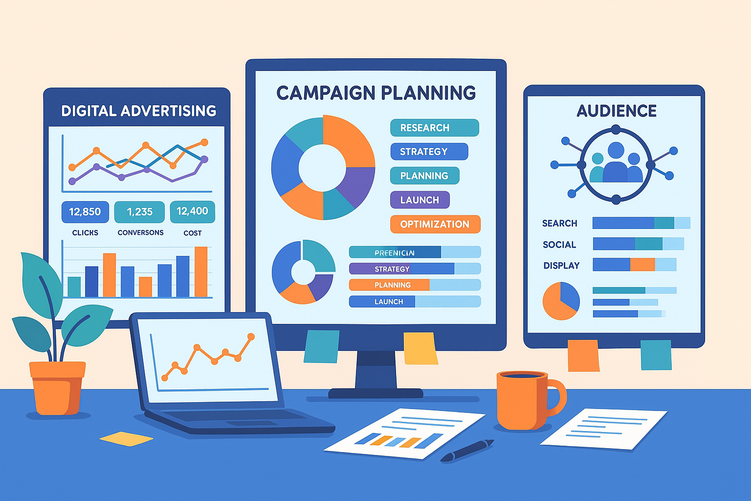
With research complete, it’s time to develop a comprehensive ad strategy that guides your advertising execution. This framework should outline your campaign objectives, target audiences, key messages, channel mix, budget allocation, and success metrics.
Channel Selection and Media Planning
The digital advertising ecosystem offers numerous channels, each with unique strengths and audience profiles. Your media planning should consider platforms including Google Ads, social media advertising, programmatic display, video platforms, and emerging channels like connected TV.
According to eMarketer, UK adults spend an average of 3 hours and 54 minutes daily on digital media, with mobile devices accounting for nearly 70% of that time. This data underscores the importance of mobile-optimised campaigns and cross-device targeting strategies.
Your channel selection should align with where your target audience spends time and how they prefer to consume content. B2B campaigns might prioritise LinkedIn and search advertising, whilst consumer brands often find success with Instagram, Facebook, and TikTok. The key is matching your message to the right platform at the right time.
Budget Allocation and Bidding Strategies
Strategic budget allocation across channels and campaigns is crucial for maximising ROI. Industry benchmarks suggest allocating 70% of your budget to proven channels and reserving 30% for testing new platforms and approaches. This balanced approach ensures stability whilst allowing room for innovation and growth.
Different bidding strategies serve different objectives. Cost-per-click (CPC) bidding works well for traffic generation, whilst cost-per-acquisition (CPA) bidding aligns with conversion goals. Smart bidding strategies powered by machine learning can optimise bids in real-time based on numerous signals, improving efficiency and performance.
Creative Development and Messaging
Even the most sophisticated media planning falls flat without compelling creative assets. Your ad creative should capture attention, communicate value, and inspire action. Research by Facebook Business indicates that creative quality drives 56% of campaign effectiveness, making it the single most important factor in advertising success.
Crafting Effective Ad Copy
Effective ad copy speaks directly to your audience’s needs and desires. It should be clear, concise, and action-oriented. Headlines should grab attention within the first few words, whilst body copy builds interest and desire. Strong calls-to-action (CTAs) tell users exactly what to do next, whether that’s “Shop Now,” “Learn More,” or “Get Started.”
Testing different messaging approaches is essential for optimising performance. A/B testing headlines, descriptions, and CTAs helps identify which messages resonate most strongly with your audience, allowing you to refine your approach continuously.
Visual Assets and Video Content
Visual content dominates digital advertising, with video emerging as the most engaging format. Wyzowl’s Video Marketing Statistics report that 91% of businesses now use video as a marketing tool, and viewers retain 95% of a message when watching a video compared to just 10% when reading text.
Your visual assets should align with brand guidelines whilst being optimised for each platform’s specifications. Different platforms require different aspect ratios, file sizes, and formats. Creating platform-specific variations ensures your content displays optimally across all channels.
Campaign Implementation and Advertising Execution
With strategy and creative in place, it’s time for advertising execution. This phase requires meticulous attention to detail, as small errors in campaign setup can significantly impact performance.
Technical Setup and Tracking Implementation
Proper tracking implementation is non-negotiable for effective campaign management. Conversion tracking pixels, UTM parameters, and analytics integration ensure you can measure campaign performance accurately. Google Tag Manager simplifies tag implementation and management across multiple platforms.
Campaign structure impacts both performance and management efficiency. Organising campaigns by objective, audience, or product category helps maintain clarity and enables more precise optimisation. Ad groups should contain tightly themed keywords and ads for maximum relevance and Quality Score.
Quality Assurance and Launch
Before launching any campaign, conduct thorough quality assurance checks. Verify that all tracking is functioning correctly, landing pages load properly, forms submit successfully, and ads display as intended across devices. A pre-launch checklist helps ensure nothing is overlooked.
Consider a soft launch approach for larger campaigns, starting with a smaller budget to validate setup and performance before scaling. This cautious approach can prevent costly errors and provides early insights for optimisation.
Monitoring, Optimisation, and Campaign Management
Launching your campaign is just the beginning. Ongoing campaign management separates high-performing initiatives from underperforming ones. Daily monitoring during the first week is essential, transitioning to regular check-ins as campaigns stabilise.
Key Performance Indicators and Reporting
Establish clear KPIs aligned with your campaign objectives. Common metrics include impressions, clicks, click-through rate (CTR), conversion rate, cost per acquisition (CPA), and return on ad spend (ROAS). Different campaign types and objectives require different metrics focus.
Regular reporting keeps stakeholders informed and provides insights for optimisation. Dashboard tools like Google Data Studio or Tableau can automate reporting, saving time whilst providing real-time visibility into campaign performance.
Continuous Optimisation Strategies
Top-performing campaigns undergo continuous refinement. Regular optimisation activities include adjusting bids, pausing underperforming ads, adding negative keywords, refining audience targeting, and testing new creative variations. According to WordStream, businesses that optimise their campaigns regularly see an average improvement of 30% in performance metrics.
Data-driven decision-making is crucial for effective optimisation. Rather than making changes based on hunches, let performance data guide your actions. Allow sufficient time for statistical significance before drawing conclusions, typically at least 100 conversions or two weeks of data.
Scaling and Expanding Successful Campaigns
Once you’ve identified winning campaigns, scaling becomes the focus. Gradual budget increases allow algorithms to adjust whilst maintaining performance. Expanding to new audiences, keywords, or placements can unlock additional growth opportunities.
Geographic expansion is particularly relevant for UK businesses looking to grow nationally or internationally. Testing campaigns in new markets requires adjusting messaging for local preferences and cultural nuances whilst maintaining brand consistency.
Leveraging AI and Automation in Campaign Management
Artificial intelligence is transforming digital campaign planning and execution. Machine learning algorithms can analyse vast datasets to identify patterns humans might miss, optimise bids in real-time, and predict future performance trends.
Kaizen AI Consulting specialises in helping businesses leverage AI to enhance their advertising execution and campaign management. From automated bid management to predictive analytics and dynamic creative optimisation, AI tools can significantly improve efficiency and results.
Automated rules and scripts can handle routine optimisation tasks, freeing up time for strategic thinking and creative development. However, human oversight remains essential to ensure automation aligns with business objectives and brand values.
Common Pitfalls and How to Avoid Them
Even experienced marketers encounter challenges in digital campaign planning. Common pitfalls include inadequate tracking implementation, insufficient budget allocation, premature optimisation based on limited data, neglecting mobile users, and failing to align ad copy with landing page content.
Another frequent mistake is set-and-forget campaign management. Digital advertising requires ongoing attention and optimisation. Market conditions change, competitors adjust strategies, and audience preferences evolve. Campaigns that aren’t actively managed inevitably decline in performance.
Getting Expert Support for Your Campaigns
While this guide provides a comprehensive framework for digital campaign planning, executing successful campaigns consistently requires expertise, experience, and dedicated resources. Many businesses find that partnering with specialists accelerates results whilst avoiding costly mistakes.
If you’re looking to elevate your digital advertising efforts, contact Kaizen AI Consulting today. Our team of certified digital marketing experts can help you develop winning ad strategies, implement robust campaign management processes, and leverage AI to maximise your advertising ROI. From initial strategy development through to ongoing optimisation and scaling, we provide end-to-end support tailored to your business objectives.
Conclusion
Successful digital campaign planning requires a strategic approach that encompasses research, planning, execution, and continuous optimisation. By understanding your audience, developing clear objectives, selecting appropriate channels, creating compelling creative assets, and implementing robust tracking and optimisation processes, you can maximise the effectiveness of your digital advertising investments.
The digital advertising landscape continues to evolve rapidly, with new platforms, formats, and technologies emerging regularly. Staying informed about industry trends, testing new approaches, and learning from both successes and failures will help ensure your campaigns remain competitive and effective.
Remember that great advertising execution isn’t about perfection from the start but rather continuous improvement. Each campaign provides valuable insights that inform future efforts, creating a virtuous cycle of learning and optimisation that drives increasingly better results over time.