
In today’s rapidly evolving business landscape, the ability to make informed financial decisions can mean the difference between exponential growth and stagnation. Financial modeling has become an indispensable tool for UK businesses seeking to navigate uncertainty, optimise resources, and drive sustainable expansion. According to PwC research, companies that employ sophisticated financial analysis techniques are 2.5 times more likely to achieve their growth targets than those relying on intuition alone.
Financial modeling combines quantitative analysis, business acumen, and technological capabilities to create dynamic representations of a company’s financial performance. Whether you’re a startup seeking investment or an established enterprise planning expansion, mastering advanced finance techniques is crucial for staying competitive in the modern marketplace.
Understanding the Fundamentals of Financial Modeling
Financial modeling is the process of creating a mathematical representation of a company’s operations, enabling decision-makers to forecast future performance under various scenarios. Unlike basic budgeting, sophisticated modeling techniques incorporate multiple variables, sensitivities, and assumptions to provide comprehensive insights into potential outcomes.
The foundation of effective financial modeling rests on three core pillars: historical data analysis, assumption development, and projection methodologies. By examining past performance patterns, businesses can identify trends and establish baseline metrics that inform future projections. Research from the Institute of Chartered Accountants in England and Wales indicates that models built on robust historical data demonstrate 40% greater accuracy in forecasting than those relying primarily on market averages.
For UK businesses navigating Brexit-related uncertainties and evolving economic conditions, the ability to model multiple scenarios has become particularly valuable. Companies can test assumptions about currency fluctuations, supply chain disruptions, and market volatility before committing significant resources to strategic initiatives.
Essential Modeling Techniques for Business Forecasting
Three-Statement Financial Models
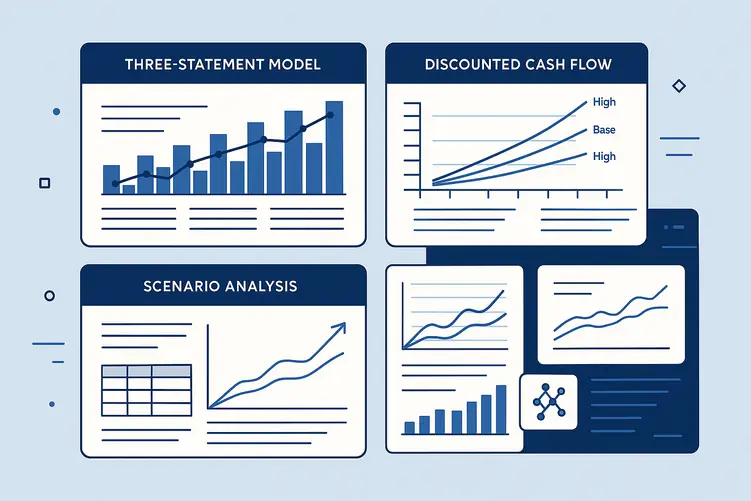
The three-statement model forms the backbone of comprehensive financial analysis, integrating the income statement, balance sheet, and cash flow statement into a single, interconnected framework. This approach ensures consistency across financial statements and reveals the cascading effects of operational decisions throughout the organisation.
Building an effective three-statement model requires meticulous attention to the relationships between line items. Revenue growth assumptions flow through to accounts receivable on the balance sheet, whilst capital expenditure decisions impact both the cash flow statement and fixed assets. Professional guidance from specialists like Kaizen AI Consulting can help businesses establish these connections properly, ensuring models accurately reflect operational realities.
Discounted Cash Flow Analysis
Discounted cash flow (DCF) modeling represents one of the most sophisticated techniques for business valuation and investment appraisal. By projecting future cash flows and discounting them to present value, DCF analysis provides an intrinsic valuation that reflects a company’s true earning potential rather than market sentiment.
The methodology requires careful determination of the weighted average cost of capital (WACC), terminal value assumptions, and growth rates. According to Financial Times analysis, approximately 87% of investment professionals consider DCF modeling essential for strategic decision-making, yet many SMEs lack the technical expertise to implement it effectively.
Scenario and Sensitivity Analysis
In an environment characterised by volatility and rapid change, single-point forecasts provide insufficient guidance for strategic planning. Scenario analysis enables businesses to model base case, optimistic, and pessimistic outcomes, whilst sensitivity analysis identifies which variables exert the greatest influence on results.
This approach proves particularly valuable when evaluating new market entry, product launches, or significant capital investments. By understanding how changes in key assumptions affect projected returns, executives can make more informed risk assessments and develop contingency plans. Monte Carlo simulation, an advanced technique that tests thousands of variable combinations, has become increasingly accessible through modern financial analysis software.
Advanced Finance Techniques for Growth-Stage Businesses
Working Capital Optimization Models
For many growing businesses, cash flow management presents a greater challenge than profitability. Working capital models help organisations optimise the timing and magnitude of cash inflows and outflows, ensuring sufficient liquidity to support expansion whilst minimising opportunity costs.
These models examine the interplay between inventory levels, accounts receivable collection periods, and payment terms with suppliers. Research from BDO suggests that UK businesses with sophisticated working capital models maintain 30% lower cash reserves whilst experiencing fewer liquidity crises than competitors using basic cash forecasting.
Driver-Based Modeling
Rather than modeling every line item independently, driver-based approaches identify the key operational metrics that influence financial performance. For a software-as-a-service business, these might include customer acquisition cost, churn rate, and average revenue per user. For retailers, inventory turnover, same-store sales growth, and gross margin evolution drive results.
This technique creates more intuitive models that non-financial stakeholders can understand and engage with meaningfully. When Kaizen AI Consulting works with clients on financial modeling projects, the team emphasises driver-based approaches that align financial planning with operational strategy, ensuring models serve as practical management tools rather than abstract exercises.
Technology Integration in Modern Financial Modeling
The landscape of financial modeling has been transformed by technological advancement. Whilst spreadsheet software remains ubiquitous, artificial intelligence and machine learning capabilities are revolutionising how businesses approach business forecasting and analysis.
Modern platforms can automatically update models with real-time data feeds, identify anomalies that warrant investigation, and even suggest optimisation opportunities based on pattern recognition. According to McKinsey research, companies leveraging AI-enhanced financial analysis tools reduce forecasting time by 50-70% whilst improving accuracy by up to 35%.
Cloud-based modeling platforms enable collaborative scenario planning, version control, and seamless integration with enterprise resource planning systems. This connectivity ensures models reflect current operational data rather than becoming outdated shortly after creation. For businesses seeking to implement these advanced capabilities, partnering with specialists who understand both the technical and strategic dimensions of financial modeling can accelerate implementation and maximise return on investment.
Building Models That Drive Strategic Decision-Making
Model Design Principles
Effective financial models balance sophistication with usability. Overly complex models become difficult to maintain, audit, and explain to stakeholders, whilst oversimplified approaches fail to capture important dynamics. Best practice model design incorporates clearly separated sections for inputs, calculations, and outputs, with comprehensive documentation of assumptions and methodologies.
Flexibility represents another critical design consideration. Models should accommodate changes in business strategy, market conditions, and organisational structure without requiring complete reconstruction. This adaptability proves especially important for growth-stage businesses whose operations evolve rapidly.
Validation and Stress Testing
Even technically sophisticated models produce misleading outputs if built on flawed assumptions or logical errors. Rigorous validation processes compare model outputs against historical results, industry benchmarks, and reasonability tests. Stress testing examines model behaviour under extreme scenarios, ensuring formulas function correctly across the full range of possible inputs.
Professional modelers recommend third-party review for models supporting major strategic decisions. Independent validation identifies errors, challenges assumptions, and provides additional confidence in model reliability. This quality assurance step often reveals opportunities for refinement that significantly improve decision-making utility.
Implementation Strategies for Your Organisation
Developing robust financial modeling capabilities requires more than technical skills. Successful implementation demands a structured approach that considers organisational readiness, data infrastructure, and stakeholder engagement.
Begin by assessing current modeling practices and identifying gaps between existing capabilities and strategic requirements. Many UK businesses discover that whilst they possess basic forecasting abilities, they lack sophisticated techniques for evaluating growth investments, optimising capital structure, or conducting rigorous scenario analysis.
Data quality and accessibility often present the greatest implementation challenges. Models require accurate, consistent historical information and reliable processes for ongoing data inputs. Organisations should audit data sources, establish governance protocols, and invest in systems that facilitate seamless information flow between operational and financial functions.
Training and capability development ensure models become embedded management tools rather than occasional exercises. Cross-functional teams should understand model assumptions, interpret outputs correctly, and contribute operational insights that improve projection accuracy.
Driving Growth Through Analytical Excellence
Financial modeling represents far more than a technical exercise. When implemented effectively, these modeling techniques transform how organisations evaluate opportunities, allocate resources, and respond to changing conditions. The ability to quantify potential outcomes, compare alternative strategies, and identify value drivers provides a significant competitive advantage in today’s data-driven business environment.
For UK businesses seeking to scale operations, enter new markets, or optimise performance, sophisticated financial analysis capabilities have become essential infrastructure. The investment in developing these capabilities delivers returns through improved decision quality, reduced risk exposure, and enhanced stakeholder confidence.
However, building world-class modeling capabilities requires specialised expertise that many organisations lack internally. The complexity of advanced finance techniques, combined with the strategic importance of accurate forecasting, makes professional guidance invaluable for businesses serious about leveraging financial modeling for competitive advantage.
Ready to transform your financial planning and unlock new growth opportunities? Contact Kaizen AI Consulting today to discover how our team can help you develop sophisticated financial models tailored to your specific business objectives. Our experts combine deep technical knowledge with practical business experience to deliver modeling solutions that drive measurable results. Don’t let inadequate financial analysis hold back your growth potential.