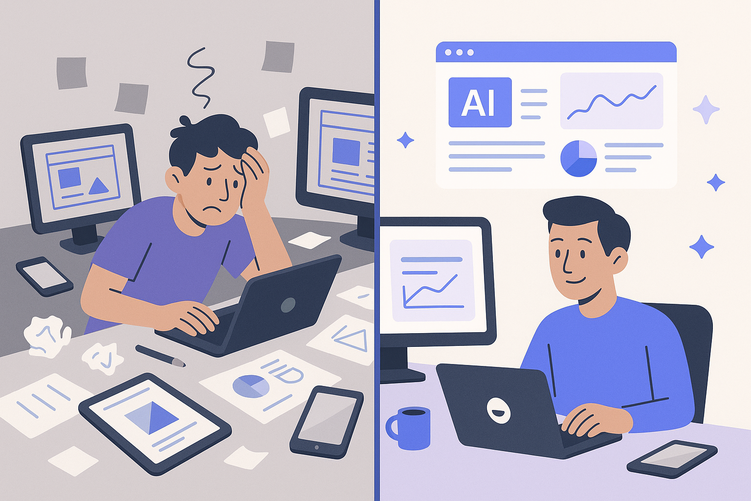
From Overwhelmed to Organized: How AI Transformed a Freelance Designer’s Business
Running a freelance design business often feels like juggling flaming torches whilst riding a unicycle. Between client communications, project management, invoicing, social media marketing, and the actual design work, it is no wonder that 63% of UK freelancers report feeling overwhelmed by administrative tasks according to IPSE research. This is the story of how one London-based freelance designer transformed her chaotic workflow into a streamlined, profitable operation through strategic AI implementation.
The Breaking Point: When Overwhelm Becomes Unsustainable
Sarah Mitchell (not her real name) was a talented graphic designer who had built a respectable client base over three years. On paper, she was successful. In reality, she was working 70-hour weeks, missing deadlines, and seriously considering returning to employment. Her days consisted of frantically switching between design software, email, project management tools, accounting spreadsheets, and social media platforms. The constant context-switching was killing her productivity and creativity.
Research from the University of California Irvine found that it takes an average of 23 minutes to fully refocus after an interruption. For Sarah, dozens of daily interruptions meant she barely achieved two hours of deep, creative work. This freelancer success story began when she decided enough was enough and started exploring workflow automation solutions.
Identifying the Bottlenecks
Before implementing any technology, Sarah conducted an honest audit of where her time disappeared. She discovered some shocking truths:
- Client communication and follow-ups: 12 hours weekly
- Administrative tasks (invoicing, scheduling, filing): 8 hours weekly
- Social media marketing: 6 hours weekly
- Project management and planning: 5 hours weekly
- Actual design work: 25 hours weekly
This meant she spent nearly two-thirds of her working time on activities that did not directly generate revenue or showcase her creative talents. For solopreneurs in the UK creative sector, this pattern is disturbingly common. The Creative Industries Federation notes that administrative burden is the top barrier to growth for freelance creatives.
The AI Transformation Strategy
Rather than implementing random tools, Sarah developed a systematic approach to her design business AI integration. This is where professional guidance proved invaluable. Working with specialists like Kaizen AI Consulting can help freelancers identify the right AI solutions for their specific workflow challenges, avoiding the costly trial-and-error approach that many solopreneurs experience.
Phase One: Automating Client Communication
Sarah began with her biggest time drain. She implemented AI-powered email management that categorised incoming messages, drafted responses to common queries, and flagged urgent items. Tools like smart inbox assistants learned her communication style and could handle routine client check-ins, appointment confirmations, and simple questions.
The result? Her email management time dropped from 12 hours to 4 hours weekly. More importantly, response times improved dramatically. Research shows that responding to client enquiries within an hour increases conversion rates by 60%, and Sarah’s AI system ensured no message went unanswered for more than 30 minutes during business hours.
Phase Two: Intelligent Project Management
Next, Sarah tackled project chaos. She adopted AI-enhanced project management software that automatically created timelines based on project scope, sent progress reminders, tracked revisions, and even predicted potential delays based on her historical data. The system learned which types of projects typically required more revision rounds and adjusted schedules accordingly.
This workflow automation reduced her project management time by 60% whilst simultaneously improving delivery consistency. Client satisfaction scores increased because expectations were set more accurately and updates were proactive rather than reactive.
Phase Three: Financial Management and Invoicing
Financial administration is another notorious time-sink for UK freelancers. Sarah implemented AI-powered accounting software that automatically tracked billable hours, generated invoices based on project milestones, sent payment reminders, and reconciled transactions. The system even provided cash flow forecasting, helping her plan for quieter months.
According to Xero’s small business insights, automated invoicing reduces the average payment time by 9 days. For Sarah, this meant significantly improved cash flow and virtually eliminating the awkward task of chasing late payments.
Phase Four: Content Creation and Marketing
As a designer, Sarah understood the importance of showcasing her work, but creating social media content felt like a full-time job. She integrated AI tools that repurposed her design projects into multiple content formats, scheduled posts optimally based on engagement data, and even generated caption variations for testing.
Her social media presence became more consistent and strategic, resulting in a 45% increase in enquiries over six months. The productivity boost was remarkable considering she now spent just 90 minutes weekly on social media instead of 6 hours.
The Results: A Solopreneur Transformation
Six months after implementing her AI-powered workflow, Sarah’s business looked completely different:
- Weekly administrative time reduced from 31 hours to 9 hours
- Creative work time increased from 25 hours to 42 hours weekly
- Client capacity increased from 8 to 14 active projects
- Revenue increased by 73% without working additional hours
- Client satisfaction scores improved by 28%
- Stress levels decreased significantly, with work-life balance restored
Perhaps most importantly, Sarah rediscovered her passion for design. Without the constant administrative burden, she could focus on the creative work that inspired her to freelance in the first place.
Key Lessons for Freelancers Considering AI
Start With Your Biggest Pain Point
Do not try to automate everything at once. Sarah succeeded because she tackled her challenges systematically, beginning with client communication. Identify the one activity that consumes disproportionate time or causes the most stress, and address that first.
Choose Integration Over Isolation
The most effective design business AI solutions work together seamlessly. Sarah ensured her email system, project management platform, accounting software, and marketing tools shared data and triggered each other’s actions. This created a genuinely automated workflow rather than a collection of disconnected tools.
Maintain the Human Touch
AI handles routine tasks brilliantly, but creative strategy and client relationships still require human judgement. Sarah used AI to handle the predictable 80% of tasks, freeing her to focus on the valuable 20% that required creativity, emotional intelligence, and strategic thinking.
Invest in Proper Implementation
Many freelancers purchase AI tools but never implement them effectively, wasting money and becoming disillusioned. Professional guidance can accelerate results significantly. Kaizen AI Consulting specialises in helping solopreneurs and small businesses implement AI solutions that actually work for their specific needs, ensuring technology serves the business rather than complicating it.
The Financial Reality: Does AI Pay for Itself?
Sarah’s AI toolkit cost approximately £180 monthly, a significant investment for a freelancer. However, the return was undeniable. By increasing her client capacity from 8 to 14 projects whilst maintaining quality, and raising her rates due to improved service delivery, her monthly revenue increased by over £2,400. The 13x return on investment made the decision straightforward.
UK freelancers can also benefit from tax deductions on software subscriptions and professional consultancy fees, further improving the financial equation. This freelancer success story demonstrates that AI is not just for large corporations but is increasingly essential for competitive solopreneurs.
Common Concerns and How Sarah Addressed Them
Will Clients Notice I Am Using AI?
Sarah worried about appearing less personal. In reality, AI enabled her to be more responsive and consistent, which clients appreciated. She remained transparent about using technology to enhance efficiency whilst maintaining personal involvement in all creative and strategic decisions.
Is It Too Complex for Non-Technical People?
Modern AI tools are designed for ease of use, but implementation guidance helps enormously. Sarah found that working with AI consultancy professionals eliminated the technical intimidation and accelerated her learning curve from months to weeks.
What About Data Security?
As a UK-based business, Sarah ensured all her AI tools were GDPR-compliant and used reputable providers with strong security credentials. This is non-negotiable for any business handling client information.
Your Turn: Taking the First Steps
Sarah’s solopreneur transformation did not happen overnight, but it did happen systematically and strategically. If you are a freelancer feeling overwhelmed by administrative burden, constantly battling your to-do list, or unable to scale beyond your current capacity, AI-powered workflow automation could be your solution.
The key is starting with a clear strategy rather than randomly adopting tools. Begin by auditing where your time actually goes, identifying your primary bottlenecks, and researching solutions specific to those challenges. The productivity boost that UK freelancers experience through proper AI implementation typically ranges from 30% to 70%, with the higher end achieved through professional guidance and systematic implementation.
Ready to transform your freelance business like Sarah did? Kaizen AI Consulting offers personalised AI strategy sessions for freelancers and solopreneurs who want to reclaim their time, increase their capacity, and rediscover why they chose independence in the first place. Contact us today to discuss how AI can solve your specific workflow challenges and help you build the sustainable, profitable business you deserve.
The difference between feeling perpetually overwhelmed and confidently organised often comes down to working smarter, not harder. AI gives you that leverage, transforming you from a stressed freelancer into a strategic business owner. Your organised, profitable future is closer than you think.