In the competitive landscape of UK business, the difference between a thriving enterprise and a failed venture often comes down to one critical factor: effective sales optimisation. This is the story of how a struggling Manchester-based tech startup transformed itself from the brink of closure to achieving consistent profitability through strategic sales optimization success.
The Crisis: A Startup on the Brink
When TechFlow Solutions launched in 2021, the founders had everything they thought they needed: an innovative product, seed funding, and industry connections. However, by their second year of operation, they faced a harsh reality. Despite spending over £150,000 on marketing and having a quality product, their conversion rates hovered at a dismal 1.2%, and monthly recurring revenue had plateaued at £18,000 against operational costs of £25,000.
According to Office for National Statistics data, approximately 60% of UK startups fail within their first three years. TechFlow was heading directly towards becoming part of this statistic. The company had six months of runway left, and the founders knew they needed a dramatic business turnaround or they would join the ranks of failed ventures.
Identifying the Core Problems
The first step in any successful sales strategy overhaul is accurate diagnosis. TechFlow’s leadership conducted a comprehensive audit of their sales process and uncovered several critical issues:
Disconnected Sales and Marketing
Their marketing team generated leads, but the sales team complained about lead quality. Meanwhile, marketing blamed sales for failing to convert. This classic disconnect costs UK businesses an estimated £10 billion annually in lost productivity. The two departments operated in silos, with no shared metrics or communication protocols.
Inadequate Sales Training and Process
The sales team lacked a structured approach. Each salesperson followed their own methodology, making it impossible to identify what worked and what didn’t. New hires received minimal training, often learning through trial and error at the company’s expense. Research from the Chartered Institute of Personnel and Development shows that companies with structured sales training programmes see 50% higher net sales per employee.
Poor Data Utilisation
TechFlow collected mountains of data but made few data-driven decisions. Their CRM system contained valuable insights about customer behaviour, pain points, and buying patterns, but this information remained largely untapped. They were flying blind, making decisions based on intuition rather than evidence.
The Transformation: Implementing Sales Optimization
Understanding the problems was only the beginning. TechFlow needed to implement comprehensive solutions quickly. Here’s how they executed their UK business recovery strategy:
Stage One: Process Mapping and Standardisation
The company mapped every step of their customer journey, from initial awareness through to closed deals and customer retention. They documented what worked in successful deals and identified where prospects typically dropped off. This exercise revealed that 47% of potential customers abandoned the process during a convoluted three-week proposal phase.
By standardising their sales process and reducing the proposal phase to five days through templates and pre-approved pricing tiers, they immediately saw a 23% increase in conversion rates. This kind of strategic business optimisation is precisely what separates surviving startups from thriving ones.
Stage Two: Sales and Marketing Alignment
TechFlow implemented weekly alignment meetings between sales and marketing teams, established shared KPIs, and created a lead scoring system that both departments contributed to developing. They defined what constituted a “sales-qualified lead” and agreed on handoff procedures.
Within two months, lead quality improved dramatically. Sales reported that 68% of passed leads were genuinely sales-ready, compared to just 31% previously. This alignment alone reduced customer acquisition costs by 34%.
Stage Three: Data-Driven Decision Making
The company invested in proper CRM training and established weekly data review sessions. They tracked metrics including lead response time, conversion rates at each pipeline stage, average deal size, and sales cycle length. This visibility allowed them to make informed adjustments quickly.
One crucial insight emerged from the data: prospects who received follow-up within five minutes were nine times more likely to convert than those contacted after 30 minutes. This finding, consistent with Harvard Business Review research, led to implementing automated response systems and restructuring the team’s schedule to ensure rapid follow-up during peak inquiry times.
Stage Four: Strategic Sales Training
Rather than generic sales training, TechFlow invested in industry-specific coaching tailored to their market. They implemented role-playing exercises based on actual customer objections, created a knowledge base of effective responses, and established mentorship pairings between top performers and newer team members.
The results were remarkable. Average deal size increased by 41% as salespeople learned to identify and articulate higher-value solutions. Win rates improved from 12% to 29% within four months.
The Role of Expert Guidance in Sales Optimization Success
Whilst TechFlow’s internal team drove much of this transformation, they recognised the value of external expertise. Many businesses attempting a turnaround struggle because they lack the objectivity and specialised knowledge required for effective sales optimisation. This is where organisations like Kaizen AI Consulting prove invaluable, bringing both strategic insight and implementation expertise to businesses facing similar challenges.
Professional consultants can accelerate the transformation process by identifying issues that internal teams might miss, bringing proven frameworks from successful turnarounds, and providing objective analysis free from internal politics. For businesses in crisis, this external perspective can mean the difference between startup survival and closure.
The Results: From Failing to Thriving
The transformation didn’t happen overnight, but the trajectory changed dramatically within the first quarter of implementation. Here’s what TechFlow achieved over 12 months:
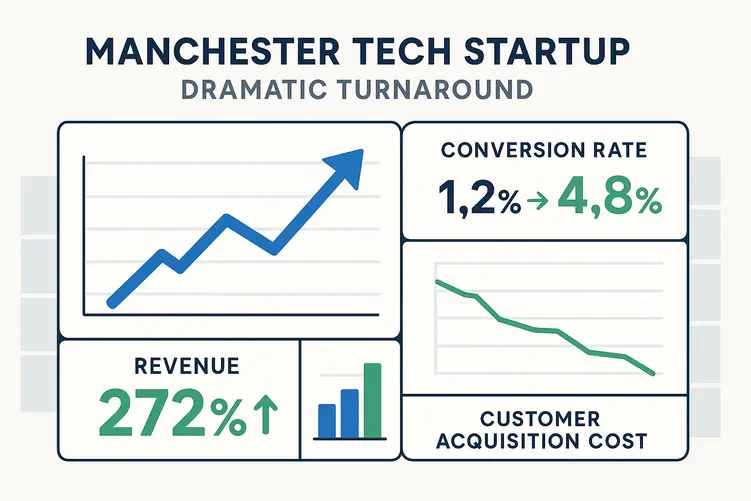
Revenue Growth: Monthly recurring revenue increased from £18,000 to £67,000, a 272% increase. By month 18, they reached £94,000 in monthly recurring revenue, finally achieving profitability with healthy margins.
Conversion Rate Improvements: Overall conversion rates jumped from 1.2% to 4.8%. For sales-qualified leads specifically, conversion rates reached 29%, placing them in the top quartile for their industry.
Sales Cycle Reduction: The average sales cycle decreased from 87 days to 43 days, allowing the team to close more deals with the same resources and improving cash flow significantly.
Customer Acquisition Cost: CAC decreased by 52%, from £4,200 per customer to £2,016, whilst customer lifetime value increased by 67% through improved onboarding and retention processes.
Team Performance: Sales team productivity increased by 156%. The same five-person team that previously closed 8-12 deals monthly was now closing 28-35 deals.
Key Lessons for UK Businesses Facing Similar Challenges
TechFlow’s business turnaround offers valuable lessons for other UK startups and SMEs struggling with sales performance:
1. Act Quickly But Strategically
When facing a crisis, speed matters, but hasty decisions can worsen the situation. TechFlow spent three weeks on thorough diagnosis before implementing solutions. This investment in understanding root causes prevented wasted effort on symptoms rather than underlying problems.
2. Focus on Process Before Technology
Many failing businesses believe new software will solve their problems. TechFlow already had quality tools but wasn’t using them effectively. They optimised processes first, then leveraged technology to scale those processes. According to McKinsey research, companies that prioritise process optimisation before technology implementation see 3.5 times better ROI.
3. Measure Everything That Matters
You cannot improve what you don’t measure. Establishing clear metrics and reviewing them regularly allowed TechFlow to identify what worked and double down on successful strategies whilst quickly abandoning ineffective approaches.
4. Invest in Your People
Sales training and team development delivered some of the highest returns in TechFlow’s transformation. UK businesses that invest at least 5% of revenue in employee development report 24% higher profit margins than those that don’t, according to CIPD data.
5. Consider Expert Guidance
Whilst not every business can afford full-time consultants, targeted expert input at critical junctures can accelerate success and avoid costly mistakes. Whether through formal consulting relationships, advisory boards, or mentorship programmes, external perspective adds tremendous value during transformations.
Is Your Business Ready for Sales Optimization?
If your organisation is experiencing stagnant growth, declining conversion rates, or inefficient sales processes, you don’t need to face these challenges alone. The strategies that saved TechFlow can be adapted to businesses across industries and sizes.
Key indicators that your business would benefit from sales optimisation include:
- Conversion rates below industry averages
- Long or inconsistent sales cycles
- High customer acquisition costs
- Disconnect between marketing and sales teams
- Lack of clear sales processes or metrics
- Inconsistent performance across sales team members
- Difficulty scaling despite increased marketing spend
Take Action Today
TechFlow’s transformation from struggling startup to profitable enterprise demonstrates that with the right sales strategy and commitment to optimisation, business turnaround is possible even in challenging circumstances. The UK business landscape is competitive, but companies that embrace data-driven sales optimisation position themselves for sustainable growth.
Don’t wait until you’re down to your last months of runway. Whether you’re facing an immediate crisis or simply want to maximise your sales effectiveness, professional guidance can help you identify opportunities and implement proven strategies tailored to your specific situation.
Ready to transform your sales performance and secure your business’s future? Contact Kaizen AI Consulting today for a confidential consultation. Our team specialises in helping UK businesses implement the kind of sales optimization strategies that turn struggling ventures into success stories. Let’s discuss how we can help you achieve your own remarkable turnaround.