How to Build an Automated Competitor Price Tracker with AI
In today’s hyper-competitive marketplace, knowing what your rivals charge is no longer a nice-to-have — it is a commercial necessity. Across UK retail, e-commerce, SaaS, and B2B sectors, businesses are racing to implement automated competitor price tracking systems powered by artificial intelligence. The reason is simple: manual price checks are slow, unreliable, and increasingly impossible to scale. Leading retailers are now refreshing competitor pricing data hundreds or even thousands of times per day, making real-time AI price monitoring a core operational function rather than a periodic reporting exercise.
This guide walks you through the architecture, tools, and practical steps required to build a robust automated competitor price tracker — and explains why getting professional support can dramatically reduce the time it takes to see results.
Why Competitor Price Tracking Matters More Than Ever in 2026
The pricing landscape has shifted considerably. According to TGN Data’s 2026 competitive pricing report, brands are no longer adjusting prices on a daily basis — leading players are making pricing decisions in near real-time, detecting competitor changes within minutes. Businesses still relying on manual monitoring or weekly spreadsheet updates are falling behind at a measurable pace.
Consumer behaviour is amplifying this pressure. UK shoppers have unprecedented access to real-time price comparison through AI assistants, deal aggregators, and mobile comparison tools. Scayle’s 2026 UK fashion retail report confirms that value-driven shopping is on the rise, with consumers switching to more affordable brands and resale platforms at speed. This means that even a small pricing misstep can translate into measurable revenue loss.
At the same time, automation is becoming mainstream across UK marketing and commercial teams. HubSpot’s 2026 marketing statistics show that 92% of businesses now use automation for data analysis and reporting, and 47% apply it to core marketing processes. Competitor price intelligence sits squarely within this automation wave.
The Six Layers of a Modern AI Price Monitoring System
A production-grade competitor analysis tool is not a single script — it is a layered pipeline. Understanding the architecture helps you make smarter decisions about what to build, what to buy, and where AI adds genuine value.
1. Source Discovery
The first layer involves identifying and maintaining a list of competitor product URLs, category pages, and marketplace listings. For most UK businesses this includes curated links to rivals on Amazon UK, eBay UK, and direct retail sites. Source discovery can be supplemented with sitemap parsing and SERP-based discovery to ensure coverage remains comprehensive as competitor catalogues grow.
2. Data Collection
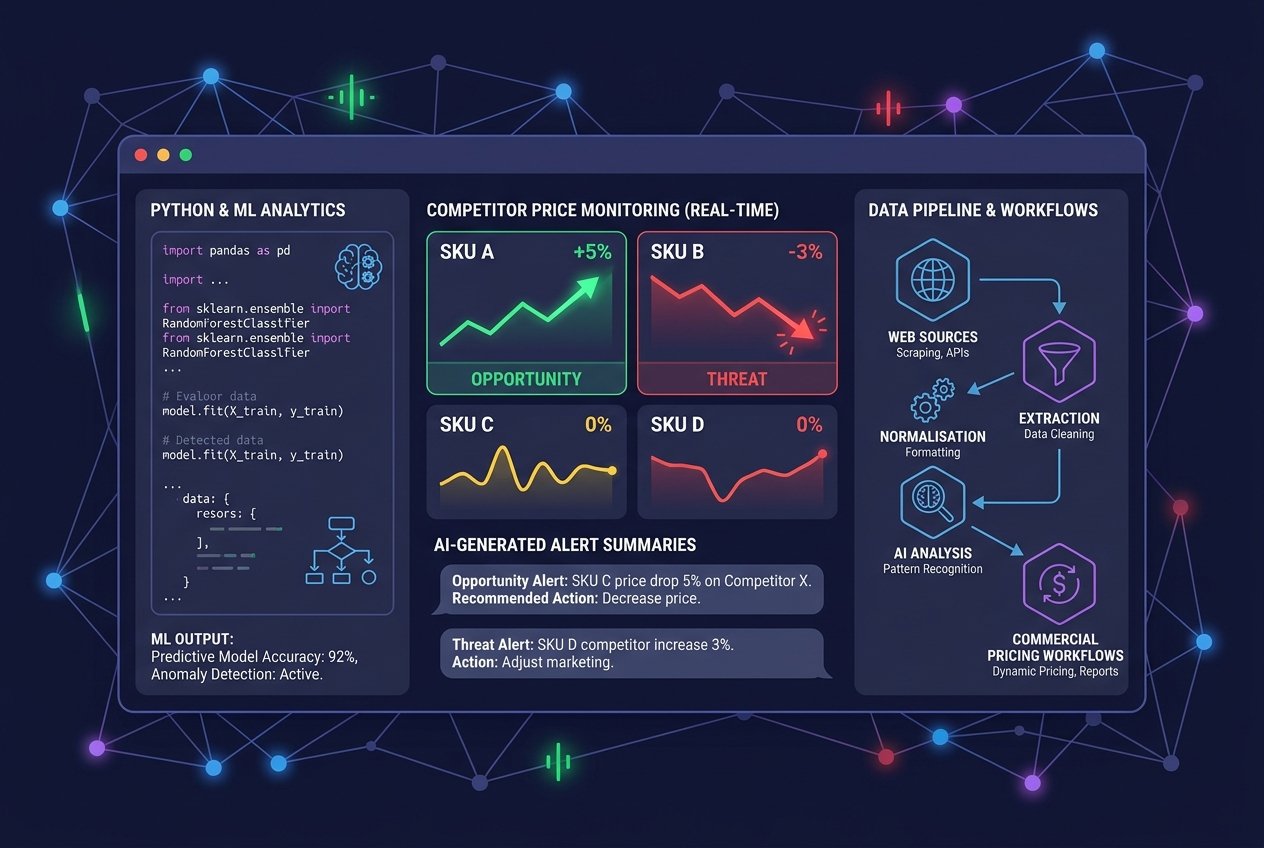
The collection layer fetches page content using the lightest method that works reliably. Static pages are handled with Python libraries such as requests and httpx. JavaScript-rendered pages — which represent the majority of modern retail sites — require headless browser tools like Playwright. A well-engineered system will attempt a lightweight HTTP fetch first and escalate to full browser rendering only when necessary, keeping infrastructure costs manageable.
3. Data Extraction
Extraction is where most DIY projects fail. Best practice involves attempting to read structured data first — specifically JSON-LD Product.offers.price schema — before falling back to DOM selectors or regex patterns. The most resilient systems capture not just the current price, but also the previous price, promotional badges, stock status, shipping cost, unit price, and a confidence score for each data point. For UK retailers, VAT-inclusive versus VAT-exclusive logic must be handled explicitly to avoid systematic errors in price comparisons.
4. Normalisation and Validation
Raw price data is messy. A single product may display as “£1,299.00”, “1299”, or “£1,299 inc. VAT” across different competitor pages. A robust normalisation layer converts all values to a consistent format — typically pence in the UK context — and validates that no price has changed beyond plausible bounds without triggering a manual review flag. Screenshots and raw HTML snapshots should be retained for auditability, which is increasingly important as PwC’s 2026 AI predictions note that 60% of executives now tie responsible AI governance directly to ROI and efficiency.
5. Change Detection and Intelligence
This is the layer where AI delivers its greatest value in a modern market intelligence automation workflow. Change detection operates at three levels:
- Rule-based alerts: trigger when a competitor undercuts your price by more than a defined threshold, when stock status changes, or when a promotional badge appears.
- Statistical methods: moving averages, z-score deviation detection, and change-point analysis help distinguish genuine pricing shifts from temporary anomalies.
- Machine learning and LLMs: AI models now classify changes as price updates, promotional events, layout redesigns, or noise. Large language models are increasingly used to generate plain-English summaries such as “Competitor A dropped price from £99 to £79 and added a free delivery badge” — making alerts immediately actionable without manual interpretation.
AI also enables predictive capabilities: forecasting the likelihood of a competitor discounting ahead of seasonal events, clustering rivals by their pricing behaviour patterns, and ranking which alerts are commercially most significant.
6. Delivery and Actioning
The final layer delivers intelligence where it is needed. Standard integrations include Slack, Microsoft Teams, email, Google Sheets, and webhooks into repricing engines or ERP systems. For more mature implementations, automated repricing rules can be triggered directly — raising prices when competitors go out of stock, or matching a competitor’s promotion within minutes of detection. Dashboards built in Power BI, Looker, or Streamlit give commercial teams a single view of the competitive landscape.
Build, Buy, or Partner? Choosing the Right Approach for Your Business
The 2026 market offers three distinct paths, and the right one depends on your team’s technical capacity, catalogue size, and speed-to-value requirements.
Building in-house using Python with Playwright, PostgreSQL, and a scheduling tool like Airflow gives maximum flexibility and is well-suited to businesses with a small, well-defined set of competitors and available engineering resource. The typical stack also includes BeautifulSoup for parsing, pandas and scikit-learn for analysis, and Celery or cron for job scheduling.
Commercial tools such as Prisync, Competera, Visualping, and PageCrawl offer rapid deployment for businesses tracking thousands of SKUs without wanting to maintain scraping infrastructure. These platforms increasingly incorporate AI-powered summaries and repricing recommendations as standard features.
Partnering with a specialist is the most effective route for businesses that need a custom solution integrated with existing systems, but lack the internal technical resource to build and maintain one. This is where the team at Kaizen AI Consulting adds significant value — designing and implementing bespoke market intelligence automation pipelines that connect competitor price data directly to your pricing strategy, CRM, or commercial dashboards. Rather than spending months building and debugging infrastructure, businesses working with Kaizen AI Consulting can be operational in weeks with a system tailored to their specific competitive landscape.
UK-Specific Considerations for Competitor Price Tracking
Building a competitor price tracker for the UK market introduces several requirements that generic guides often overlook. VAT handling is the most common source of error: consumer-facing prices are VAT-inclusive, while B2B pricing may be quoted net. A system that conflates these will produce systematically misleading comparisons.
Seasonal pricing events also need explicit handling. UK retailers operate distinct pricing cycles around Black Friday, Boxing Day, January sales, Easter promotions, and bank holiday campaigns. A well-designed tracker should flag changes against these seasonal patterns to help teams distinguish a structural price repositioning from a short-term promotional response.
For businesses selling across borders, GBP-to-EUR or USD normalisation must be applied consistently. Delivery cost is another often-neglected dimension: a headline price that appears £5 cheaper may carry a higher shipping cost, making the landed price uncompetitive. The most commercially useful trackers capture the full delivered cost, not just the item price.
Legal and operational boundaries also apply. UK businesses should review competitor website terms of service, respect robots.txt policies where appropriate, and ensure their data collection practices are aligned with database rights legislation and any relevant contractual obligations. Logging raw HTML snapshots and maintaining audit trails is good practice from both a governance and a dispute-resolution perspective.
Common Use Cases Across UK Industries
Automated competitor price tracking delivers value across a wide range of UK sectors:
- Electronics retail: monitoring pricing across Currys, Argos, John Lewis, AO, and Amazon UK on a sub-daily basis.
- Fashion and apparel: tracking markdown timing, promotional intensity, and discount depth to inform own-brand promotion scheduling.
- DIY and home goods: watching bundle compositions, delivery pricing, and Click and Collect availability.
- B2B distributors: monitoring reseller pricing for MAP (Minimum Advertised Price) compliance and detecting repeated violations.
- SaaS and subscription businesses: tracking competitor pricing page changes, plan restructuring, and introductory offer patterns.
- FMCG brands: checking marketplace seller pricing and stock availability across Amazon UK and grocery platforms.
If your business operates in any of these sectors, a well-implemented AI price monitoring system can provide a measurable commercial advantage. You can explore how Kaizen AI Consulting supports businesses with AI-driven business intelligence and automation consulting to understand the range of solutions available.
A Phased Implementation Roadmap
For businesses starting their competitor price tracking journey, a phased approach reduces risk and delivers early value before committing to a full build:
- Phase 1 — Pilot: Select 20 to 100 SKUs and 3 to 5 key competitors. Use structured data extraction and simple rule-based alerts.
- Phase 2 — Expand: Broaden coverage, add stock and promotion tracking, introduce statistical change detection.
- Phase 3 — Intelligence: Layer in LLM-powered change summaries, competitor behaviour clustering, and alert prioritisation.
- Phase 4 — Automation: Connect price intelligence to repricing rules or commercial workflows, with appropriate human oversight and governance controls.
Each phase produces usable output, meaning the business does not need to wait for a full system to realise value. The key is ensuring that data quality and normalisation are solid before adding analytical complexity — a principle that experienced practitioners apply consistently, and one that the team at Kaizen AI Consulting embeds into every implementation engagement.
Getting Started
Automated competitor price tracking powered by AI is no longer a capability reserved for enterprise retailers with large data engineering teams. The combination of accessible Python tooling, commercial monitoring platforms, and AI-powered summarisation has made it achievable for mid-market and even smaller UK businesses — provided the architecture is thoughtfully designed from the outset.
Whether you are evaluating commercial tools, scoping a custom build, or looking to upgrade an existing system that has outgrown its original design, the starting point is always the same: define the commercial questions you need to answer, then build the data infrastructure to answer them reliably.
If you would like to discuss how an automated competitor price tracker could be built and integrated within your business, get in touch with the Kaizen AI Consulting team for a no-obligation conversation about your requirements. Our specialists work with UK businesses across retail, distribution, and digital sectors to design market intelligence systems that deliver genuine commercial impact.