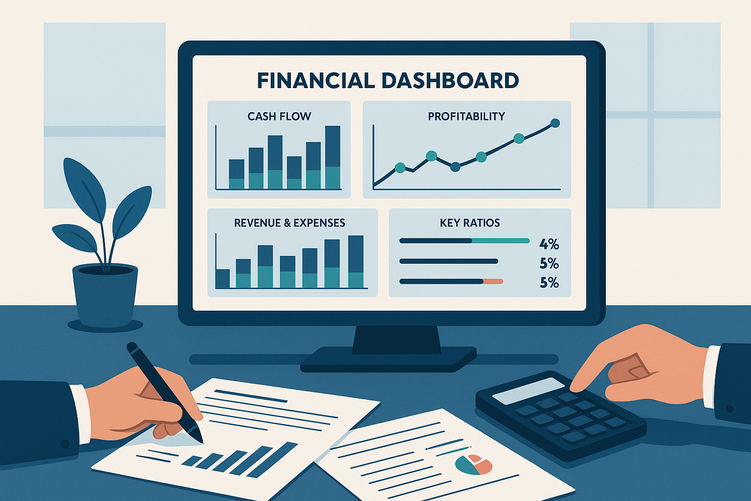
Understanding the financial health of your business is crucial for long-term success and sustainability. A comprehensive financial health check acts as a diagnostic tool, revealing strengths to leverage and weaknesses to address before they become critical issues. Whether you’re a startup or an established enterprise, regular financial assessments can mean the difference between thriving and merely surviving in today’s competitive UK business landscape.
According to ONS data, approximately 20% of UK businesses fail within their first year, with poor financial management being a leading cause. A structured financial health check can help you avoid becoming part of this statistic.
What is a Business Financial Health Check?
A financial health check is a comprehensive business audit that examines all aspects of your company’s financial performance. This systematic financial assessment evaluates your cash flow, profitability, debt levels, and overall financial stability. Think of it as an MOT for your business finances, identifying potential problems before they escalate into serious issues.
The process involves analysing key financial metrics, reviewing accounting practices, assessing risk exposure, and comparing your performance against industry benchmarks. For many UK businesses, engaging experts like Kaizen AI Consulting can provide the objective analysis and advanced tools needed to conduct a thorough financial review.
Why Regular Financial Health Checks Matter
Research from the Institute of Chartered Accountants in England and Wales (ICAEW) shows that businesses conducting regular financial reviews are 40% more likely to achieve sustained growth over five years. Regular business diagnostics enable you to:
- Identify cash flow problems before they become critical
- Make informed decisions about expansion or investment
- Improve profitability through cost optimisation
- Enhance your appeal to investors and lenders
- Ensure compliance with HMRC and Companies House requirements
- Prepare effectively for economic uncertainty
Key Components of a Comprehensive Financial Health Check
Cash Flow Analysis
Cash flow is the lifeblood of any business. Your financial assessment should begin with a detailed examination of money moving in and out of your business. According to UK Corporate Finance Association research, 82% of business failures result from poor cash flow management rather than lack of profitability.
Examine your cash flow statements from the past 12-24 months. Look for patterns, seasonal variations, and potential problem areas. Calculate your cash conversion cycle to understand how quickly you turn inventory and receivables into cash. A healthy UK SME typically maintains a cash reserve covering 3-6 months of operating expenses.
Profitability Metrics
Profitability analysis goes beyond simply checking whether you’re making money. Your business audit should examine gross profit margin, net profit margin, and operating profit margin. Compare these figures against previous periods and industry averages.
The Department for Business and Trade provides sector-specific benchmarking data that can help you assess whether your profitability is healthy for your industry. If margins are declining, investigate whether this results from rising costs, pricing pressure, or operational inefficiencies.
Debt and Liabilities Assessment
Understanding your debt position is crucial for financial health. Calculate your debt-to-equity ratio and interest coverage ratio. A debt-to-equity ratio above 2:1 typically indicates high financial risk for most UK businesses, though this varies by sector.
Review all outstanding liabilities, including loans, credit agreements, and payment terms with suppliers. Ensure your debt servicing costs aren’t consuming an unsustainable portion of your revenue. The average UK SME spends approximately 5-8% of turnover on debt servicing, according to British Business Bank data.
Working Capital Analysis
Working capital represents the funds available for day-to-day operations. Calculate your current ratio by dividing current assets by current liabilities. A ratio between 1.5 and 2.0 generally indicates healthy liquidity, though optimal levels vary by industry.
Examine your inventory turnover, accounts receivable days, and accounts payable days. Slow-moving inventory ties up cash that could be deployed elsewhere. Similarly, if customers are taking 60-90 days to pay when terms are 30 days, this creates unnecessary cash flow strain.
Conducting Your Financial Health Check: A Step-by-Step Process
Step 1: Gather Financial Documents
Collect all relevant financial documentation including profit and loss statements, balance sheets, cash flow statements, bank statements, tax returns, and management accounts for at least the past two years. Having organised, accurate records is essential for meaningful business diagnostics.
Step 2: Calculate Key Financial Ratios
Calculate essential financial ratios including current ratio, quick ratio, debt-to-equity ratio, return on assets (ROA), return on equity (ROE), and gross profit margin. These metrics provide quantifiable insights into your business’s financial position.
Step 3: Analyse Trends Over Time
Single data points can be misleading. Look at trends over multiple periods to identify patterns. Is profitability improving or declining? Are costs rising faster than revenue? Understanding trajectories is often more valuable than isolated figures.
Step 4: Benchmark Against Industry Standards
Compare your financial metrics against industry averages and competitors where possible. Resources like FAME (Financial Analysis Made Easy) database and industry association reports provide valuable benchmarking data for UK businesses.
Step 5: Identify Risk Factors
Assess potential risks including customer concentration, supplier dependence, market changes, regulatory shifts, and economic factors. The Bank of England regularly publishes economic forecasts that can inform your risk assessment.
Step 6: Develop an Action Plan
Based on your findings, create a prioritised action plan addressing identified weaknesses and leveraging strengths. Set specific, measurable objectives with realistic timelines. This is where partnering with Kaizen AI Consulting can add significant value, as our team specialises in translating financial diagnostics into actionable strategies that drive measurable business improvement.
Common Red Flags to Watch For
During your financial assessment, be alert for warning signs including declining gross margins, increasing debtor days, growing inventory levels, rising overhead costs as a percentage of revenue, decreasing cash reserves, and reliance on overdrafts or credit cards for operational expenses.
If you notice multiple red flags, don’t panic but do act promptly. Research from R3 (The Association of Business Recovery Professionals) shows that businesses addressing financial concerns early have significantly higher survival rates than those delaying action.
Technology and Tools for Financial Health Checks
Modern accounting software like Xero, QuickBooks, and Sage dramatically simplifies the financial review process. These platforms offer real-time dashboards, automated reporting, and integration with banking systems, making continuous monitoring possible rather than quarterly or annual assessments.
Advanced analytics and AI-powered tools can identify patterns and anomalies human reviewers might miss. Kaizen AI Consulting leverages cutting-edge technology to provide deeper insights from your financial data, combining artificial intelligence with human expertise to deliver comprehensive business diagnostics that go beyond traditional accounting reviews.
When to Seek Professional Help
While business owners can conduct basic financial health checks, complex situations often benefit from professional expertise. Consider engaging financial advisors or consultants if you’re preparing for investment or acquisition, experiencing rapid growth or decline, facing financial difficulties, planning succession or exit strategies, or simply lack in-house financial expertise.
Professional advisors bring objectivity, industry benchmarking data, and technical expertise that internal teams may lack. The investment in professional business audit services typically delivers returns through improved decision-making and risk mitigation.
Creating a Regular Financial Review Schedule
Financial health checks shouldn’t be one-off exercises. Establish a regular schedule with monthly monitoring of cash flow and key performance indicators, quarterly detailed financial reviews, annual comprehensive business audits, and ad-hoc assessments triggered by significant business changes.
Building this discipline into your business operations transforms financial management from reactive to proactive, enabling you to spot opportunities and address challenges before they impact performance.
Taking Action: Your Next Steps
Understanding your business’s financial health is the first step towards sustainable growth and success. Regular financial assessments provide the insights needed to make informed decisions, secure funding, and navigate economic uncertainty with confidence.
Don’t wait for a crisis to examine your finances. Start your financial health check today by gathering your financial statements, calculating key ratios, and identifying areas requiring attention. If you need expert guidance, contact Kaizen AI Consulting for a comprehensive business diagnostic that combines financial analysis with strategic planning. Our team of specialists can help you transform financial data into actionable insights that drive business growth.
Remember, financial health isn’t about perfection but about understanding your position, recognising trends, and taking timely action. With regular monitoring and expert support when needed, you can build a financially resilient business capable of thriving in any economic climate.
Ready to gain clarity on your business finances? Reach out to Kaizen AI Consulting today to schedule your comprehensive financial health check and discover opportunities for improvement you might be missing.