Is AI Right for My Business? 10 Questions to Ask Yourself
Artificial intelligence has moved from science fiction to business reality. According to PwC research, AI could contribute up to £232 billion to the UK economy by 2030. Yet despite these impressive figures, not every business is ready to implement AI, and not every challenge requires an AI solution.
The question is not whether AI is transformative, but whether it is right for your specific business at this moment in time. This comprehensive AI decision guide will help you conduct your own AI readiness assessment and determine if artificial intelligence aligns with your business objectives, resources, and operational needs.
Understanding AI Suitability for Your Business
Before diving into the questions, it is essential to understand that AI implementation is not a one-size-fits-all solution. The technology encompasses everything from simple automation tools to complex machine learning algorithms. Research from TechUK shows that whilst 68% of UK businesses are exploring AI, only 15% have successfully implemented it at scale. This gap often stems from inadequate business AI evaluation before committing resources.
Whether you are a small business owner in Manchester or running a mid-sized enterprise in London, asking the right questions will save you time, money, and potential frustration. Let us explore the ten critical questions that will help you answer: should I use AI?
Question 1: Do I Have a Clearly Defined Problem to Solve?
The most common mistake businesses make is implementing AI because it seems trendy, not because it solves a specific problem. AI excels at addressing repetitive tasks, processing large datasets, predicting patterns, and automating decision-making processes.
Ask yourself: What specific challenge am I trying to address? Is it customer service response times? Inventory management inefficiencies? Marketing campaign optimisation? The more precisely you can define the problem, the better you can evaluate whether AI is the appropriate solution.
According to IBM research, businesses with clearly defined use cases are three times more likely to see positive ROI from AI investments. If your problem statement is vague or poorly defined, pause and clarify your objectives before proceeding.
Question 2: Do I Have Access to Quality Data?
AI systems are only as good as the data they learn from. This is perhaps the most critical component of any AI readiness assessment. Your business needs sufficient, relevant, and clean data to train AI models effectively.
Consider these data requirements:
- Volume: Do you have enough data? Most AI applications require substantial datasets to identify meaningful patterns.
- Quality: Is your data accurate, consistent, and free from significant errors?
- Relevance: Does your data directly relate to the problem you are trying to solve?
- Accessibility: Can you easily access and compile this data, or is it scattered across multiple systems?
The UK National AI Strategy emphasises that data infrastructure is foundational to AI success. If your data is limited or poorly organised, you may need to invest in data collection and management systems before pursuing AI implementation.
Question 3: What Is My Budget for AI Implementation?
AI projects vary dramatically in cost. Simple chatbots might cost a few thousand pounds, whilst custom machine learning solutions can run into six or seven figures. Your business AI evaluation must include a realistic budget assessment.
Consider these cost factors:
- Initial development or software licensing fees
- Data preparation and cleaning costs
- Integration with existing systems
- Training for staff members
- Ongoing maintenance and updates
- Potential consulting fees for expert guidance
Working with AI consultants like Kaizen AI Consulting can help you accurately scope project costs and identify solutions that fit your budget whilst delivering meaningful results. Many businesses find that expert guidance prevents costly mistakes and accelerates time-to-value.
Question 4: Do I Have Leadership Buy-In?
AI transformation requires support from the top. According to McKinsey research, organisations with strong executive sponsorship are 1.5 times more likely to achieve their AI objectives.
Leadership buy-in ensures adequate resource allocation, helps overcome organisational resistance, and maintains momentum when challenges arise. If decision-makers in your business are sceptical or disengaged, address these concerns before moving forward with implementation.
Question 5: Is My Team Ready for AI?
Technology alone does not guarantee success. Your team needs the capability and willingness to work alongside AI systems. This AI decision guide would be incomplete without addressing the human element.
Evaluate your team across these dimensions:
- Technical skills: Do you have staff with relevant technical expertise, or will you need to hire or train?
- Change readiness: How does your team respond to new technologies and processes?
- Capacity: Do employees have time to learn new systems, or are they already overextended?
Research from CIPD shows that 72% of UK employees feel anxious about AI in the workplace. Addressing these concerns through transparent communication and adequate training is essential for successful adoption.
Question 6: What Are My Expectations for ROI and Timeline?
Unrealistic expectations are a primary cause of AI project failure. Some AI initiatives deliver quick wins within weeks, whilst others require months or years to show significant returns.
Be honest about your expectations:
- How quickly do you need to see results?
- What metrics will you use to measure success?
- Are you prepared for an iterative process with gradual improvements?
A study by Deloitte found that businesses with patient, long-term approaches to AI see 2.3 times greater benefits than those seeking immediate results. Setting realistic expectations from the outset prevents disappointment and premature abandonment of valuable initiatives.
Question 7: Do I Understand the Risks and Ethical Considerations?
AI implementation carries risks that responsible businesses must consider. These include data privacy concerns, algorithmic bias, security vulnerabilities, and potential job displacement.
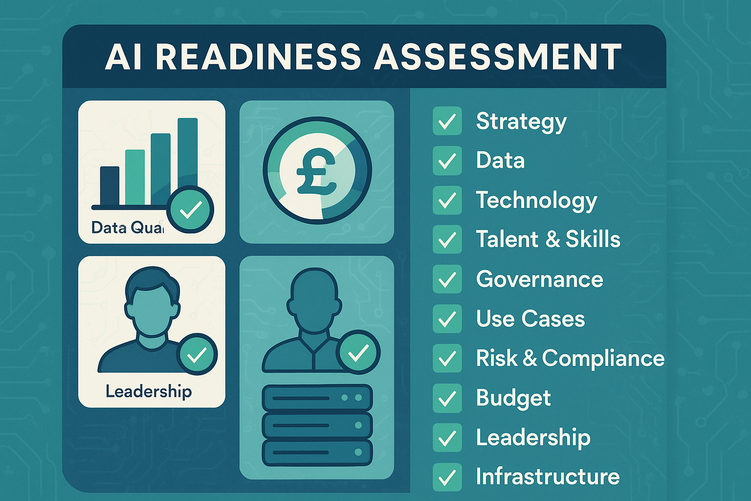
Your AI readiness assessment should address:
- Compliance with UK GDPR and data protection regulations
- Potential biases in your training data or algorithms
- Transparency and explainability of AI decisions
- Cybersecurity implications
- Impact on employees and customers
The UK government provides guidance on ethical AI deployment. Businesses that proactively address these concerns build trust with customers and avoid regulatory complications.
Question 8: Can My Current Technology Infrastructure Support AI?
AI systems often require robust computing power, cloud infrastructure, and integration with existing software. If your current technology stack is outdated or fragmented, AI implementation becomes significantly more challenging.
Assess your infrastructure across these areas:
- Computing resources and cloud capabilities
- Data storage and processing capacity
- Integration points with existing systems
- Network security and data access controls
Many UK businesses discover that infrastructure upgrades are necessary before AI deployment. Kaizen AI Consulting specialises in assessing technical readiness and developing pragmatic roadmaps that sequence infrastructure improvements with AI implementation for maximum efficiency.
Question 9: Do I Have a Plan for Scaling and Maintenance?
Successfully implementing a pilot AI project is only the beginning. For AI to deliver sustained value, you need strategies for scaling successful initiatives and maintaining systems over time.
Consider these questions:
- If the pilot succeeds, how will you expand it across the organisation?
- Who will monitor AI performance and address issues?
- How will you keep AI models updated as your business evolves?
- What happens if key personnel leave?
According to MIT Sloan Management Review, businesses with clear scaling strategies realise 40% more value from AI investments. Build these considerations into your planning from day one.
Question 10: Have I Explored Alternative Solutions?
Sometimes the answer to should I use AI is actually no, at least not yet. Before committing to AI, honestly evaluate whether simpler solutions might address your needs more effectively.
Alternative approaches might include:
- Process optimisation and workflow improvements
- Traditional automation tools without machine learning
- Additional staff or training
- Off-the-shelf software solutions
The goal is not to implement AI for its own sake, but to solve business problems effectively. Sometimes AI is the right answer; sometimes it is not. A thorough business AI evaluation considers all options objectively.
Making Your Final Decision
After working through these ten questions, you should have a clearer picture of AI suitability for your business. If you answered positively to most questions, you are likely ready to explore AI implementation. If several areas raised concerns, address those gaps before proceeding.
Remember that AI readiness is not binary. You might be ready for certain AI applications but not others. Start with manageable projects that address clear business needs, build capabilities gradually, and scale as you gain experience and confidence.
Taking the Next Steps
Determining whether AI is right for your business is just the first step. The implementation journey requires careful planning, expert guidance, and ongoing commitment.
If you have worked through this AI decision guide and believe your business is ready for AI, or if you need help clarifying any of these questions, Kaizen AI Consulting offers comprehensive AI readiness assessments tailored to UK businesses. Our team helps you identify high-value use cases, develop realistic implementation roadmaps, and navigate the technical and organisational challenges of AI adoption.
The AI revolution is here, and businesses that thoughtfully embrace it will gain significant competitive advantages. By asking yourself these ten critical questions, you are taking an important step towards making an informed decision that aligns with your business objectives, resources, and readiness. Whether you proceed with AI implementation now or decide to prepare your foundation first, this structured evaluation process ensures your decisions are strategic, not reactionary.
Do not let uncertainty hold you back. Contact Kaizen AI Consulting today to discuss your specific situation and explore how AI can transform your business in practical, measurable ways. Our expertise helps UK businesses move from curiosity to capability, ensuring your AI investments deliver genuine value.