How a Manchester Agency Transformed Client Results with Data Analytics
In the heart of Greater Manchester, a digital marketing agency faced a challenge familiar to many businesses today: how to demonstrate tangible value to clients in an increasingly competitive marketplace. The answer came not from flashier campaigns or bigger budgets, but from harnessing the power of data analytics to drive meaningful client results. This data analytics case study reveals how strategic implementation of analytics transformed not just individual campaigns, but the entire agency’s approach to client success.
According to Forbes, businesses that adopt data-driven decision-making are 23 times more likely to acquire customers and six times more likely to retain them. For this Manchester business, those statistics would soon become their reality.
The Challenge: Stagnant Growth and Client Retention Issues
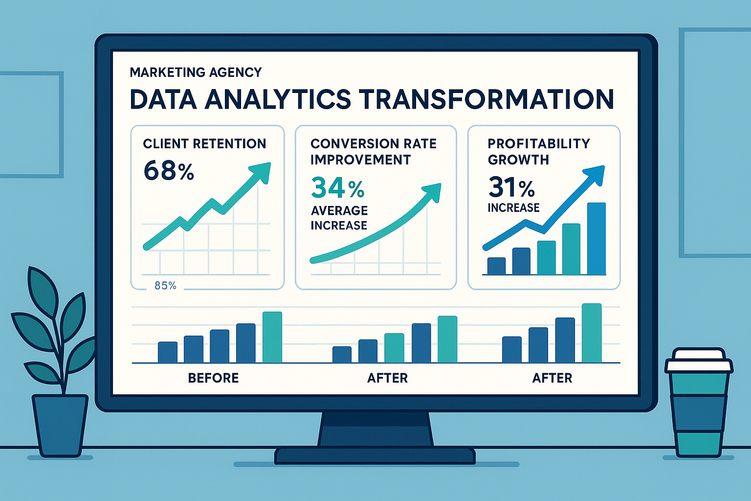
Like many marketing agencies in Manchester’s vibrant business ecosystem, the agency had built a solid reputation through creative campaigns and relationship management. However, by 2022, they encountered significant hurdles. Client retention rates had dropped to 68%, below the industry average of 75%, and new client acquisition had plateaued. Most concerning was the inability to clearly demonstrate return on investment across different client sectors.
The agency’s leadership recognised that gut feeling and creative intuition, whilst valuable, were no longer sufficient in a marketplace where McKinsey research shows that data-driven organisations are 19 times more likely to be profitable. They needed a fundamental shift in their approach, one that would place analytics at the core of their client delivery model.
The Analytics Transformation Journey
Phase One: Infrastructure and Data Collection
The first step involved implementing robust data collection systems across all client accounts. The agency invested in integrating Google Analytics 4, customer relationship management systems, and social media analytics platforms into a centralised dashboard. This infrastructure allowed them to track over 50 key performance indicators across different client industries, from e-commerce conversion rates to lead generation quality scores.
The implementation wasn’t without challenges. Data silos between platforms, inconsistent tracking parameters, and historical data gaps required three months of intensive work. However, this foundation proved essential for the analytics impact that would follow. For businesses looking to undertake similar transformations, partnering with specialists like Kaizen AI Consulting can accelerate this process significantly, leveraging AI-powered solutions to streamline data integration and analysis.
Phase Two: Team Training and Cultural Shift
Technology alone doesn’t create change; people do. The agency invested in comprehensive training for their 25-person team, ensuring everyone from account managers to creative designers understood how to interpret and apply data insights. They partnered with Manchester Metropolitan University’s Business School to develop a customised analytics training programme, resulting in a 40% improvement in data literacy scores across the team.
This cultural shift meant moving from campaign planning based primarily on creative ideas to a hybrid model where data insights informed creative direction. The change wasn’t always comfortable, but it proved transformational. As Harvard Business Review notes, organisations with strong data cultures see productivity improvements of 30-40%.
Phase Three: Client-Specific Analytics Frameworks
Rather than applying a one-size-fits-all approach, the agency developed bespoke analytics frameworks for each client sector. A retail client received real-time dashboards tracking customer journey touchpoints, basket abandonment rates, and seasonal purchasing patterns. A B2B professional services client gained insights into lead quality scoring, content engagement metrics, and sales cycle acceleration indicators.
This tailored approach to analytics implementation mirrors the methodology used by Kaizen AI Consulting’s consulting services, where industry-specific expertise ensures analytics solutions address unique business challenges rather than generic metrics.
The Results: Quantifiable Agency Success
Client Performance Improvements
Within 12 months of implementing their data-driven approach, the agency documented remarkable improvements across their client portfolio:
E-commerce Clients: Average conversion rates increased by 34%, with some clients seeing improvements of up to 58%. By analysing user behaviour flows and identifying friction points in the checkout process, the agency helped clients optimise their customer journey. Return on ad spend improved from an average of 3.2:1 to 5.7:1 across the e-commerce portfolio.
Lead Generation Clients: Cost per qualified lead decreased by 41% whilst lead quality scores (measured by sales team conversion rates) increased by 29%. The agency used predictive analytics to identify which content types, channels, and messaging resonated most effectively with each client’s target audience.
Brand Awareness Campaigns: By implementing proper attribution modelling, the agency demonstrated that brand campaigns were contributing to a 23% increase in direct and organic traffic for clients, a connection previously unmeasured. This data helped justify continued investment in upper-funnel activities.
Agency Business Impact
The analytics impact extended beyond client results to transform the agency’s own business metrics. Client retention rates improved from 68% to 87% within 18 months, significantly above the industry average. Annual client value increased by 52% as satisfied clients expanded their service packages, and the agency successfully attracted 15 new clients specifically seeking their data-driven approach.
Perhaps most notably, the agency’s average project profitability improved by 31%. By using data analytics to identify which services and client types delivered optimal returns, they could focus resources strategically and price services more accurately. According to Deloitte research, insight-driven businesses grow at an average of 30% annually, a benchmark this Manchester business was now exceeding.
Key Success Factors and Lessons Learned
Executive Commitment
The agency’s leadership didn’t simply mandate the use of analytics; they actively participated in training, regularly reviewed data insights, and allocated significant budget to technology and skills development. This top-down commitment proved essential for organisational buy-in.
Client Education and Transparency
Rather than hiding behind complex analytics jargon, the agency invested in educating clients about data interpretation. Monthly strategy sessions included data literacy components, helping clients understand not just what the numbers showed, but why they mattered and how to act on them. This transparency built trust and positioned the agency as true strategic partners rather than mere service providers.
Continuous Optimisation
The agency established a quarterly review process to assess which analytics approaches delivered the most value. They weren’t afraid to abandon metrics that looked impressive but didn’t drive actionable insights, focusing instead on the 20% of data points that explained 80% of performance variations.
Technology Integration
By connecting previously siloed data sources, the agency could identify cross-channel patterns invisible in isolated platform reports. For instance, they discovered that for one client, podcast advertising didn’t generate immediate conversions but increased branded search volume by 156% within two weeks, leading to higher-quality organic leads.
Applying These Insights to Your Manchester Business
This data analytics case study demonstrates that transformation doesn’t require unlimited budgets or massive teams. The Manchester agency began with 25 employees and a focused commitment to data-driven decision-making. However, they also recognised when to seek external expertise to accelerate their journey.
For businesses considering a similar transformation, several practical steps can initiate the process:
Audit Your Current Data Infrastructure: Identify what data you’re currently collecting, where gaps exist, and which systems aren’t communicating effectively. This baseline assessment provides the foundation for improvement.
Define Your Key Questions: Rather than collecting data for its own sake, identify the specific business questions you need to answer. Do you need to understand customer acquisition costs by channel? Identify your most profitable customer segments? Optimise your pricing strategy? Clear questions drive focused analytics implementation.
Invest in Skills Development: Whether through training existing team members or bringing in specialists, analytical capability must match technological capability. The gap between data collection and data-driven action is bridged by human expertise.
Start Small and Scale: The agency began with three pilot clients before rolling out their analytics framework across the entire portfolio. This approach allowed them to refine their methodology and demonstrate value before broader implementation.
The Future of Analytics-Driven Agency Success
The Manchester agency’s journey didn’t end with initial success. They’ve continued evolving their approach, incorporating artificial intelligence and machine learning to identify patterns human analysis might miss. Predictive analytics now help them forecast campaign performance and proactively adjust strategies before problems emerge.
According to Gartner, marketing analytics spending is expected to grow by 15% annually through 2025, reflecting broader industry recognition of its critical importance. Businesses that establish strong analytics foundations now will be positioned to capitalise on emerging capabilities in AI-powered analysis, automated optimisation, and predictive customer modelling.
Taking the Next Step Towards Data-Driven Success
The transformation achieved by this Manchester business demonstrates that data analytics isn’t just for global corporations with unlimited resources. Medium-sized agencies and businesses across the UK can leverage analytics to drive meaningful improvements in client results and business performance.
However, the journey requires strategic planning, appropriate technology investment, and often, expert guidance to navigate complexity and avoid costly missteps. The difference between successful analytics implementation and expensive failed projects often comes down to having experienced partners who understand both the technical requirements and the strategic business context.
If your business is ready to harness the power of data analytics to transform client results and drive agency success, Kaizen AI Consulting can help you develop and implement a tailored analytics strategy that delivers measurable impact. Our team specialises in helping UK businesses leverage AI and analytics to achieve breakthrough results, combining technical expertise with practical business understanding.
The data analytics case study outlined above isn’t an isolated success story; it’s a roadmap that forward-thinking businesses across Manchester and the UK are following. The question isn’t whether data-driven approaches will define future agency success, but whether your business will lead or follow in this transformation.
Contact Kaizen AI Consulting today to discuss how we can help your business achieve similar results through strategic data analytics implementation. Your journey to data-driven success begins with a single conversation.