Multi-Agent AI Systems: The Next Evolution for Business Automation
If 2025 was the year AI agents arrived in the enterprise, 2026 is the year they learned to work together. Multi-agent AI systems are rapidly moving from experimental pilots to production-ready deployments, and UK businesses that understand this shift stand to gain a significant competitive advantage. From streamlining complex back-office workflows to orchestrating real-time customer service pipelines, the age of coordinated, intelligent automation is no longer on the horizon – it is already here.
What Are Multi-Agent AI Systems?
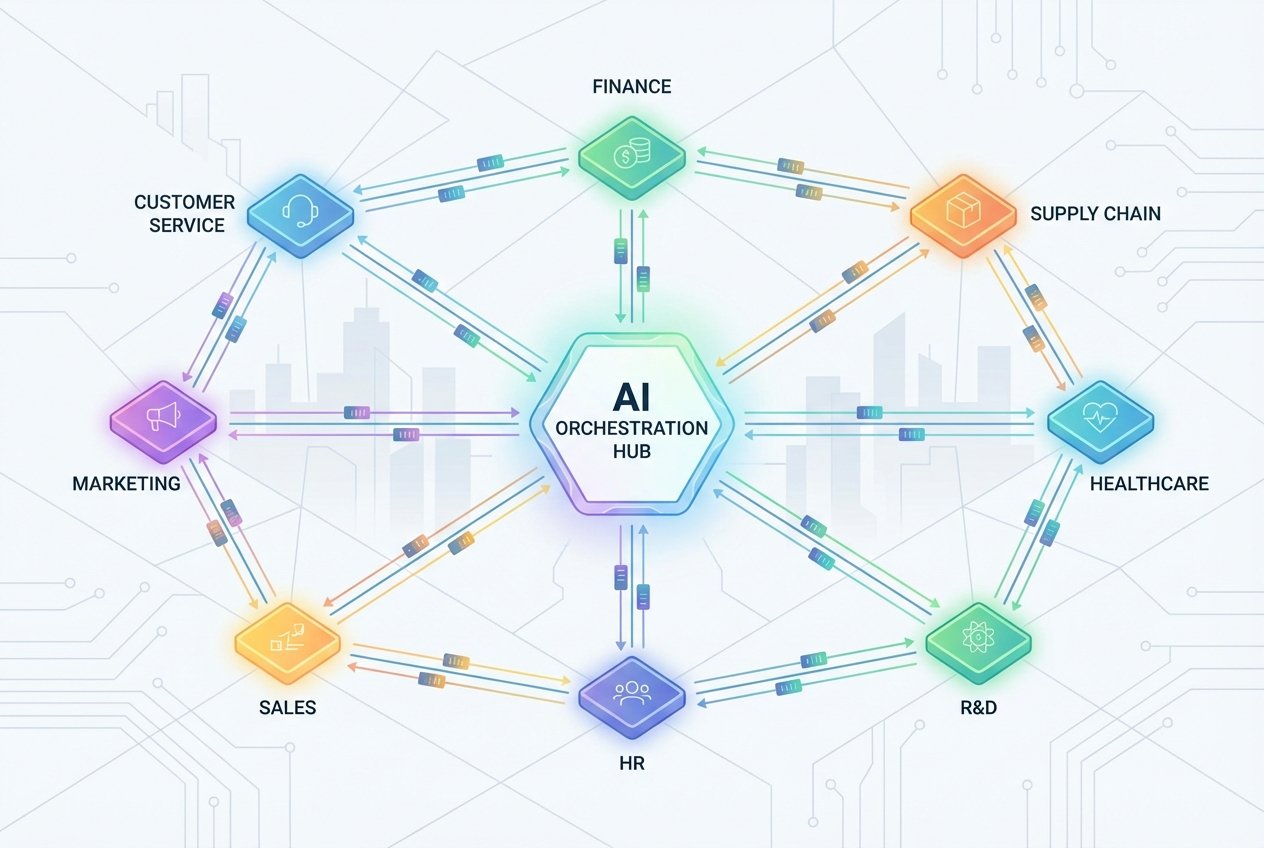
A multi-agent AI system is an architecture in which multiple specialised AI agents, each with defined roles, tools, and permissions, work collaboratively to accomplish complex goals that a single AI model simply cannot handle alone. Rather than relying on one general-purpose model to do everything, these systems divide tasks intelligently – assigning a planning agent, a research agent, an execution agent, and a quality-checking agent to work in parallel or in sequence, all coordinated by a central AI orchestration layer.
According to Airia (April 2026), multi-agent AI architectures enable businesses to break down sophisticated, multi-step processes into modular, manageable tasks – reducing what once took days into operations completed in minutes. This is the foundational principle of agent systems in business: specialisation at scale, coordinated intelligently.
Why 2026 Is the Defining Year for Enterprise Adoption
Industry analysts and technology leaders are in broad agreement: 2026 marks a structural reset in how enterprises approach automation. As the Economic Times CIO (April 2026) reports, organisations are shifting from isolated AI tools to coordinated multi-agent networks capable of handling end-to-end workflows across CRM, ERP, and customer support systems simultaneously.
The scale of adoption is striking. Enterprise uptake of multi-agent systems surged by 327% in less than four months during 2025, according to Instinctools research. Globally, 78% of companies used AI in at least one business function in 2025, with 62% actively experimenting with AI agents. In the UK, the picture is equally compelling: the British Chambers of Commerce (March 2026) found that 54% of UK firms are now actively using AI, up from just 35% in 2025 and 25% in 2024 – a trajectory that shows no sign of slowing.
For UK SMEs and mid-market businesses, the question is no longer whether to adopt advanced automation powered by multi-agent AI, but how to do so effectively and at the right pace.
How AI Orchestration Powers Multi-Agent Systems
At the heart of every effective multi-agent deployment is AI orchestration – the process of coordinating multiple AI agents within a unified system to achieve shared objectives efficiently. As IBM defines it, an orchestrator evaluates task roadmaps, manages role-based access, enables memory sharing between agents, and handles both parallel and sequential execution – whilst resolving conflicts and maintaining governance standards.
Think of AI orchestration as the conductor of an orchestra. Each agent is a skilled musician, highly proficient in their instrument. Without a conductor, the music becomes noise. With one, the combined performance becomes something far greater than the sum of its parts. In business terms, this means a single customer query could simultaneously trigger an inventory check, a personalised response draft, a CRM update, and a refund authorisation – all handled by specialised agents working in concert, in real time.
Appsterk Corp (February 2026) notes that multi-agent orchestration enables 56% of organisations using such frameworks to achieve measurable scalability gains, reducing bottlenecks that once plagued single-model deployments.
Real-World Applications Across Business Functions
One of the most compelling aspects of multi-agent AI is its versatility. These systems are being deployed across a remarkably broad range of industries and functions:
Customer Service and Experience
In customer-facing roles, multi-agent architectures allow one agent to handle inventory queries, another to process refunds, and a third to personalise responses based on purchase history – all within a single conversation. The result is faster resolution times and significantly higher customer satisfaction, without the need to scale human headcount proportionally.
Finance and Risk Management
Financial services firms are deploying agent systems for real-time fraud detection, automated auditing, and compliance monitoring. Agents can simultaneously cross-reference transaction data, check regulatory requirements, and flag anomalies – tasks that would previously require multiple human analysts working in shifts.
Supply Chain and Operations
In logistics and manufacturing, multi-agent AI is transforming demand forecasting and procurement. According to Prelude Solutions (January 2026), citing Gartner analysis, demand signals can trigger inventory adjustments whilst simultaneously factoring in financial constraints, supplier lead times, and compliance requirements – all orchestrated autonomously.
Sales and Marketing
Marketing teams are leveraging agent systems to conduct competitive analysis, identify market opportunities, generate qualified leads, and synchronise data across CRM, CMS, and analytics platforms – compressing what was once a multi-day campaign planning process into hours.
Healthcare Administration
Notably, AI scribing and patient administration agents are reported to save practices in excess of $1 million per year (Druid AI, 2026) by reducing physician administrative burden – a figure that translates powerfully into the NHS and private healthcare context here in the UK.
The Architecture Behind Scalable Agent Systems
Building a reliable agent system for business at scale requires more than connecting a handful of AI models. Effective multi-agent architectures share several key characteristics, as outlined by leading enterprise AI practitioners:
- Specialisation: Each agent is purpose-built for a specific domain or task, improving accuracy and reducing hallucination risks.
- Shared memory and context: Agents can access and update a common knowledge base, ensuring continuity and coherence across complex, multi-step tasks.
- Fault tolerance: If one agent encounters an error, the orchestration layer can redistribute its workload to another, maintaining operational continuity.
- Human-in-the-loop protocols: For high-stakes decisions – particularly in regulated industries such as finance, legal, or healthcare – escalation to a human reviewer is built into the workflow.
- Governance and security: Role-based access controls and zero-trust security models protect sensitive data as agents interact across systems.
At Kaizen AI Consulting, our team specialises in designing and implementing precisely this kind of robust, scalable multi-agent architecture for UK businesses – tailoring the right orchestration strategy to your existing technology stack, regulatory environment, and operational objectives. Whether you are exploring your first agentic AI deployment or looking to scale a pilot into a full production system, our consultants can guide you through every stage of the journey.
Key Challenges to Be Aware Of
Whilst the opportunities are significant, honest advice demands acknowledging the challenges. Industry research warns that over 40% of agentic AI projects are expected to be cancelled by 2027 due to difficulties scaling beyond initial pilots. The most common pitfalls include:
- Governance gaps: Without clear oversight frameworks, agent interactions can create exponential complexity that is difficult to audit or control.
- Integration complexity: Connecting agents to legacy systems, third-party APIs, and proprietary databases requires careful architectural planning.
- Workforce readiness: Staff need to understand how to work alongside autonomous agents, and change management is often underestimated.
- Interoperability standards: Emerging protocols such as MCP, A2A, and AG-UI are still maturing, and technology choices made today can create lock-in risks tomorrow.
Understanding these challenges upfront is essential for UK businesses seeking to move beyond experimentation into sustained, commercially valuable advanced automation.
What Gartner and Industry Analysts Are Predicting
The strategic outlook for multi-agent AI is compelling. Gartner predicts that by 2027, 70% of multi-agent systems will feature narrowly specialised agents to improve accuracy and reliability. By 2028, 15% of all daily business decisions will be automated by AI agents, and 70% of customers will interact with businesses primarily through conversational AI interfaces. These are not distant horizons – they are business planning realities that UK organisations need to be preparing for today.
The UK Government’s own AI Adoption Research (February 2026) reinforces the commercial case: 75% of businesses using AI reported improved workforce productivity, and 57% reported the development of new or improved processes and operations. The productivity dividend from well-implemented multi-agent AI is no longer theoretical – it is being realised by UK businesses right now.
Getting Started: A Practical Roadmap for UK Businesses
For business leaders looking to harness multi-agent AI and advanced automation, the path forward does not require a full-scale transformation overnight. A phased, value-driven approach is almost always more effective:
- Audit your current processes: Identify the workflows with the highest complexity, repetition, and cross-functional dependency – these are the prime candidates for multi-agent deployment.
- Define clear success metrics: Whether it is cost reduction, speed to resolution, error rate, or customer satisfaction, establish measurable benchmarks before you begin.
- Start with a scoped pilot: Select one business function and build a proof of concept. Validate the architecture, test governance controls, and demonstrate ROI before scaling.
- Invest in change management: Bring your teams along on the journey. The most technically advanced agent system will underperform if the humans working alongside it are not equipped to use it effectively.
- Scale with confidence: Once your pilot proves value, use the learnings to roll out across additional functions, with governance and monitoring frameworks already in place.
If you would like expert guidance on any of these steps, the team at Kaizen AI Consulting is ready to help. From initial AI readiness assessments through to full multi-agent system design and implementation, we work with UK businesses of all sizes to make intelligent automation commercially viable, practically achievable, and strategically sound. Get in touch today to explore how a tailored multi-agent AI strategy could transform your operations.
The Competitive Imperative
Perhaps the most important insight from the research is this: the gap between AI leaders and AI laggards is widening. As Beam AI (March 2026) observes, the future of AI lies in collaborative systems where multiple specialised agents work together to solve complex problems – and the businesses building that capability today are establishing durable advantages that will be increasingly difficult for competitors to close.
For UK businesses navigating this landscape, the question is not whether multi-agent AI will reshape your industry. It will. The question is whether your organisation will be among those shaping what that future looks like, or responding to it after the fact. The tools, the talent, and the strategic frameworks are available right now – and with the right guidance, the transition from single-model experimentation to truly intelligent, orchestrated advanced automation is entirely within reach.
Looking to explore what multi-agent AI could mean for your business? Read more about our approach on the Kaizen AI Consulting blog or speak to our team for a no-obligation consultation.