The AI Bubble: What Small Businesses Should Know About AI Investment
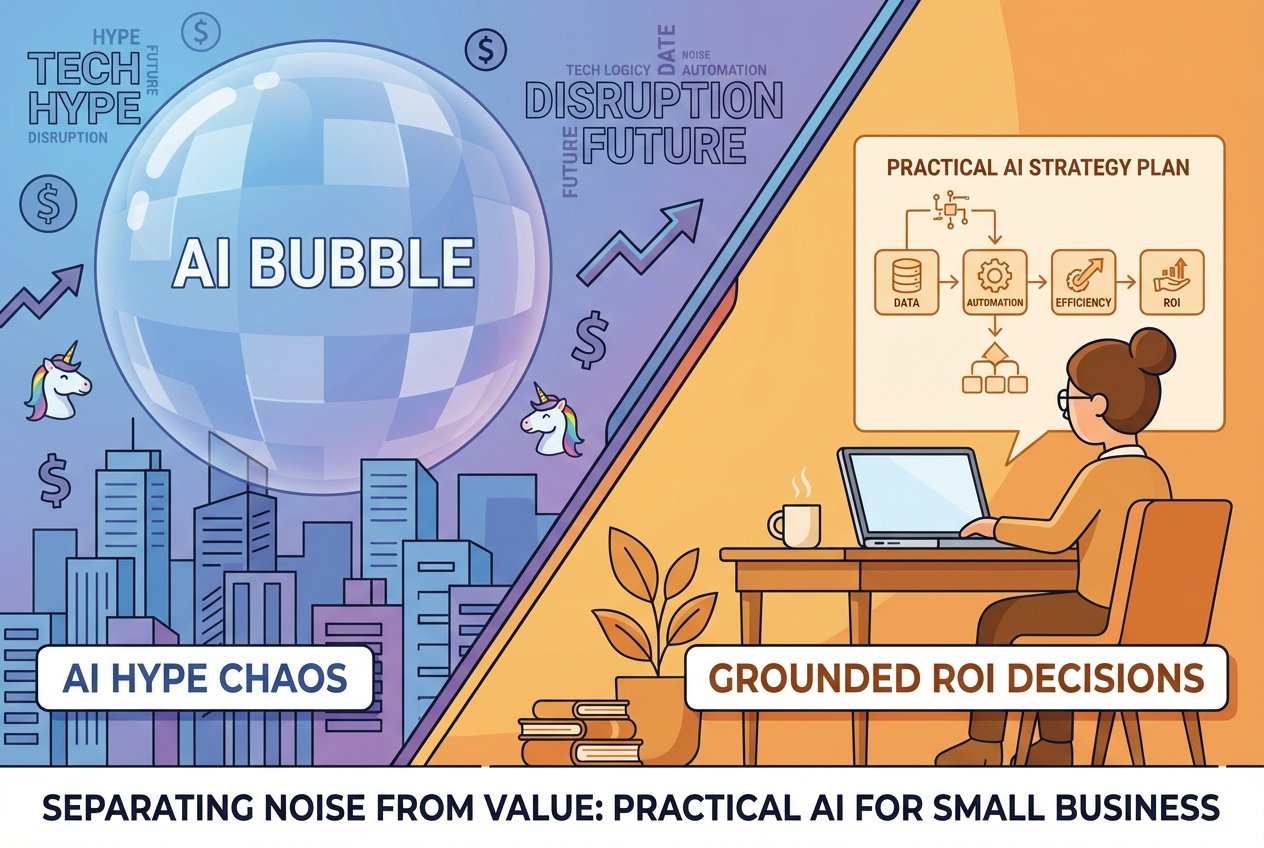
Artificial intelligence is everywhere right now. From boardroom strategy sessions to social media adverts, the promise of AI-powered transformation is being sold to businesses of every size. But beneath the headlines and the hype, a more complicated picture is emerging. The term AI bubble is no longer reserved for economists and financial analysts. It is a conversation that every small business owner in the UK needs to be having before committing budget, time, and resources to AI investment.
This guide cuts through the noise to give you a grounded, honest assessment of where the AI market truly stands in 2026, what the risks are for smaller businesses, and how to invest in AI technology in a way that delivers genuine, measurable value.
Understanding the AI Bubble: Is It Real?
The short answer is: it depends on who you ask, and which part of the AI market you are looking at. According to a Fortune analysis published in March 2026, one layer of the AI bubble has arguably already deflated. Big Tech price-to-earnings ratios fell sharply through late 2025, and AI stock valuations corrected significantly from their peaks. Capital Economics analyst John Higgins described this as the AI stock bubble having largely burst by October 2025.
Yet another phase of AI investment is still expanding. As of autumn 2025, there were 498 AI unicorn companies carrying a combined valuation of $2.7 trillion, according to CB Insights data. OpenAI alone reached a valuation of $730 billion in early 2026, up from $500 billion just months prior. The Magnificent Seven technology stocks (Apple, Amazon, Alphabet, Meta, Microsoft, Nvidia, and Tesla) collectively exceeded $21 trillion in value, representing approximately 40% of the entire S&P 500 index.
Meanwhile, global AI capital expenditure is projected at $539 billion in 2026, with US mega-cap technology firms planning to spend $1.1 trillion on AI infrastructure between 2026 and 2029. These are staggering numbers, and they raise a critical question for small business owners: does any of this actually translate into practical, affordable, return-generating AI tools for businesses like yours?
The ROI Reality: Why Most AI Projects Fail
Here is the statistic that no AI vendor wants you to see prominently on their landing page. According to a landmark report from MIT, 95% of generative AI pilots fail to deliver measurable impact on profit and loss. A separate study cited by the University of Queensland Business School puts the broader AI and data science project failure rate at 80%.
The reasons are consistent across industries and business sizes:
- Unrealistic expectations: Many businesses begin with vague goals such as “we need AI” without defining the specific problem they want to solve or the metric they want to move.
- Poor data infrastructure: AI tools are only as good as the data they are trained on. Many small businesses have siloed, inconsistent, or insufficient data to power meaningful AI outputs.
- The expertise gap: Building or customising AI internally requires machine learning, data engineering, and MLOps skills that most SMEs simply do not have in-house.
- Low adoption: Even when AI tools are deployed, employee resistance, poor training, and unclear workflows mean many tools go unused or underused.
- Build versus buy decisions: Research suggests in-house AI builds succeed only around 33% of the time, compared to a roughly 67% success rate when working with specialist vendors and consultants.
Perhaps most strikingly, a Business Insider analysis from December 2025 highlighted that economist Ruchir Sharma identified four critical warning signs present in the current AI investment environment: overinvestment, overvaluation, over-ownership, and over-leverage. These are macro-level signals, but they have very real downstream consequences for small businesses that rush into AI investment without a clear strategy.
What Is the UK Government Doing About AI?
It is worth noting that the UK government is making significant commitments to AI, and some of these create genuine opportunities for small businesses. The 2025 Spending Review allocated £2 billion for the AI Opportunities Action Plan, and the government’s R&D spending is set to grow from £20.4 billion in 2025-26 to over £22.6 billion annually by 2029-30, according to GOV.UK.
The UK AI sector generated £23.9 billion in revenue and contributed £11.8 billion in gross value according to the government’s most recent AI sector study. High-profile private investment is also flowing in, with Microsoft pledging £22 billion for supercomputer infrastructure and Nvidia committing £11 billion to establish AI factories in the UK.
For small businesses specifically, Innovate UK’s BridgeAI programme offers access to funding of up to £200,000, tailored guidance, and sector-specific expertise. Five designated AI Growth Zones across Great Britain have already generated £28.2 billion in investment and created over 15,000 jobs. The government has also committed to upskilling 10 million workers by 2030 through its technology skills strategy.
These are genuinely promising signals. But government investment and private sector infrastructure spending do not automatically translate into business-level ROI. The gap between macro AI investment and ground-level commercial outcomes is precisely where small businesses need to focus their attention.
The Four Signs You Might Be Falling for AI Hype
When evaluating any AI tool or platform, watch for these warning signs that suggest you might be spending money on hype rather than genuine value:
1. Vague Value Propositions
If an AI vendor cannot clearly articulate how their tool will improve a specific, measurable outcome for your business within a defined timeframe, treat that as a red flag. Genuine AI solutions solve specific, well-scoped problems. Generic promises of “transformation” and “efficiency” without numbers attached are hallmarks of hype-driven selling.
2. No Integration with Your Existing Data
AI that cannot be trained on, or integrated with, your existing customer data, sales records, or operational systems will deliver generic outputs at best. The best AI tools for small businesses are those that learn from your specific context, not just from publicly available information.
3. High Upfront Cost Without a Pilot Phase
Any credible AI implementation for an SME should begin with a scoped pilot phase that allows you to test outcomes before committing significant budget. If a provider is pushing you toward a large annual contract before demonstrating results, the risk-reward balance is working against you.
4. No Clear Adoption Plan
Technology without adoption is just an expense. If a proposed AI solution does not come with a clear plan for employee training, workflow integration, and usage monitoring, it is likely to join the 80-95% of AI projects that fail to deliver.
Where AI Genuinely Delivers for UK Small Businesses
The good news is that AI does work, and it works exceptionally well when applied to the right problems with the right approach. For UK SMEs, the highest-ROI AI applications tend to cluster around four core areas:
- Back-office automation: Automating repetitive administrative tasks such as invoicing, data entry, appointment scheduling, and compliance reporting consistently delivers measurable cost savings and time efficiencies. This is the area where AI-generated ROI is most consistent and most quickly realised.
- Customer service and engagement: AI-powered chatbots and automated response tools, when properly trained on your specific products and services, can handle a significant volume of customer queries around the clock, improving satisfaction while reducing support costs.
- Marketing personalisation: AI tools that analyse customer behaviour and automate personalised email sequences, ad targeting, or content recommendations can meaningfully improve conversion rates for businesses with an established digital presence.
- Data analysis and forecasting: For businesses sitting on underutilised data, AI-powered analytics tools can surface insights about customer behaviour, inventory patterns, and revenue forecasting that previously required expensive human analysis.
The common thread across all successful AI applications is specificity. Businesses that start with a clearly defined problem, a measurable success metric, and a realistic timeline are dramatically more likely to see returns on their AI investment. This is not a coincidence; it is a reflection of how AI technology actually works when deployed responsibly.
At Kaizen AI Consulting, we work directly with UK small businesses to cut through the AI noise and identify the specific use cases and tools that align with genuine business objectives. Rather than advocating for AI adoption as a blanket strategy, our approach begins with your business goals and works backwards to identify where AI can meaningfully contribute, and where it simply is not the right tool for the job.
How to Approach AI Investment Strategically in 2026
Given the current AI market reality, here is a practical framework for small business owners considering AI investment in 2026:
Start with the problem, not the technology
Define the specific operational, customer, or financial problem you want to solve. Quantify its current cost, in time, money, or missed opportunity. This becomes your benchmark for evaluating whether any AI solution is worth the investment.
Demand a proof of concept
Before committing to any significant AI spend, insist on a structured pilot with clear KPIs, a defined timeline, and agreed success criteria. A reputable provider will welcome this approach.
Assess your data readiness
Audit the quality, consistency, and accessibility of the data your business holds. AI tools will only be as effective as the data they can access. If your data is scattered, inconsistent, or incomplete, investment in data infrastructure should precede investment in AI tools.
Budget for adoption, not just implementation
Reserve a meaningful portion of your AI budget for training, change management, and ongoing optimisation. The implementation is rarely where AI projects fail; it is the adoption phase that determines whether the investment pays off.
Explore available UK funding
Before spending your own capital, investigate whether your business qualifies for Innovate UK’s BridgeAI programme or other government-backed AI adoption schemes. Grant funding exists specifically to help SMEs explore and adopt AI responsibly.
The Bottom Line on the AI Bubble
The AI bubble is real at the macro level, characterised by extraordinary valuations, unprecedented capital expenditure, and a significant gap between investment activity and broad-based commercial returns. But this does not mean AI is without value for small businesses. It means that undisciplined, hype-driven AI investment carries real risks, while targeted, well-governed AI adoption can deliver genuine competitive advantage.
The businesses that will come out ahead are not the ones that invested the most in AI. They are the ones that invested most thoughtfully. As the technology trends cycle continues and the dust settles around which AI tools and platforms genuinely deliver, the competitive advantage will belong to those who approached AI strategically from the start.
If you are a UK small business owner navigating these decisions, you do not have to figure it out alone. The team at Kaizen AI Consulting specialises in helping businesses like yours cut through the complexity of AI adoption, identify genuine opportunities, and build AI strategies grounded in real commercial outcomes. Get in touch today to find out how we can help your business make smart, evidence-led decisions about AI investment, without the hype.
For further reading on how to position your business for growth in an AI-driven landscape, explore our insights on building a successful business from startup to scale.