
How a UK Online Store Cut Customer Service Costs by 50% with AI
In the competitive landscape of UK e-commerce, rising operational costs pose a significant challenge for online retailers. Customer service departments, whilst essential for maintaining satisfaction and loyalty, often represent one of the largest overhead expenses. However, a growing number of forward-thinking UK businesses are discovering that customer service AI can dramatically reduce costs whilst simultaneously improving service quality.
One mid-sized UK fashion retailer recently achieved remarkable results by implementing intelligent automation: a 50% reduction in customer service costs within just six months. This case study demonstrates how strategic AI implementation can transform e-commerce operations and deliver substantial e-commerce cost reduction without compromising customer experience.
The Rising Cost Challenge in UK E-Commerce
According to recent retail industry research, UK online retailers spend an average of £8-12 per customer service interaction when factoring in staff salaries, training, infrastructure, and management overhead. With typical e-commerce businesses handling thousands of enquiries monthly, these costs accumulate rapidly.
The situation has intensified post-pandemic, with ONS data showing that online retail now accounts for over 27% of all UK retail sales. This growth brings increased customer service demands across multiple channels including email, live chat, social media, and telephone support. Traditional customer service models struggle to scale efficiently, leading many businesses to explore support automation as a viable solution.
Understanding the 50% Cost Reduction: A Real-World Case Study
The UK fashion retailer at the centre of this transformation, a Leeds-based company with annual turnover of £4.5 million, faced mounting pressure from customer service expenses consuming 18% of revenue. Their seven-person support team handled approximately 2,400 enquiries monthly, with response times averaging 6-8 hours during peak periods.
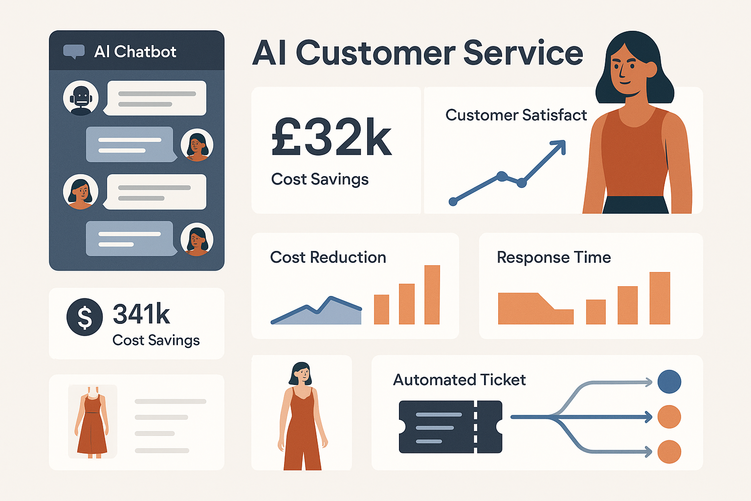
By implementing a comprehensive online retail automation strategy focused on intelligent chatbots, automated email responses, and AI-powered ticket routing, they achieved transformative results within six months. The implementation reduced their support team from seven to four staff members whilst simultaneously improving average response time to under 2 hours and increasing customer satisfaction scores by 23%.
Key Areas Where AI Delivered Cost Savings
The cost savings AI generated came from several strategic implementation areas that any UK e-commerce business can replicate.
Automated Response to Repetitive Enquiries
Analysis revealed that 67% of customer enquiries fell into just eight categories: order tracking, returns process, sizing questions, delivery timeframes, stock availability, payment issues, discount codes, and account access. AI chatbots now handle these routine questions instantly, 24/7, without human intervention. This single change eliminated approximately 1,600 monthly interactions requiring human attention, representing a direct labour cost saving of £12,800 monthly.
Intelligent Ticket Routing and Prioritisation
Before automation, customer service representatives spent significant time reviewing and categorising incoming enquiries. The new AI system automatically analyses enquiry content, assigns priority levels, and routes complex issues to the most appropriate team member based on expertise and workload. This innovation reduced average handling time per complex enquiry by 35%, allowing remaining staff to manage higher volumes more efficiently.
Proactive Customer Communication
The retailer implemented automated updates for order status, dispatch notifications, and delivery confirmations, significantly reducing “where is my order” enquiries which previously accounted for 28% of all customer contact. These proactive communications not only reduce support volume but enhance customer experience by providing information before it is requested.
Measuring Return on Investment
The financial impact of this e-commerce cost reduction initiative extended beyond simple headcount reduction. Total implementation costs, including software licensing, integration, and training, amounted to £24,000. Monthly savings of £16,200 delivered full ROI within 90 days, with ongoing annual savings projected at £194,400.
However, the benefits extended beyond direct cost savings. Customer satisfaction scores increased from 72% to 88%, repeat purchase rates improved by 15%, and negative reviews related to customer service declined by 64%. These improvements demonstrate that properly implemented customer service AI enhances rather than diminishes the customer experience.
Critical Success Factors for UK Retailers
Not all AI implementations achieve these impressive results. The case study revealed several critical factors that determined success.
Comprehensive Data Analysis Before Implementation
The retailer invested three weeks analysing historical customer service data to identify patterns, common questions, and bottlenecks. This analysis informed which processes to automate first, ensuring maximum impact. Many businesses rush into AI implementation without this crucial groundwork, leading to disappointing results.
Maintaining the Human Touch Where It Matters
Rather than replacing all human interaction, the strategy focused on freeing customer service representatives from repetitive tasks so they could concentrate on complex issues requiring empathy, judgement, and problem-solving skills. Complaints, refund requests, and sensitive issues still receive immediate human attention, preserving the personal touch that builds customer loyalty.
Continuous Learning and Optimisation
The AI systems implemented utilise machine learning to continuously improve response accuracy and effectiveness. Monthly reviews of chatbot interactions identify gaps in knowledge bases, allowing refinement of automated responses. This ongoing optimisation ensures the system becomes more effective over time rather than stagnating.
How Kaizen AI Consulting Facilitates This Transformation
Implementing effective support automation requires careful planning, appropriate technology selection, and seamless integration with existing e-commerce platforms. This is where Kaizen AI Consulting provides invaluable expertise to UK online retailers seeking similar transformations.
Our approach begins with comprehensive analysis of your current customer service operations, identifying specific opportunities for automation that align with your business objectives. We then develop tailored implementation roadmaps that prioritise quick wins whilst building towards comprehensive online retail automation. Throughout the process, we ensure your team receives thorough training and ongoing support to maximise the benefits of new AI systems.
Overcoming Common Implementation Challenges
UK retailers considering AI implementation often express concerns about technical complexity, integration with existing systems, and customer acceptance of automated service. These challenges are valid but entirely manageable with proper planning and expertise.
Integration with E-Commerce Platforms
Modern customer service AI solutions integrate seamlessly with popular UK e-commerce platforms including Shopify, WooCommerce, Magento, and BigCommerce. API connections enable real-time access to order information, inventory data, and customer history, allowing AI systems to provide accurate, personalised responses without requiring separate data management.
Customer Acceptance and Trust
Initial concerns about customer resistance to chatbots proved largely unfounded. Research from Which? consumer research indicates that 73% of UK online shoppers prefer instant automated responses for simple queries over waiting for human assistance. The key is transparency, clearly indicating when customers are interacting with AI whilst ensuring effortless escalation to human agents when needed.
Staff Training and Change Management
Successful implementations address team concerns proactively, positioning automation as a tool that enhances rather than threatens jobs. The Leeds retailer involved their customer service team throughout implementation, demonstrating how AI would eliminate frustrating repetitive tasks and allow them to focus on more rewarding, complex customer interactions. This approach transformed potential resistance into enthusiastic adoption.
Practical Steps to Get Started
UK online retailers can begin their journey towards significant cost savings AI by following a structured approach that minimises risk whilst building momentum.
Audit Your Current Customer Service Operations
Document the volume, type, and handling time for all customer enquiries over a three-month period. Identify which questions repeat most frequently and which take longest to resolve. This baseline data proves essential for measuring improvement and prioritising automation opportunities.
Start with a Focused Pilot Project
Rather than attempting comprehensive transformation immediately, begin with one high-volume, low-complexity enquiry category. Order tracking represents an ideal starting point for most retailers, offering substantial volume reduction with straightforward automation. Success here builds confidence and demonstrates value, facilitating broader implementation.
Select Appropriate Technology Partners
Numerous customer service AI platforms serve UK e-commerce businesses, each with different strengths, pricing models, and integration capabilities. Evaluation should consider factors including UK data protection compliance, scalability, multilingual support, and integration with your specific e-commerce platform. Expert guidance during this selection process prevents costly mistakes and ensures optimal fit for your requirements.
Looking Beyond Cost Reduction
Whilst the 50% cost reduction achieved by this UK retailer represents compelling justification for AI implementation, the strategic benefits extend considerably further. Enhanced customer service capabilities enable extended trading hours without proportional cost increases, supporting international expansion into different time zones. Data gathered through AI interactions provides valuable insights into customer needs, pain points, and preferences, informing product development and marketing strategies.
Additionally, improved response times and service consistency strengthen brand reputation in an increasingly competitive marketplace where customer experience often determines purchase decisions. UK Finance research indicates that 86% of consumers will pay more for superior customer service, making service excellence a significant competitive differentiator beyond mere cost consideration.
Take the Next Step Towards E-Commerce Cost Reduction
The transformation achieved by this Leeds-based fashion retailer demonstrates that significant e-commerce cost reduction through customer service AI is not merely theoretical but practically achievable for UK online businesses of all sizes. The combination of reduced operational costs, improved customer satisfaction, and enhanced scalability positions AI implementation as a strategic imperative rather than an optional enhancement.
If your UK online retail business is struggling with escalating customer service costs or seeking to improve service quality whilst managing expenses, now is the ideal time to explore how support automation can transform your operations. The business case for action strengthens as AI technology becomes more accessible, affordable, and proven through real-world success stories like this one.
Ready to discover how your e-commerce business could achieve similar cost reductions and service improvements? Contact Kaizen AI Consulting today for a complimentary consultation. Our team will analyse your specific customer service challenges and develop a tailored roadmap showing exactly how AI implementation could reduce your costs whilst enhancing customer satisfaction. Do not let competitors gain the advantage whilst you delay – take the first step towards transformation today.