How to Choose the Right AI Tool for Your Business Needs
The artificial intelligence market is experiencing unprecedented growth, with UK businesses investing over £1.3 billion in AI technologies in recent years. Yet despite this enthusiasm, many organisations struggle with AI tool selection, often investing in solutions that don’t align with their actual business requirements. Choosing AI software isn’t just about picking the most advanced technology; it’s about finding the right fit for your organisation’s unique challenges, goals, and capabilities.
This comprehensive guide will walk you through the essential considerations for making informed decisions about business AI tools, helping you avoid costly mistakes and maximise your return on investment.
Understanding Your Business Requirements
Define Your Specific Use Case
Before diving into AI vendor comparison, you must clearly articulate the problem you’re trying to solve. According to McKinsey research, 70% of AI projects fail due to unclear objectives and misaligned expectations. Are you looking to automate customer service responses, enhance data analysis capabilities, improve marketing personalisation, or streamline operational processes?
Document specific pain points, quantify the impact of current inefficiencies, and establish measurable success criteria. For instance, if you’re implementing a chatbot, define targets such as reducing customer service response times by 40% or handling 60% of routine enquiries automatically.
Assess Your Current Infrastructure
Your existing technology stack plays a crucial role in AI decision making. Evaluate your current systems, data storage capabilities, and integration requirements. Does your organisation use cloud-based or on-premises solutions? What customer relationship management (CRM) or enterprise resource planning (ERP) systems need to integrate with your new AI tool?
Understanding these technical parameters early prevents costly integration challenges later. Many UK businesses discover that legacy systems require significant upgrades before AI implementation becomes feasible.
Key Factors in AI Tool Selection
Scalability and Future-Proofing
The AI tool you choose today should grow with your business tomorrow. According to Gartner projections, over 80% of enterprises will use generative AI applications by 2026. Select business AI tools that offer flexible pricing models, can handle increasing data volumes, and regularly release updates to incorporate emerging AI capabilities.
Consider whether the solution offers modular functionality that allows you to start small and expand features as your needs evolve. This approach minimises initial investment whilst providing a clear growth pathway.
Data Security and Compliance
In the UK, data protection isn’t optional. Your AI solution must comply with UK GDPR regulations, and depending on your industry, additional requirements like FCA regulations for financial services or NHS Digital standards for healthcare organisations.
When choosing AI software, verify that vendors provide transparent data handling policies, offer data residency options within the UK or EU, and maintain relevant certifications such as ISO 27001 or Cyber Essentials Plus. Question where your data will be processed, how it’s encrypted, and what happens if you decide to switch providers.
Integration Capabilities
Seamless integration with your existing systems is non-negotiable. The best AI tools offer robust APIs, pre-built connectors for popular business applications, and comprehensive documentation for technical teams.
According to research from Salesforce, organisations using integrated technology stacks see 25% higher productivity rates. Evaluate whether the AI solution supports the integration methods your team can realistically implement and maintain.
Conducting Effective AI Vendor Comparison
Evaluate Vendor Credibility and Support
The AI landscape includes established technology giants and innovative startups. Both offer advantages, but your AI vendor comparison should assess long-term viability, customer support quality, and industry expertise.
Review case studies from similar organisations, check customer testimonials, and request references. How responsive is their support team? Do they offer dedicated account management? What training resources and onboarding assistance do they provide?
For UK businesses, consider vendors with local presence and support teams operating in compatible time zones. This seemingly minor detail significantly impacts implementation success and ongoing satisfaction.
Request Demonstrations and Trial Periods
Never commit to an AI tool without hands-on experience. Reputable vendors offer demonstrations tailored to your use case and provide trial periods allowing your team to test functionality with real data.
During trials, involve end-users who will work with the system daily. Their feedback often reveals usability issues that technical evaluators might overlook. Test the tool’s performance under realistic conditions, including peak usage periods and edge cases specific to your business.
Analyse Total Cost of Ownership
AI decision making requires looking beyond initial subscription fees. Calculate the total cost of ownership, including implementation expenses, customisation requirements, training costs, ongoing maintenance, and potential infrastructure upgrades.
According to PwC analysis, UK businesses investing in AI typically see returns within 18-24 months, but only when implementation costs are accurately forecasted. Hidden expenses often include data preparation, change management, and productivity losses during the transition period.
Technical Considerations for Business AI Tools
User Experience and Accessibility
Even the most powerful AI tool fails if your team won’t use it. Prioritise solutions with intuitive interfaces, comprehensive training materials, and strong user adoption rates. The tool should enhance workflows, not complicate them.
Consider accessibility features ensuring all team members, including those with disabilities, can effectively use the system. This isn’t just good practice; it’s a legal requirement under the Equality Act 2010.
Performance Metrics and Reporting
Quality business AI tools provide detailed analytics demonstrating their impact on your operations. Look for solutions offering customisable dashboards, automated reporting, and clear metrics aligned with your success criteria.
Can you track ROI effectively? Does the system provide insights that drive continuous improvement? These capabilities transform AI tools from black boxes into transparent, accountable business assets.
Making the Final Decision
Create a Structured Evaluation Framework
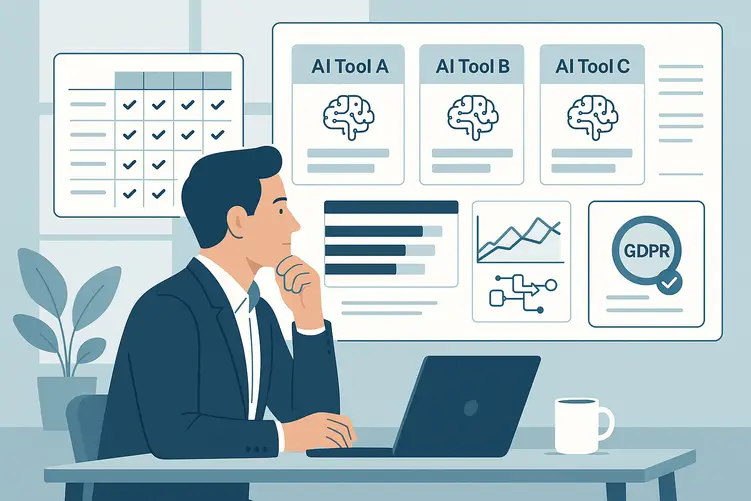
Systematic AI tool selection requires a scoring framework weighted according to your priorities. Typical categories include functionality (does it solve your problem?), usability (will your team adopt it?), integration (does it work with existing systems?), cost (does it fit your budget?), and vendor reliability (will they support you long-term?).
Involve stakeholders from different departments in this evaluation. IT teams focus on technical compatibility, whilst department heads assess practical functionality and finance teams scrutinise costs. This collaborative approach prevents tunnel vision and builds organisational buy-in.
Consider Expert Guidance
Navigating the complex landscape of business AI tools can overwhelm even experienced technology leaders. Many UK organisations benefit from working with consultancies that specialise in AI implementation. Kaizen AI Consulting helps businesses assess their unique requirements, evaluate suitable solutions, and implement AI tools that deliver measurable results.
Expert guidance proves particularly valuable for organisations making their first AI investment or those struggling with previous implementation failures. Consultants bring vendor-neutral perspectives, industry best practices, and technical expertise that accelerate decision making whilst reducing risk.
Implementation Planning and Success Factors
Develop a Phased Rollout Strategy
Once you’ve completed your AI vendor comparison and selected a solution, resist the temptation to deploy enterprise-wide immediately. Successful implementations typically follow phased approaches, starting with pilot programmes in specific departments or use cases.
This strategy allows you to identify issues, refine processes, and demonstrate value before full-scale deployment. It also creates internal champions who can support wider adoption based on firsthand positive experiences.
Invest in Training and Change Management
Technology alone doesn’t drive transformation; people do. According to CIPD research, 64% of UK employees feel anxious about AI in the workplace. Address these concerns through comprehensive training, clear communication about how AI tools augment rather than replace human capabilities, and ongoing support during the transition period.
Budget adequate resources for change management. This investment significantly impacts adoption rates and overall project success.
Maximising Your AI Investment
Choosing AI software represents just the beginning of your journey. Successful organisations continually optimise their AI tools, measuring performance against initial objectives, gathering user feedback, and staying informed about new features and capabilities.
Regular reviews ensure your AI solution continues meeting evolving business needs. As your organisation grows and market conditions change, your AI strategy should adapt accordingly. Many businesses find that quarterly assessments strike the right balance between stability and agility.
For organisations seeking to maximise their AI investments, professional guidance can prove invaluable. Kaizen AI Consulting’s AI strategy services help businesses not only select the right tools but also optimise their usage, ensuring continuous improvement and sustained competitive advantage.
Take the Next Step in Your AI Journey
Selecting the right AI tool for your business needs requires careful consideration of technical requirements, organisational readiness, and strategic objectives. By following the framework outlined in this guide, UK businesses can make informed decisions that drive genuine transformation rather than accumulating unused technology.
Remember that AI tool selection isn’t a one-time decision but an ongoing process of evaluation, implementation, and optimisation. The most successful organisations approach AI as a strategic capability requiring continuous investment and refinement.
If you’re ready to explore how AI can transform your business operations but feel overwhelmed by the choices available, we can help. Contact Kaizen AI Consulting today for a comprehensive assessment of your business needs and personalised recommendations for AI tools that will deliver measurable results. Our team of UK-based AI specialists brings vendor-neutral expertise and proven implementation methodologies that turn AI potential into business reality.
Don’t let the complexity of AI decision making prevent your organisation from capturing competitive advantages. With the right approach and expert guidance, you can confidently navigate the AI landscape and select solutions that drive sustainable growth for your business.