Using AI for Construction Project Management: Tools and Best Practices
The UK construction industry is at a pivotal crossroads. Long characterised by tight margins, persistent project delays, and complex regulatory demands, the sector is now embracing a transformative force: artificial intelligence. From intelligent scheduling tools to AI-powered site management platforms, construction project management AI is reshaping the way building projects are planned, delivered, and monitored across Britain.
Yet adoption remains surprisingly low. According to a 2026 Government AI Adoption Research report, only around 16% of UK businesses actively use at least one AI technology, and construction trails even further behind, with approximately 9.9% of construction firms currently deploying AI tools in their operations, per the Civil Engineering Contractors Association (CECA) AI in UK Construction Report. For forward-thinking firms, this represents a significant competitive opportunity.
In this guide, we explore the most effective AI tools and best practices currently available for UK construction businesses, covering everything from construction planning software and predictive risk management to BIM integration and AI-driven site management.
Why AI Matters for UK Construction Right Now
The global AI in construction market was valued at USD 4.5 billion in 2025 and is projected to reach USD 28.4 billion by 2035, according to Future Market Insights. Closer to home, the European AI in construction market is growing at a CAGR of 19.3%, with the UK positioned as a key growth market.
Investor confidence is running high: the RICS Artificial Intelligence in Construction Report 2025 found that 56% of investors planned to increase their AI-related spending, making it the top construction technology for investment. For contractors and developers willing to act now, the window to gain a real first-mover advantage is open.
The drivers are clear: construction projects in the UK routinely suffer from schedule overruns and budget creep. AI tools offer a data-driven antidote, enabling teams to make smarter decisions faster, automate repetitive administrative tasks, and anticipate problems before they escalate into costly crises.
Key AI Tools for Construction Project Management
1. Procore with AI-Powered Decision Support
Procore remains one of the most widely adopted end-to-end building project tools for mid-to-large contractors. Its integrated AI capabilities provide decision support by analysing outstanding tasks, RFIs (Requests for Information), and submittals to surface risk hotspots before they derail a project. Construction IQ, embedded within Procore, continuously scans project data to flag areas requiring urgent attention, shifting project teams from reactive firefighting to proactive management.
2. Autodesk Construction Cloud
Autodesk Construction Cloud integrates Building Information Modelling (BIM) with scheduling, procurement, and document management tools in one platform. As Autodesk’s own expert analysis confirms, AI-enhanced construction management platforms are streamlining project coordination by unifying BIM with scheduling and commercial workflows. For UK firms already operating within BIM Level 2 and ISO 19650 frameworks, this integration is particularly powerful.
3. Construction AI (UK-Native Platform)
In March 2026, a significant milestone was reached for UK construction SMEs: the launch of Construction AI, described as the first AI-native project management platform built specifically for the UK market. According to a GlobeNewswire release, the platform comprises over 700,000 lines of code across 60+ AI-powered tools and 22 modules. Crucially, it is priced to be accessible to firms with under 20 employees, addressing the technology gap that has excluded the 98% of UK construction firms priced out of enterprise solutions.
The platform is trained on UK-specific standards including CDM requirements and building regulations, and offers features such as OCR-powered drawing management, AI-generated RAMS, intelligent tender analysis, and semantic document search.
4. Asta Powerproject with AI Analytics
A UK favourite for scheduling, Asta Powerproject has evolved to incorporate AI-driven analytics. According to Elecosoft, users are achieving planning and reporting time reductions of around 20% through data-driven 4D planning and cloud-based collaboration, making it a strong choice for UK project teams managing complex programmes.
5. InspectMind AI for Document QA
InspectMind AI specialises in pre-construction quality assurance, checking specifications against drawings, detecting coordination conflicts, and integrating directly with Procore and Autodesk Construction Cloud. For UK teams managing large document sets across complex multi-phase developments, this tool can significantly reduce rework and compliance risk.
Best Practices for Implementing Construction Project Management AI
Start with High-Impact, Low-Risk Pilots
The RICS report advises organisations to begin AI adoption with focused pilots in areas that offer clear, measurable returns: scheduling, risk identification, and cost estimation. Attempting a whole-system transformation immediately creates unnecessary disruption. Instead, identify one pain point, deploy a targeted AI tool, measure outcomes carefully, and scale from a position of evidence.
Arup, named the Association for Project Management’s Company of the Year 2025, has been leading the way in this regard. Their approach uses AI for risk prediction, scenario modelling, and automated scheduling across major project portfolios, demonstrating the practical value of incremental, evidence-based AI deployment.
Prioritise Data Quality and Common Data Environments
AI tools are only as good as the data they process. For construction planning software to deliver reliable outputs, firms must invest in clean, well-structured, and consistently maintained datasets. Adopting a Common Data Environment (CDE) aligned with ISO 19650 standards is the foundation. Without reliable input data, even the most sophisticated AI will produce misleading or inaccurate outputs.
Maintain Human Oversight at Every Stage
In safety-critical environments, the principle of human-in-the-loop must be rigorously observed. The CECA’s AI in UK Construction Report explicitly states that AI must not displace or dilute human responsibility, particularly in contexts affecting worker safety, structural integrity, or regulatory compliance. AI should augment the judgement of experienced professionals, not replace it.
This is especially relevant in the context of the UK’s Building Safety Act 2022 and the evolving regulatory landscape around higher-risk buildings, where accountability chains must remain clearly human-led.
Invest in Workforce Upskilling
The CECA report identified a critical challenge: there is very limited knowledge of AI within the UK construction workforce, with few industry-specific training opportunities available. For AI tools to deliver value, project managers, site managers, quantity surveyors, and engineers need practical training in how to use and interpret AI-generated outputs. Firms that invest in upskilling now will build a durable competitive advantage.
This is an area where specialist support can make a significant difference. At Kaizen AI Consulting, we work with businesses across a range of industries to design and deliver practical AI training programmes tailored to real operational contexts, helping teams move from AI curiosity to AI competence with confidence.
Integrate AI Across the Full Project Lifecycle
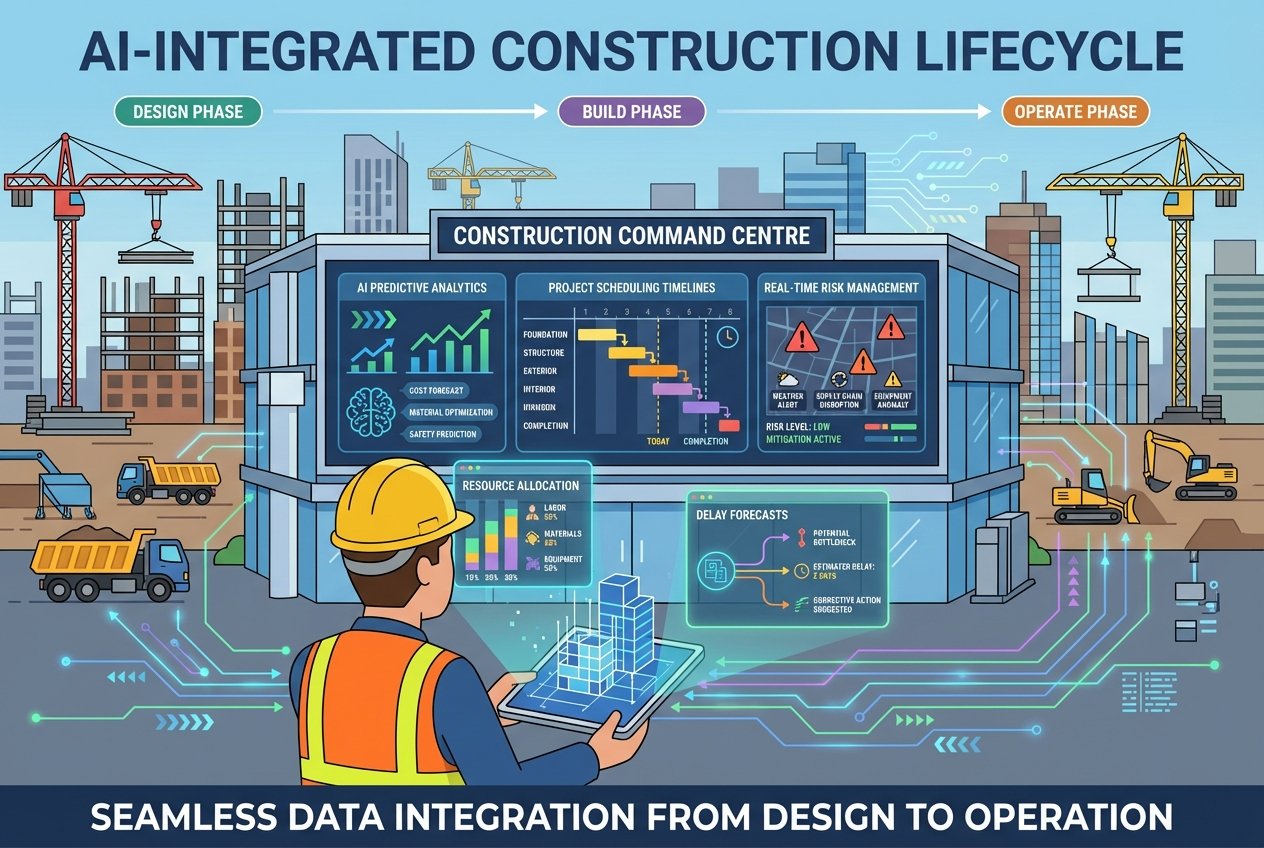
The most significant productivity gains come not from using AI in isolation, but from integrating it across the entire project lifecycle. Pre-construction AI tools can optimise designs and improve tender accuracy. During delivery, AI-powered site management platforms monitor progress, flag safety risks, and reforecast programmes in real time. Post-completion, AI analysis of project data can feed lessons learned back into future bids and planning processes, creating a virtuous cycle of continuous improvement.
According to CMiC’s 2026 Construction Project Management Best Practices guide, firms that embed AI across all project phases are achieving improvements in cost control, schedule adherence, and stakeholder visibility simultaneously.
The Transformative Power of Predictive Analytics in Construction
Perhaps no application of AI in construction is more immediately impactful than predictive analytics. Traditional construction project management is inherently reactive: problems are identified after they have already caused delay or cost. Predictive analytics inverts this dynamic, using machine learning to analyse patterns in historical and live project data to identify risks before they materialise.
In one standout example, Ramboll and Vattenfall deployed an AI network design tool capable of generating capital expenditure distributions, with analysis suggesting potential national savings of up to £32 billion. Closer to everyday construction management, Construction Management Magazine’s Digital Construction Awards 2026 shortlist highlights Taylor Woodrow’s use of AI for Inspection Test Plans (ITPs), which is reducing both rework effort and defect rates on live projects.
AI-powered predictive tools analyse procurement lead times, weather data, labour availability, and subcontractor performance to produce dynamic programme forecasts. For project managers, this means fewer surprises, more informed contingency planning, and improved client confidence.
Addressing the UK Construction Technology Gap
Despite the promise, there remains a significant technology gap in UK construction. The majority of firms, particularly SMEs, have not yet begun their AI journey. Barriers include the perceived cost of enterprise software, a lack of internal technical expertise, concerns about data security, and uncertainty about where to start.
Innovate UK’s BridgeAI programme is actively working to address these barriers by accelerating AI-focused construction startups including Constructify, BOHM, and Lattice. Government support, combined with the emergence of more affordable, UK-specific platforms, is gradually lowering the entry barriers for smaller firms.
For businesses that want to bridge this gap without the overhead of building an in-house AI capability, working with a specialist consultancy is one of the most cost-effective routes. Kaizen AI Consulting helps UK businesses navigate AI adoption strategically, identifying the right tools for each organisation’s specific needs, managing implementation risks, and ensuring teams are equipped to extract maximum value from their investment. Whether you are a main contractor, subcontractor, developer, or consultancy, a tailored approach to AI adoption will always outperform a generic one.
Looking Ahead: AI and the Future of UK Construction
The direction of travel is clear. As AI capabilities mature and become more accessible, the competitive divide between firms that have embraced digital tools and those that have not will widen. The Deloitte 2026 Engineering and Construction Industry Outlook predicts that AI-driven tools will optimise designs, automate calculations, and manage schedules in real time as standard practice across the sector within the coming years.
For UK construction businesses, the question is no longer whether to adopt AI, but how to do so effectively. The firms that invest now in the right tools, the right data infrastructure, and the right workforce capabilities will be best positioned to win work, deliver projects profitably, and lead the industry into its next chapter.
Ready to Explore AI for Your Construction Business?
Whether you are just beginning to explore construction project management AI or looking to scale an existing digital strategy, expert guidance makes all the difference. Get in touch with Kaizen AI Consulting today to arrange a no-obligation consultation and discover how the right AI strategy can transform your project delivery, reduce costs, and give your business a measurable competitive edge in the UK market.