Pricing your products or services correctly is one of the most powerful levers you can pull as a small business owner. Set prices too high and you lose customers to competitors. Set them too low and you erode your margins. For decades, small businesses have relied on gut instinct, spreadsheets, or occasional competitor research to make these critical decisions. In 2026, that approach is no longer enough.
Artificial intelligence is transforming how businesses of every size approach pricing, and the good news is that you do not need a large enterprise budget to benefit. AI pricing strategy tools are now accessible, affordable, and genuinely impactful for UK small businesses and SMEs. In this guide, we break down exactly how AI can help you build smarter, more profitable pricing strategies, and what steps you can take to get started today.
Why Traditional Pricing Is Letting Small Businesses Down
Most small businesses still price reactively. They set a rate at launch, revisit it once or twice a year, and rely on anecdotal feedback from customers to know if they have pitched it correctly. The problem is that the market moves faster than this approach allows.
Consumer demand shifts daily. Competitors adjust their offers regularly. Seasonality, supply chain fluctuations, and macroeconomic pressures all play a role. Without data-driven insight, it is almost impossible to respond in real time.
According to the Office for National Statistics, only 25% of UK businesses were using AI in any capacity as of late 2025. More recent data from the British Chambers of Commerce (March 2026) shows that figure has now risen to around 54% across all firms, but adoption among small businesses specifically still lags significantly behind larger organisations. This means there is a genuine competitive advantage available for small businesses that act now.
What Is an AI Pricing Strategy?
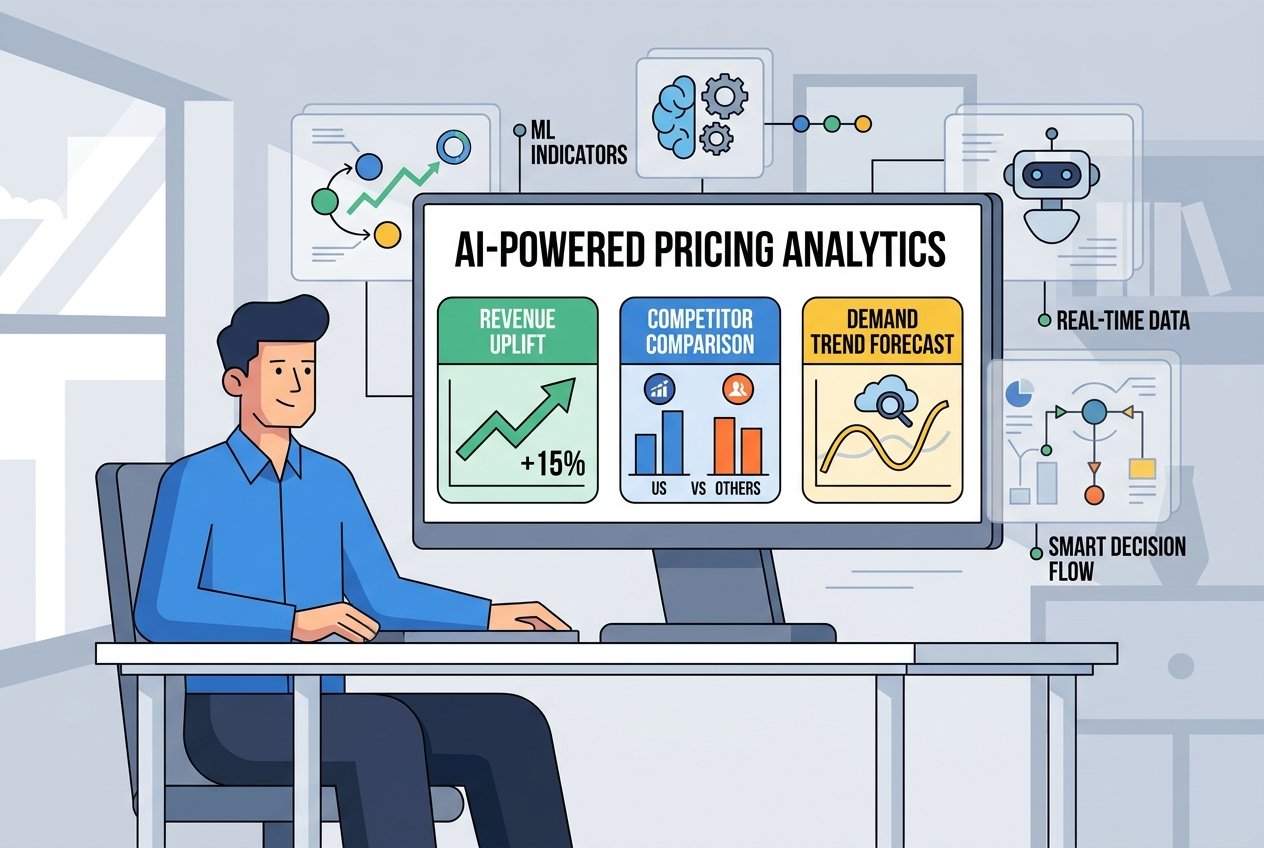
An AI pricing strategy uses machine learning and predictive analytics to help businesses set, adjust, and optimise prices based on real-time data. Rather than relying on static rules or manual reviews, AI pricing tools continuously monitor a range of variables including:
- Competitor pricing across online and offline channels
- Customer demand signals and purchasing behaviour
- Inventory levels and supply chain data
- Seasonal trends and external market conditions
- Historical sales data and price elasticity
The result is a dynamic, responsive pricing model that maximises revenue and protects margins without the need for constant manual input.
It is worth noting that AI pricing strategy is not about racing to the bottom on price. Done well, it is about finding the optimal price point that balances competitiveness with profitability, and doing so with precision that manual methods simply cannot match.
The Power of Dynamic Pricing for Small Businesses
Dynamic pricing is the practice of adjusting your prices in response to changing market conditions. You may already be familiar with it from industries like airlines, hotels, and ride-hailing apps, where prices fluctuate based on demand. Thanks to AI, dynamic pricing is now within reach for small businesses across retail, e-commerce, hospitality, services, and more.
For a UK small business, dynamic pricing powered by AI might look like this:
- An independent e-commerce retailer automatically raising prices on high-demand products during peak periods such as bank holidays or seasonal events
- A local service provider adjusting booking rates based on availability and local demand signals
- A wholesale supplier repricing stock in real time when a key competitor runs out of inventory
Research from Abbacus Technologies (April 2026) highlights that AI-powered pricing in 2026 goes far beyond simple rule-based automation. Businesses are now leveraging advanced techniques that combine predictive analytics with deep learning to make near-autonomous pricing decisions. UK SMEs adopting these tools are reporting revenue uplifts of between 10% and 25% within the first six months of implementation.
At Kaizen AI Consulting, we work with UK small businesses to identify the right dynamic pricing tools and frameworks for their specific sector, ensuring the technology is configured to deliver measurable results from day one rather than becoming another underutilised subscription.
Key AI Tools for Pricing Optimisation in the UK
The market for AI-driven pricing tools has matured considerably, and there are now strong options suited to businesses at every stage. Here is an overview of the most relevant tools for UK small businesses in 2026:
Prisync
Prisync is one of the most popular pricing optimisation tools for UK e-commerce businesses. It tracks competitor prices in real time across multiple channels and uses AI to suggest dynamic price adjustments based on demand signals, stock levels, and price elasticity. Plans start from approximately £99 per month, making it accessible for small retailers. UK fashion and retail SMEs using Prisync have reported margin improvements of up to 12% alongside revenue uplifts of 18%, according to case study data published by Prisync in early 2026.
Omnia Retail
Omnia Retail uses machine learning to analyse competitor data, market trends, and internal cost structures, generating optimal price points on an hourly basis. It integrates with Shopify and WooCommerce, which are widely used by UK small businesses. Pricing starts from £149 per month. A UK grocery SME using Omnia during the 2025 peak season saw a 22% increase in sales with improved margin performance.
RepricerExpress
Specifically designed for Amazon UK sellers, RepricerExpress uses AI to monitor competitors and automatically adjust pricing to win the Buy Box. Plans begin at just £25 per month, making it one of the most affordable competitive pricing AI tools available for small businesses. Users within the UK seller network report an average 27% improvement in win rates and a 15% revenue increase, based on internal data published in April 2026.
ChatGPT and General-Purpose AI for Pricing Research
For small businesses not yet ready to invest in dedicated pricing tools, general-purpose AI such as ChatGPT (from around £16 to £20 per month) can be used for rapid competitor research, demand forecasting analysis, and pricing scenario modelling. While it lacks the automation of dedicated tools, it is a powerful and affordable starting point for building a more data-informed AI pricing strategy.
How to Build a Competitive Pricing AI Strategy: A Step-by-Step Approach
Implementing an AI pricing strategy does not have to be complex. The following framework is designed for UK small business owners who want to move from reactive pricing to proactive, data-led decision making.
Step 1: Audit Your Current Pricing
Before introducing any AI tools, conduct a thorough review of your existing pricing structure. Understand your cost base, current margins, and how your prices compare to direct competitors. This baseline data is essential for measuring the impact of any future changes.
Step 2: Identify Your Pricing Model
Consider which pricing model is most appropriate for your business. Options include cost-plus pricing, value-based pricing, tiered pricing, and fully dynamic pricing. AI tools can support all of these models, but the right choice depends on your sector, customer base, and competitive landscape. A Kaizen AI Consulting strategy session can help you map out the optimal approach for your specific business context, saving you significant time and costly trial and error.
Step 3: Integrate Data Sources
Effective AI pricing relies on quality data. Connect your sales platform, inventory management system, Google Analytics 4, and any CRM data you hold. The richer your data inputs, the more accurate and useful the AI outputs will be.
Step 4: Select and Deploy the Right Tool
Based on your pricing model, sector, and budget, select the AI pricing tool that best fits your needs. Start with a free trial where possible and test the tool’s recommendations against your own judgement before fully automating decisions.
Step 5: Monitor, Test, and Refine
AI pricing tools improve over time as they accumulate more data. Review performance monthly, test different pricing scenarios, and refine your rules and parameters. Treat it as an ongoing process rather than a one-off implementation.
Pricing Optimisation and UK Compliance
UK small businesses should be aware that pricing practices are subject to oversight by the Competition and Markets Authority (CMA). Dynamic pricing must not be used in ways that are deceptive, exploit vulnerable consumers, or breach consumer protection law. Transparency is key: if your prices vary based on demand or other factors, ensure your customers understand this clearly.
The CMA has been increasingly active in scrutinising AI-driven pricing practices, particularly in sectors such as energy, ticketing, and grocery retail. Small businesses using competitive pricing AI should ensure their pricing logic is documented, reviewable, and compliant with UK consumer protection regulations.
The Broader AI Opportunity for UK Small Businesses
Pricing optimisation is just one dimension of the AI opportunity available to UK small businesses. According to Spicy Advisory (April 2026), 70% of UK SMBs now use AI in some form, but only 31% report a positive return on investment. The gap between adoption and genuine ROI is largely explained by a lack of strategic implementation. Businesses that deploy AI tools without a clear framework, proper data integration, or defined success metrics rarely see the results they are hoping for.
This is why strategy matters as much as technology. The businesses achieving the strongest outcomes from AI are those that treat it as a business transformation tool, not simply a software subscription. They align AI capabilities with specific commercial goals, invest time in data quality, and continuously refine their approach based on evidence.
If you are looking to move beyond basic AI experimentation and build a genuine competitive edge through smarter pricing and broader AI integration, our team at Kaizen AI Consulting is here to help. We specialise in helping UK small businesses and SMEs develop practical, commercially focused AI strategies that deliver measurable results. Get in touch today for a free discovery call and find out how we can help you transform your pricing strategy and unlock the full potential of AI in your business.
Final Thoughts
AI pricing strategy is no longer the preserve of large retailers or tech giants. In 2026, small businesses across the UK have access to powerful, affordable tools that can fundamentally change the way they price, compete, and grow. Whether you are an e-commerce retailer looking to deploy dynamic pricing, a service business wanting to better understand your value positioning, or a wholesaler seeking to respond faster to competitor moves, there is an AI solution available to you right now.
The businesses that will thrive in the coming years are those that embrace data-driven decision making at every level, and pricing is one of the most impactful places to start. The technology is ready. The question is whether you are ready to use it.