How to Create Personalised Email Campaigns with AI
Email marketing remains one of the most powerful tools in a UK business’s digital arsenal, and artificial intelligence is transforming what’s possible. According to a 2026 report by SQ Magazine, 86% of marketers now report a measurable boost in email performance as a direct result of personalisation. With UK email marketing delivering an average ROI of £35 to £42 for every £1 spent, the case for embracing AI-driven email personalisation has never been stronger.
Whether you run a growing e-commerce brand in Manchester, a B2B consultancy in London, or a retail business across the regions, personalised email campaigns powered by AI can dramatically improve customer engagement, drive conversions, and build long-term loyalty. In this guide, we walk through the practical steps to get started.
Why AI-Powered Email Personalisation Matters in 2026
Gone are the days when adding a subscriber’s first name to a subject line passed for personalisation. Today’s customers expect relevant, timely, and contextually aware communication, and AI makes this possible at scale.
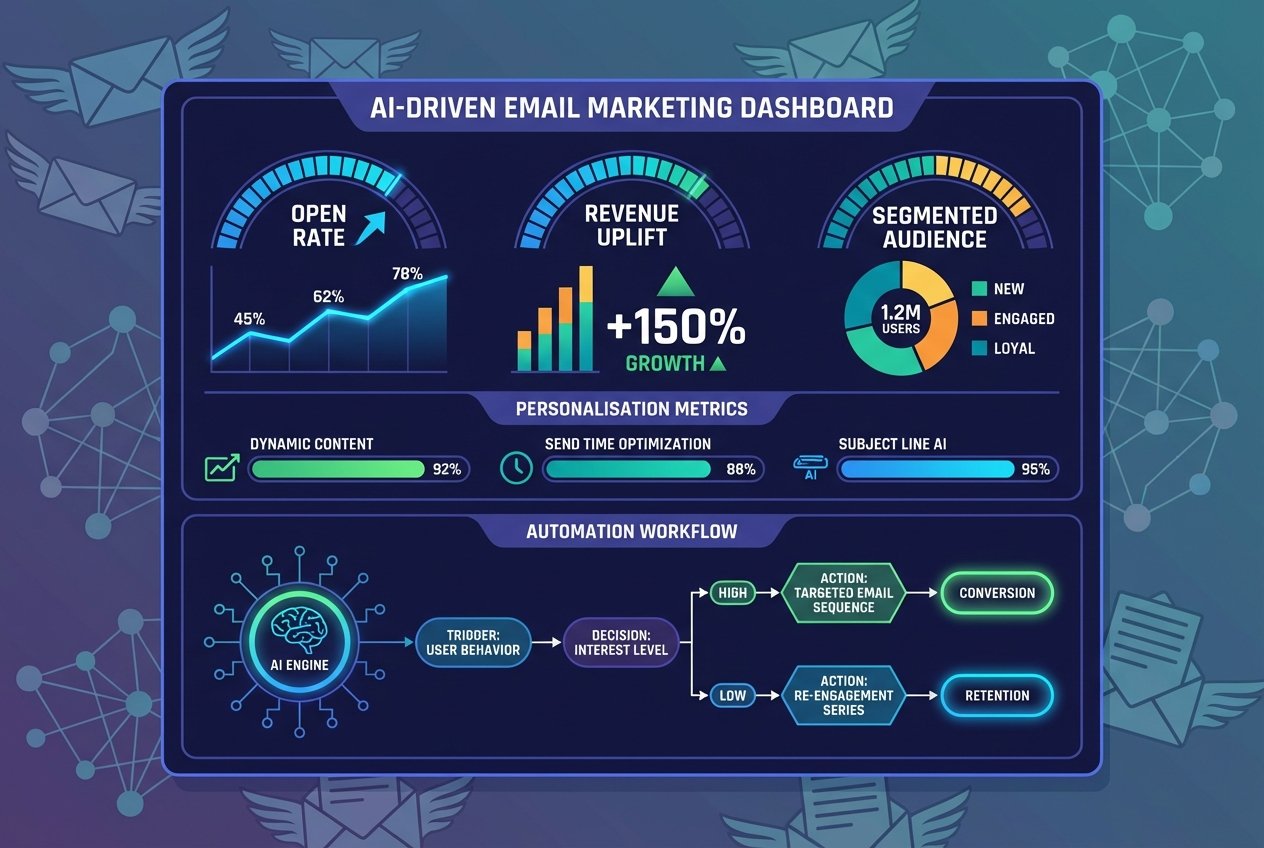
The numbers tell a compelling story. According to Knak’s 2026 Email Statistics Report, AI-generated emails achieve a click-through rate (CTR) of 9.44% compared to 8.46% for human-written equivalents, an 11% improvement. More strikingly, AI-driven email personalisation has been shown to deliver a 41% increase in revenue and a 13.44% uplift in CTR. Meanwhile, 63% of marketers now use AI tools as part of their standard email marketing workflow.
For UK SMEs, adopting marketing automation is no longer a luxury reserved for enterprise brands; it’s an accessible competitive advantage. At Kaizen AI Consulting, we help UK businesses of all sizes harness the practical power of AI to build smarter, more effective email marketing strategies from the ground up.
Step 1: Build a Clean, Segmented Contact Database
No AI tool can compensate for poor data quality. Before implementing any personalisation strategy, your first priority should be cleaning and enriching your contact database. Verify email addresses, remove duplicates, and ensure your data fields are consistently populated.
Once your data is clean, leverage AI to segment your audience far beyond basic demographics. Effective segmentation strategies include:
- Behavioural segmentation: Group subscribers by actions such as browsing history, purchase patterns, and cart abandonment behaviour.
- Predictive segmentation: Use machine learning to analyse past behaviour and forecast future actions, enabling proactive rather than reactive outreach.
- Micro-segmentation: Create highly granular audience groups that allow hyper-targeted messaging tailored to very specific interests.
- Psychographic segmentation: Group subscribers by values, interests, and lifestyle to align messaging with what truly motivates them.
According to Braze’s 2026 email marketing strategy guide, behaviour-based segmentation can increase conversion rates by up to 19%. This layered approach ensures that every subscriber receives content matched to their actual behaviour rather than broad assumptions.
Step 2: Design Modular, Dynamic Email Content
Effective AI-powered email campaigns are built on modular content architectures, not one-size-fits-all templates. Rather than crafting a single email blast to your entire list, design dynamic content blocks that AI can assemble intelligently based on each subscriber’s segment and behaviour.
A practical modular framework might include:
- Three distinct subject line variations for A/B testing
- Two hero image or banner options tailored to different audience groups
- Multiple body copy variants reflecting different customer lifecycle stages
- Dynamic product recommendation blocks driven by purchase history and browsing data
- Location-specific offers or promotions relevant to regional audiences
Dynamic content personalisation extends well beyond a recipient’s name. It encompasses the entire email experience: the images displayed, the products recommended, the tone of the copy, and even the call-to-action itself. Litmus research confirms that 73% of high-performing email campaigns now incorporate dynamic content blocks as a standard practice.
Step 3: Set Up Behavioural Trigger Campaigns
One of the most impactful applications of marketing automation is the triggered email sequence, emails that are sent automatically in response to a specific customer action or behaviour. Unlike traditional broadcast campaigns, triggered emails are inherently personalised because they respond to what an individual customer has actually done.
Key behavioural triggers to implement include:
- Welcome series: A multi-step onboarding sequence that introduces your brand, captures preferences, and builds early engagement.
- Browse and cart abandonment: Timely reminders for customers who viewed products or left items in their basket without purchasing.
- Post-purchase sequences: Educational or cross-sell emails sent after a transaction to support onboarding, reduce returns, and encourage repeat buying.
- Win-back campaigns: Re-engagement emails targeted at subscribers who have been inactive for a defined period.
- Milestone and loyalty rewards: Personalised recognition of customer anniversaries, birthdays, or loyalty tier achievements.
Triggered emails are significantly more effective than standard campaign sends. Data shows that automated email flows achieve open rates of 48.57% compared to 37-42% for standard campaign emails, generating up to three times more revenue per message sent.
Step 4: Optimise Subject Lines with AI
Your subject line is the single most important factor determining whether an email gets opened or ignored. AI tools now enable marketers to generate, test, and optimise subject lines at a scale and speed that was previously impossible.
Personalised subject lines alone drive up to a 35% increase in open rates, whilst AI-generated subject lines can boost opens by a further 21-22% compared to generic alternatives. To make the most of this capability:
- Use AI to generate multiple subject line angles for every campaign and let your platform select the best performer automatically.
- Test subject lines on a weekly cadence, declaring winners based on statistical significance before rolling out to your full list.
- Resend campaigns with alternative subject lines to subscribers who did not open the original send, a tactic that can generate an additional 25-50% revenue per campaign.
- Incorporate personalisation tokens beyond first names, such as recently browsed products or geographic references, for greater relevance.
Step 5: Implement Send Time Optimisation
Even the most beautifully crafted, perfectly personalised email will underperform if it lands in an inbox at the wrong moment. Send time optimisation (STO) is one of the highest-impact, lowest-effort applications of AI in email marketing.
Rather than selecting a single send time for your entire list, AI analyses each individual subscriber’s historical engagement patterns to predict the precise moment they are most likely to open and interact with your email. This shifts email delivery from a one-size-fits-all approach to truly personalised timing at scale.
According to Top Ten AI Agents’ UK Email Marketing Guide, AI-powered send time optimisation can deliver up to twice the click performance of standard scheduled sends, making it an essential component of any serious email personalisation strategy.
Step 6: Test, Measure, and Continuously Improve
The most successful AI-powered email programmes are built on a culture of continuous testing and iteration. Establish a disciplined weekly testing cadence focused on the three highest-leverage variables: subject lines, send times, and audience segment splits.
Key metrics to track for UK email campaigns in 2026 include:
- Open rate: A baseline health indicator; Klaviyo’s 2026 UK benchmarks (based on analysis of over 183,000 brands) set automated flow open rates at around 48.57%.
- Click-through rate (CTR): Reflects content relevance and CTA effectiveness; UK industry benchmarks range from 5.54% to 6.13% depending on sector.
- Revenue per recipient: The ultimate measure of campaign effectiveness, especially for e-commerce and retail.
- Conversion rate: Ties email performance directly to business outcomes rather than vanity metrics.
Document your test results consistently and compound your learnings over time. After a 12-week testing cycle, you will have built a data-driven optimisation playbook that becomes a genuine competitive asset for your business.
UK Compliance Considerations for AI Email Campaigns
For UK businesses, effective email personalisation must always be balanced against compliance obligations. The UK GDPR and Privacy and Electronic Communications Regulations (PECR) set clear requirements around consent, data usage, and the right to opt out. When using AI to personalise email campaigns:
- Ensure all subscriber data used for personalisation has been collected with clear, informed consent.
- Maintain robust authentication protocols (SPF, DKIM, and DMARC) to protect deliverability and sender reputation.
- Prioritise zero-party data, information customers proactively share via preference centres and surveys, over inferred behavioural data where possible.
- Provide clear unsubscribe mechanisms in every email and honour opt-out requests promptly.
As Pod Digital’s 2026 UK Email Marketing Guide notes, the most forward-thinking UK marketers are now treating compliance not as a constraint but as a framework for building deeper, more trustworthy customer relationships.
Getting Started: A Practical Roadmap for UK SMEs
If you’re ready to begin implementing AI-powered personalised email campaigns, here is a practical starting point for UK SMEs:
- Audit and clean your existing contact database.
- Select an email platform with built-in AI features (such as Klaviyo, Dotdigital, or Mailchimp’s AI tools).
- Define your core audience segments based on behaviour and lifecycle stage.
- Build your first triggered sequences: welcome, abandonment, and post-purchase.
- Set up A/B testing for subject lines and activate send time optimisation.
- Establish a weekly review cadence to measure, learn, and iterate.
Implementing these strategies effectively requires both the right technology and the right strategic approach. That’s where working with an experienced AI consultancy can make a significant difference. Kaizen AI Consulting works directly with UK businesses to design, implement, and optimise AI-powered marketing automation strategies that deliver measurable results. If you are looking to build a smarter email marketing programme and accelerate customer engagement, we would love to help.
To learn more about how AI is reshaping the way UK businesses grow, take a look at our business growth insights or explore our full range of AI consulting services.
Final Thoughts
AI-powered email personalisation is no longer a future aspiration; it is a present-day reality that is already separating high-performing UK businesses from the rest. From intelligent segmentation and dynamic content to behavioural triggers and send time optimisation, the tools and strategies available in 2026 make it possible to deliver genuinely personalised experiences to thousands of subscribers simultaneously, without sacrificing the quality or relevance that drives customer engagement.
The businesses that invest in building these capabilities now will have a significant advantage as consumer expectations continue to rise. Whether you are just beginning your AI marketing journey or looking to scale an existing programme, the steps outlined in this guide provide a clear and practical path forward.
Ready to take your email campaigns to the next level? Get in touch with Kaizen AI Consulting today and discover how we can help you build personalised, data-driven email campaigns that truly resonate with your audience.