AI for HVAC Businesses: Optimising Routes, Schedules, and Customer Service
The UK heating, ventilation, and air conditioning (HVAC) industry is undergoing a quiet revolution. Valued at approximately £2.52 billion in 2025 and projected to grow at a CAGR of up to 7.3% through 2033, the sector is under intense competitive pressure. Margins are tighter, engineers are in short supply, fuel costs are rising, and customer expectations have never been higher. For HVAC business owners across the UK, artificial intelligence is no longer a luxury reserved for large corporations; it is rapidly becoming the most practical tool available for sustainable growth.
From intelligent route planning and automated scheduling to AI-powered customer service, HVAC AI tools are transforming how businesses operate day to day. This guide breaks down exactly how these technologies work, what results you can realistically expect, and how to begin implementing them in your own heating ventilation automation strategy.
The State of AI Adoption Among UK Service Businesses
Before diving into the specifics, it is worth understanding where the UK market currently stands. According to DSIT research published in January 2026, just 16% of UK businesses are currently using AI tools, compared to significantly higher adoption rates globally. Among micro-businesses with five to nine employees, that figure drops to 14%. Yet the same data shows that businesses with 50 to 249 employees are adopting at a rate of 23%, and larger firms at 36%, suggesting a clear advantage awaiting smaller HVAC operators willing to move early.
More encouragingly, the British Chambers of Commerce reported in early 2026 that 54% of SMEs surveyed were now using AI in some form, up from 35% in 2025. The gap between early adopters and those yet to start is widening quickly, and for HVAC businesses, the practical applications are already proven.
AI Route Optimisation: Fewer Miles, Lower Costs, More Jobs Per Day
One of the most immediate and financially impactful uses of HVAC AI is intelligent route optimisation. Traditional dispatch methods, whether managed via spreadsheets, whiteboards, or gut instinct, inevitably result in inefficient scheduling: engineers criss-crossing the same postcodes, duplicate travel between similar areas, and wasted hours that could otherwise be billable time.
AI-powered route optimisation analyses job locations, engineer locations, traffic conditions, appointment windows, and skill requirements simultaneously, generating optimal routes in seconds. The financial results are substantial. According to Fieldproxy research focused on HVAC businesses, fuel savings from AI-optimised routes typically range from 15 to 30% as routes reduce total miles driven and minimise stop-and-go patterns.
At a fleet level, the savings compound quickly. Fleet Rabbit’s 2026 analysis found that businesses using AI route tools were saving £1,200 per vehicle per month, with travel time reductions of 25 to 30%. FieldCamp’s AI dispatch software reports cutting travel time by 30 to 40%, enabling engineers to complete more jobs per day without working longer hours.
For a typical HVAC business running ten vehicles across a regional territory, this could translate to tens of thousands of pounds in annual savings, as well as the ability to take on additional jobs without increasing headcount. In an industry where labour shortages are a persistent challenge, getting more productivity from existing teams is enormously valuable.
Zone-Based Scheduling and Smart Dispatch
Beyond simple route planning, advanced HVAC business tools now incorporate zone-based AI scheduling that keeps engineers within defined service areas. Rather than assigning the nearest available technician regardless of geography, these systems build day schedules that cluster appointments by postcode district, reducing dead mileage and improving punctuality.
AI scheduling platforms can factor in variables that human dispatchers frequently overlook: engineer skill sets, parts inventory on each van, historical job durations for specific equipment types, and even anticipated traffic at different times of day. The result is a schedule that is both more efficient and more accurate, meaning fewer late arrivals and fewer customer complaints.
Businesses implementing AI-driven scheduling automation are reporting operational cost reductions of 20 to 30% alongside improved first-time fix rates, a metric that directly affects profitability and customer satisfaction in equal measure.
Predictive Maintenance: Staying Ahead of Breakdowns
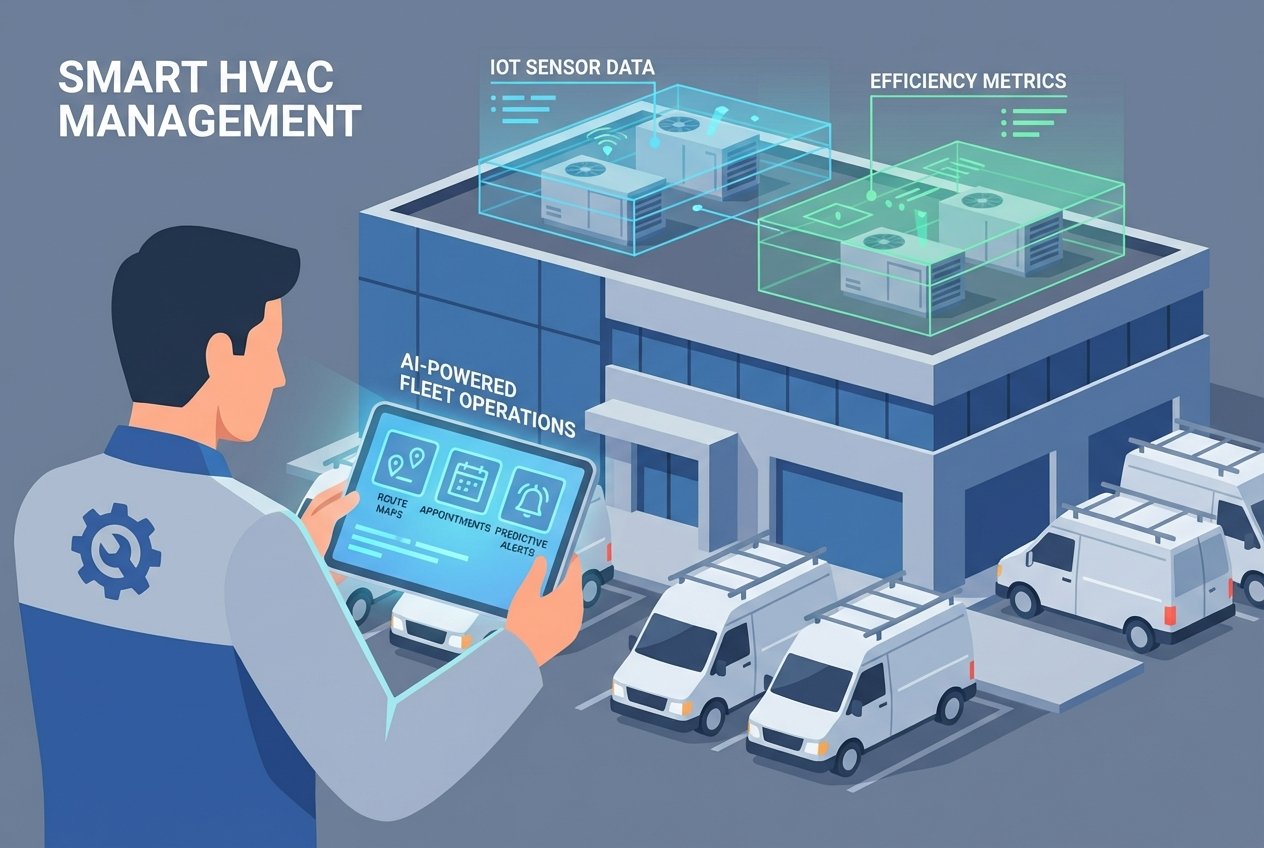
Predictive maintenance represents one of the most transformative applications of HVAC AI. Rather than waiting for equipment to fail or relying on fixed annual service schedules, AI systems continuously monitor equipment performance data through IoT sensors, smart thermostats, and building management systems to detect early warning signs of component degradation.
BrainBox AI research demonstrates that AI-driven HVAC retrofits can deliver energy savings of up to 25% and emissions reductions of up to 40%, without requiring hardware replacement. The AI integrates with existing building management systems and applies continuous learning models to anticipate failures before they occur.
For HVAC engineers, this shifts the service model from reactive to proactive. Rather than emergency call-outs that disrupt daily schedules and carry higher labour costs, predictive maintenance enables planned visits, better parts preparation, and higher first-time fix rates. Customers benefit from reduced downtime and the confidence that their systems are being looked after intelligently.
According to LeapingAI’s 2026 HVAC technology trends report, smart HVAC systems with IoT integration and predictive maintenance capabilities are now among the top technology trends reshaping the industry, offering fault detection with precision levels reaching 99.6% in advanced deployments.
AI-Powered Customer Service: Never Miss a Call, Never Lose a Lead
Customer service is where many HVAC businesses quietly lose significant revenue. A boiler breaks down on a cold January morning in Manchester, a homeowner calls three different companies, and the first one to answer gets the job. If your phone rings unanswered because your office team are on other calls, or because it is 7pm and no one is working, that customer is gone.
AI voice agents and intelligent chatbots address this directly by handling inbound enquiries around the clock. Modern service business AI tools can answer calls, qualify leads, book appointments, confirm service windows, send follow-up reminders, and even collect post-job customer feedback, all without any human intervention.
According to 2026 HVAC technology trend data, voice AI receptionists are now capable of pulling customer history and equipment details in real time, enabling them to provide genuinely helpful responses rather than generic holding messages. Companies using these tools are handling more jobs without increasing office headcount, with significant improvements in lead capture and booking conversion rates.
Beyond inbound enquiries, AI tools can also proactively reach out to existing customers: sending annual service reminders, offering maintenance plan upgrades, and requesting reviews after completed jobs. This kind of automated customer relationship management, once available only to large businesses with dedicated CRM teams, is now within reach of every HVAC operator.
At Kaizen AI Consulting, we work closely with UK service businesses, including HVAC operators, to implement exactly these kinds of intelligent customer engagement systems. Whether you need a voice AI receptionist, an automated booking workflow, or a CRM integration that keeps your engineers and your customers in perfect sync, our team can design and deploy a solution tailored to your business.
Automating Invoicing, Follow-Ups, and Admin
The administrative burden on HVAC businesses is substantial. Generating job reports, processing invoices, chasing payments, and managing compliance documentation takes time that could otherwise be spent on revenue-generating activity. AI tools are now capable of automating significant portions of this workload.
Field service management platforms powered by AI can auto-generate invoices based on completed job data, populate compliance certificates from engineer notes captured in the field, and trigger payment reminders automatically. When integrated with accounting software, these tools eliminate manual data entry almost entirely.
The cumulative time saving across a business with five or more engineers can run into hundreds of hours per year. More importantly, faster invoicing means faster payment cycles, which has a direct and positive impact on cash flow.
Choosing the Right HVAC Business Tools: What to Look For
With a growing number of HVAC business tools incorporating AI features, it can be difficult to know where to begin. The most effective implementations tend to share a few common characteristics.
First, they integrate with systems you already use. Whether that is your existing CRM, accounting software, or engineer scheduling platform, AI tools that slot into your current workflow deliver value faster than those requiring a full technology overhaul. Second, they offer measurable outcomes from day one: reduced travel time, improved booking rates, or faster invoice processing. Third, they scale with your business rather than becoming obsolete as you grow.
Popular platforms in the UK HVAC market include ServiceTitan, Commusoft, and Workiz, all of which are adding AI-powered features at pace. However, for businesses seeking a more bespoke approach to heating ventilation automation, working with a specialist AI consultancy to design a customised technology stack often delivers a stronger return on investment.
This is precisely the kind of work that Kaizen AI Consulting specialises in. Rather than off-the-shelf tools that may not fit the specifics of your operation, we assess your existing workflows, identify the highest-impact automation opportunities, and implement AI solutions that are built around your business model.
Real-World Results: What HVAC Businesses Are Achieving
The data from early HVAC AI adopters is compelling. Businesses using AI dispatch and scheduling tools are consistently reporting that their engineers complete more jobs per day without working longer hours. Route optimisation alone is delivering fuel savings of up to 30% for HVAC operators, with fleet-level savings that run into thousands of pounds per month.
On the customer service side, 24/7 AI voice handling is transforming lead capture for businesses that previously lost after-hours enquiries entirely. Rather than customers moving on to competitors, AI receptionists convert those calls into booked appointments, complete with confirmation messages and reminder sequences, while the business owner sleeps.
Predictive maintenance contracts, enabled by IoT monitoring and AI analytics, are also opening up new recurring revenue streams. Rather than purely transactional service relationships, HVAC businesses are building ongoing monitoring agreements that generate consistent monthly income and dramatically improve customer retention.
Getting Started: A Practical Approach
For most UK HVAC businesses, the sensible starting point is to identify one area of the operation where inefficiency is most costly and begin there. If your engineers are spending 20% of their day in the van, route optimisation should be the first investment. If you are losing evening and weekend enquiries to competitors, an AI voice agent or chatbot should be the priority. If your invoicing cycle is slow and your cash flow suffers as a result, AI-powered job management automation is the logical first step.
The UK HVAC market is growing, competition is intensifying, and the businesses that build AI capabilities now will have a significant structural advantage over those that wait. According to the UK government’s own assessment, OECD estimates project UK labour productivity growth from AI of 0.4 to 1.2 percentage points annually over the next decade for businesses that adopt effectively.
If you are ready to explore how AI can help your HVAC business optimise routes, automate scheduling, and deliver outstanding customer service, get in touch with the team at Kaizen AI Consulting today. We offer a no-obligation discovery call to help you understand exactly where AI can deliver the greatest impact for your specific operation.
For broader context on how AI is reshaping UK service businesses, you may also find our articles on building a scalable service business a useful companion read.