AI Quality Control for Construction: Catching Defects Before They Cost You
The UK construction industry is under more pressure than ever. With building costs forecast to rise by 15% before the end of this decade, tender prices projected to increase by 20% over the next five years, and the Building Safety Act 2022 tightening compliance requirements at every stage of a project, the margin for error has never been smaller. Yet rework caused by quality failures continues to drain budgets, with rework costs averaging 11% of total project value across UK and EU construction sites.
The good news? Artificial intelligence is rapidly changing what is possible in construction quality control. From computer vision that spots hairline cracks before they become structural failures, to autonomous drones conducting roof inspections in a fraction of the time, AI-powered defect detection is giving UK contractors, developers, and site managers a genuine competitive edge. This article explores how building inspection automation and AI-driven quality assurance work in practice, why now is the time to act, and what you need to know to get started.
The True Cost of Construction Defects in the UK
Before exploring the solutions, it is worth understanding the scale of the problem. According to a 2026 report by PlanRadar, the primary causes of rework in UK construction are poor communication between teams and stakeholders, quality control failures, and lack of organisation. Notably, in the UK specifically, poor quality materials emerged as the leading trigger for rectifications, more prevalent than in any other surveyed country.
The downstream consequences extend far beyond the direct financial hit. Defects cause project completion delays, damage relationships between contractors and clients, create reputational harm, and generate legal complications including contract breach claims. There are also ethical dimensions: unnecessary rework contributes significantly to material waste at a time when the industry faces growing pressure to reduce its environmental footprint. Perhaps less discussed is the toll on team morale. Preventable rework has been linked to job frustration and reduced productivity, affecting overall construction rates and site culture.
With the Building Safety Act 2022 now firmly embedded in construction practice, the stakes of getting quality control right are even higher. The Gateway process for higher-risk buildings (HRBs) requires rigorous quality documentation at every stage, from pre-construction through to Gateway 3 completion certification before occupation. Non-compliance can result in criminal penalties, including fines and imprisonment. The Building Safety Levy, launching 1 October 2026, adds further financial pressure. In this environment, reactive quality control is simply not sustainable.
How AI is Transforming Construction Quality Control
AI-driven quality assurance is not a single tool but an ecosystem of technologies, each addressing a different dimension of the quality challenge. Here is a breakdown of the key approaches currently being deployed on UK construction sites.
Computer Vision and Automated Defect Detection
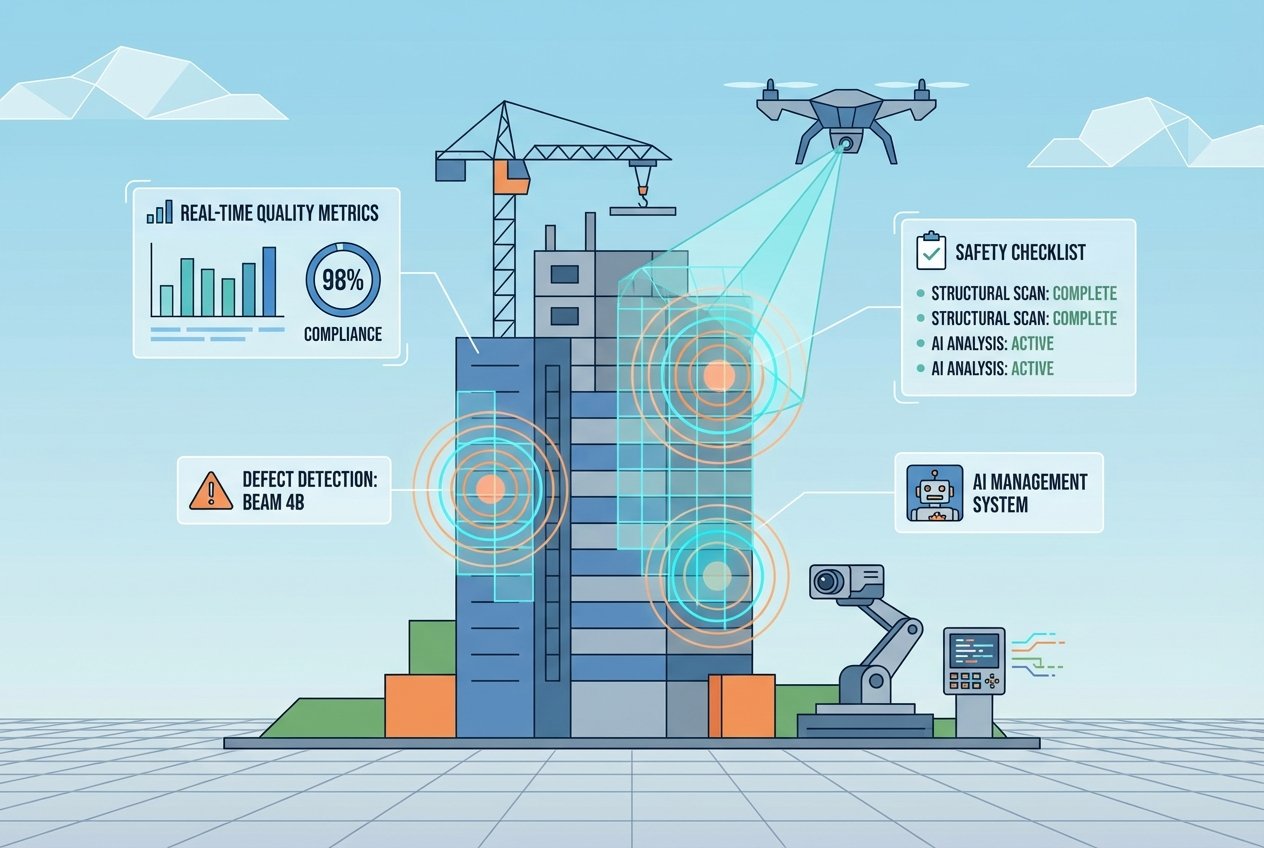
Computer vision is arguably the most impactful application of AI in construction quality control today. Camera systems and sensors capture continuous streams of visual data from site, which machine learning algorithms then analyse in real time, flagging deviations, cracks, surface defects, and dimensional discrepancies against pre-approved specifications or Building Information Modelling (BIM) models.
The accuracy of these systems is impressive. Research using the StructDamage dataset, which aggregates approximately 78,000 images of cracks and surface defects across nine material types including road, pavement, deck, and concrete, has demonstrated that convolutional neural networks (CNNs) can classify defects with up to 98.6% accuracy. For context, even the most diligent human inspector conducting a manual walkthrough cannot match that consistency across an entire project lifecycle.
Platforms such as Buildots use hardhat-mounted cameras and computer vision to track construction progress automatically, comparing site conditions against BIM models and schedules in real time. When deviations are identified, issues are automatically routed to project management systems for immediate resolution, dramatically reducing the window between a defect occurring and being addressed.
Drone-Based Building Inspection Automation
Autonomous drones are rapidly becoming a standard tool for building inspection automation, particularly for external envelope surveys, roof inspections, and progress tracking across large sites. Integrated with AI defect detection software, drone surveys are achieving efficiency gains of up to 60% compared to traditional methods, according to data cited by Building Magazine.
Beyond speed, drones access areas that are difficult, dangerous, or expensive to reach using scaffolding or rope access teams. They generate high-resolution 3D point clouds and photogrammetric models of structures, which AI algorithms then interrogate for defects, comparing outputs against design intent. The NavLive AI-driven scanner, for example, can complete surveys in under an hour where traditional methods would require days, using deep learning and sensor fusion to produce actionable defect reports.
AI-Enhanced Snag Lists and Inspection Test Plans
One of the most time-consuming elements of construction quality assurance is the generation and management of snag lists and Inspection Test Plans (ITPs). AI tools using Natural Language Processing (NLP) and large language models (LLMs) are now capable of parsing project specifications, generating ITPs and check sheets with fully traceable criteria, and updating them dynamically as designs evolve.
Taylor Woodrow’s Auto ITP system, recognised on the Digital Construction Awards 2026 Best Use of AI shortlist, demonstrates how NLP can reduce the manual effort involved in ITP creation while simultaneously reducing rework risk through more precise specification matching. Early results suggest the system is saving the equivalent of 21% of project value through smarter quality planning.
AI-Driven BIM Integration and Digital Twins
Building Information Modelling has long been a cornerstone of quality management in UK construction, but the integration of AI is elevating its capabilities considerably. AI-enhanced digital twins allow project teams to simulate construction sequences, predict potential clashes or quality failures before they reach site, and verify as-built conditions against design models automatically.
This approach is particularly valuable in the context of Building Safety Act compliance. The Gateway 3 digital handover documentation requirements demand comprehensive, evidenced records of quality throughout a project. AI-driven BIM platforms can automate much of this documentation, creating audit trails that satisfy regulatory scrutiny while reducing the administrative burden on site teams.
The Business Case for AI Quality Assurance in Construction
The return on investment from deploying AI in construction quality control is increasingly well evidenced. According to NeuraMonks’ 2026 Construction AI Playbook, AI adoption is cutting overall project costs by up to 35%, delivering 20-25% better schedule adherence and reducing material waste by 15-22%. Computer vision safety and quality systems alone have been associated with a 35% reduction in on-site incidents, while predictive maintenance applications are delivering 30-45% less equipment downtime.
For a mid-sized UK contractor turning over £20 million per year, an 11% rework rate represents up to £2.2 million in avoidable costs. Even a conservative 50% reduction in rework through AI quality control would deliver over £1 million in annual savings, providing a compelling case for investment even before accounting for the reputational and contractual benefits of consistently delivering defect-free work.
The regulatory environment strengthens the business case further. With the Building Safety Regulator’s 2026-2027 strategic plan explicitly prioritising Building Assessment Certificate call-ins for taller HRBs and expanding oversight to buildings between 11-18 metres, firms that can demonstrate robust, digitally evidenced quality management processes will hold a significant advantage in both procurement and regulatory interactions.
Practical Steps for Implementing AI Quality Control on Your Projects
Understanding the technology is one thing; knowing where to start is another. For UK construction businesses considering their first steps into AI-driven quality assurance, the following framework provides a practical roadmap.
1. Audit Your Current Quality Control Pain Points
Begin with an honest assessment of where quality failures are occurring in your projects. Are defects predominantly found during final inspections, indicating issues with in-progress quality monitoring? Are snag lists growing uncontrollably, suggesting a systemic issue with specification compliance? Is rework concentrated in specific trade packages or project phases? Understanding your specific failure modes will help you prioritise which AI capabilities to deploy first and where you will realise the fastest return.
2. Evaluate Your Data Readiness
AI systems are only as effective as the data they are trained and fed with. Before investing in any platform, assess whether your projects generate sufficient structured data through BIM models, digital specifications, site photography, and quality management records. Firms operating primarily on paper-based processes will need to digitise foundational workflows before AI quality tools can deliver full value.
3. Start with High-Impact, Lower-Risk Applications
Rather than attempting a wholesale transformation of your quality management approach, identify one or two high-impact applications to pilot. Drone surveys for external inspections are often a good starting point: they are relatively straightforward to implement, deliver immediate efficiency gains, and generate buy-in from site teams who can see tangible time savings. Progress monitoring platforms that compare site photos against BIM models are another low-friction entry point.
4. Align Technology with Regulatory Requirements
Ensure that any AI quality control tools you adopt are capable of generating the documentation formats required under the Building Safety Act, particularly for HRB projects. Gateway documentation, fire safety information under amended Regulation 38, and Building Assessment Certificate evidence all require structured, auditable records that digital AI platforms are well placed to produce automatically.
5. Invest in Team Competence
The University of Westminster’s Built Environment Responsible AI Competence Framework (BRIEF), launched in February 2026, emphasises that successful AI adoption in the built environment requires innovation to be matched with competence, ethical judgement, and professional responsibility. Investing in training your site managers, quality surveyors, and project teams to work effectively alongside AI tools is as important as the technology investment itself.
Why Now is the Right Time for UK Contractors to Act
The UK construction sector is entering a period of cautious optimism, with projected growth of 2.8% to 4.5% in 2026. However, this growth comes alongside mounting challenges: a skills shortage requiring approximately 266,000 additional workers, rising National Insurance contributions, and tightening regulatory requirements under the Building Safety Act. In this context, AI quality control is not merely a productivity tool but a strategic differentiator. Firms that can deliver consistently high-quality, defect-free buildings, supported by robust digital evidence trails, will be better positioned to win contracts, retain clients, and navigate the regulatory landscape than competitors still relying on manual inspection processes.
Furthermore, new construction regulations that took effect on 8 January 2026 have raised the bar for product testing and certification, with criminal penalties for non-compliance in technical documentation. As industrialisedconstruction.co.uk reports, only around a third of construction products are currently regulated, with approximately 30,000 products still operating outside formal oversight. AI systems that automate product verification and documentation can help contractors navigate this increasingly complex compliance landscape with greater confidence and less administrative overhead.
How Kaizen AI Consulting Can Help
Implementing AI quality control effectively in a construction business requires more than simply purchasing a software licence. It demands a clear strategy, robust data infrastructure, well-integrated workflows, and a team that is confident in using new tools. This is precisely where specialist expertise makes the difference between a costly failed pilot and a genuinely transformative deployment.
At Kaizen AI Consulting, we work with UK businesses across sectors including construction to identify the right AI applications for their specific challenges, design implementation roadmaps that deliver measurable returns, and provide the hands-on support needed to embed AI tools sustainably within existing operations. Whether you are looking to automate your building inspection processes, reduce rework through smarter defect detection AI, or build the digital documentation capabilities your projects require under the Building Safety Act, our team can guide you from strategy through to live deployment.
You can explore our broader approach to AI consulting and business transformation on our website, or read more about how we help organisations navigate the practical realities of implementing new technologies for sustainable growth.
Conclusion: Catch Defects Early or Pay the Price Later
The economics of construction quality control are straightforward: defects caught early cost a fraction of defects discovered late. An issue identified during a computer vision scan of freshly poured concrete is a minor correction. The same issue discovered during a client handover, or worse, post-occupation, becomes a legal, reputational, and financial crisis. AI-powered building inspection automation shifts quality management from a reactive, end-of-process activity to a continuous, proactive one, embedded into every phase of construction delivery.
With rework costing UK contractors an average of 11% of project value, AI quality assurance delivering cost savings of up to 35%, and regulatory requirements under the Building Safety Act demanding ever-higher standards of evidence and accountability, the question for UK construction businesses is no longer whether to adopt AI quality control, but how quickly they can do so effectively.
Ready to explore how AI quality control could transform your construction projects? Get in touch with the team at Kaizen AI Consulting today for a no-obligation consultation and discover what is possible for your business.