Artificial intelligence has moved far beyond simple automated responses. In 2026, businesses across the United Kingdom are grappling with a critical decision: should they invest in traditional chatbots or embrace the emerging power of autonomous AI agents? Understanding the distinction between these technologies is no longer a matter for IT departments alone. It is a strategic business choice that directly impacts customer experience, operational efficiency, and long-term competitiveness.
Worldwide AI spending is projected to reach $2.52 trillion in 2026, representing a 44% increase from the previous year. Yet despite this massive investment, many organisations remain unclear about what separates a chatbot from an AI agent, and more importantly, which solution aligns with their specific business objectives.
What Is a Chatbot?
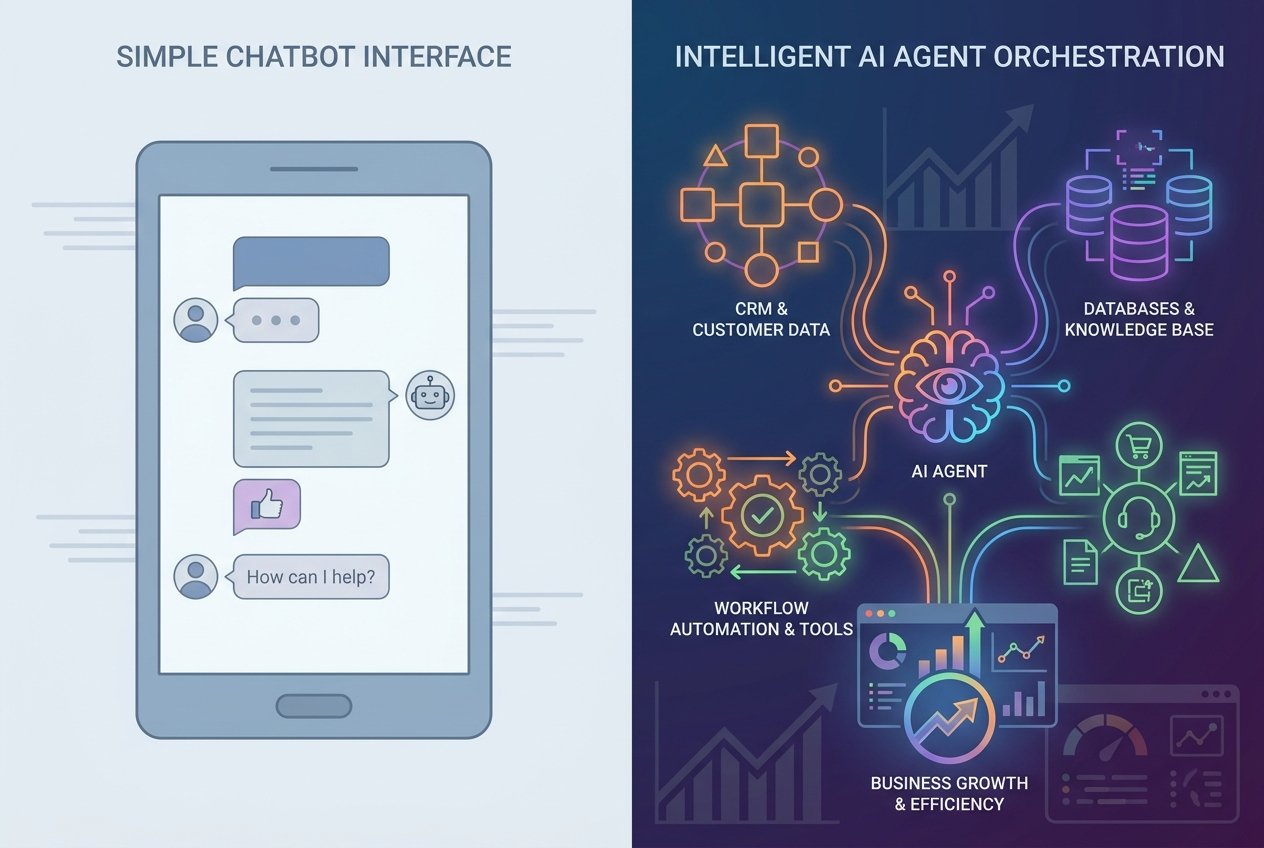
Chatbots are software applications designed to simulate human conversation through text or voice interactions. They operate using predefined rules, decision trees, or natural language processing models trained on specific datasets. When a user asks a question, the chatbot matches the input against its programmed responses and delivers an answer.
Traditional chatbots excel at handling straightforward, repetitive queries. They can answer frequently asked questions, guide users through simple processes, and provide basic troubleshooting steps. For many small businesses, chatbots offer an affordable entry point into automated customer service.
However, chatbots have clear limitations. They function as reactive systems. They generate an answer and stop. If a query falls outside their training data or programmed scenarios, they typically escalate to a human agent or provide an unsatisfactory response. This creates friction in customer journeys and can lead to frustration when users encounter complex or multi-step problems.
What Is an AI Agent?
AI agents, often referred to as agentic AI, represent a fundamental evolution in artificial intelligence capabilities. Unlike chatbots, AI agents are autonomous systems that can understand goals, create plans, and execute multi-step workflows independently. They do not simply respond to prompts. They take initiative.
An AI agent can access multiple tools and systems, such as customer relationship management platforms, email services, spreadsheets, and databases. It can reason through problems, make decisions based on real-time data, and complete entire tasks without human intervention. For example, rather than simply telling a customer how to process a refund, an AI agent could verify the purchase, check return policies, initiate the refund through the payment system, and send a confirmation email, all autonomously.
Forrester Research reports that 72% of enterprise leaders now favour AI agents over traditional chatbots for customer service operations. This shift reflects a broader recognition that modern business challenges require solutions capable of end-to-end task completion, not just conversational interaction.
Key Differences: AI Agents vs Chatbots
When conducting a chatbot comparison, several critical distinctions emerge:
Autonomy and Decision-Making
Chatbots follow scripts. They require explicit user input for every interaction and cannot deviate from their programming. AI agents possess a degree of autonomy. They can evaluate situations, prioritise actions, and adapt their approach based on changing circumstances. This makes autonomous AI particularly valuable for dynamic business environments where rigid workflows are insufficient.
Task Complexity
A chatbot handles single-turn interactions effectively. An AI agent manages complex, multi-step processes across multiple systems. McKinsey reports that 65 to 80% of customer inquiries can be resolved autonomously with modern agentic AI systems, compared to significantly lower resolution rates for traditional chatbots.
Integration Capabilities
Chatbots typically operate within a single channel, such as a website widget or messaging platform. AI agents integrate across an organisation’s entire technology stack. They can pull data from enterprise resource planning systems, update inventory records, schedule appointments, and trigger downstream workflows. This cross-system functionality is what enables agentic AI explained in practical business terms.
Learning and Adaptation
While some advanced chatbots incorporate machine learning, their ability to improve is generally limited to refining responses within their existing scope. AI agents continuously learn from outcomes, adjusting their strategies to achieve better results over time. This self-improving capability means that agentic AI systems become more valuable the longer they operate within a business.
Business Impact and Adoption Trends
The business case for AI agents is strengthening rapidly. Organisations deploying agentic systems are reporting 30 to 50% reductions in support costs alongside 25 to 35% improvements in customer satisfaction scores. These are not marginal gains. They represent transformative shifts in operational performance.
Despite these compelling benefits, adoption remains uneven. Capgemini research indicates that only 14% of organisations have deployed AI agents at full or partial scale. This gap between interest and implementation creates both risk and opportunity for UK businesses. Early adopters who successfully integrate agentic AI stand to capture significant competitive advantages, while laggards may find themselves struggling to match the service levels and efficiency benchmarks set by more advanced competitors.
The economic potential is substantial. Capgemini estimates that agentic AI could generate up to $450 billion in economic value by 2028. For British enterprises navigating post-Brexit competitiveness and digital transformation imperatives, this technology represents a genuine pathway to sustainable growth.
Choosing the Right Solution for Your Business
The decision between AI agents and chatbots should be driven by specific business requirements rather than technology trends alone. Consider the following factors when evaluating your business AI choice:
Volume and Complexity of Interactions
If your customer service team primarily handles simple, repetitive queries such as password resets, order status checks, and basic product questions, a well-designed chatbot may suffice. However, if your team regularly encounters complex issues requiring investigation across multiple systems, an AI agent will deliver far greater value.
Integration Requirements
Assess how deeply your automated solution needs to connect with existing business systems. Chatbots work well as front-end interfaces. AI agents function as operational engines that can transform back-office processes. If your goal is end-to-end automation rather than conversational support, agentic AI is the appropriate path.
Budget and Resource Constraints
Chatbots generally require lower initial investment and can be deployed more quickly. AI agents demand more sophisticated implementation, including system integrations, security protocols, and ongoing optimisation. However, the return on investment for agentic AI tends to be significantly higher over time. Capgemini notes that AI is delivering an average ROI of 1.7x, with 40% of organisations expecting positive returns within one to three years.
Scalability Ambitions
Consider your long-term growth trajectory. A chatbot that meets today’s needs may become a constraint tomorrow. AI agents are inherently more scalable, capable of taking on increasingly complex responsibilities as your business expands. For organisations with ambitious growth plans, investing in agentic AI from the outset can prevent costly platform migrations later.
Implementation Considerations for UK Businesses
British organisations must navigate specific regulatory and operational considerations when deploying AI solutions. The UK’s voluntary AI Cyber Security Code of Practice and evolving data protection frameworks mean that any automated system must prioritise security, transparency, and compliance. This is particularly relevant for AI agents, which by their nature access and manipulate sensitive business data across multiple platforms.
Working with experienced consultants who understand both the technical and regulatory landscape is essential. Kaizen AI Consulting specialises in helping UK businesses navigate these complexities, ensuring that AI implementations meet the highest standards of security and governance while delivering measurable business outcomes.
The Future of Business AI
The trajectory is clear. Gartner found that 58% of organisations are replacing or retiring legacy chatbot platforms in favour of more capable solutions. This is not a temporary trend but a structural shift in how businesses leverage artificial intelligence.
Looking ahead, the distinction between chatbots and AI agents may blur as even basic conversational tools incorporate more sophisticated capabilities. However, the underlying principle will remain constant. Businesses that deploy systems capable of autonomous action, cross-system integration, and continuous learning will outperform those relying on reactive, single-function tools.
For organisations at the beginning of their AI journey, the key is to start with clarity about desired outcomes. Define what success looks like, whether that means reduced operational costs, improved customer satisfaction, faster response times, or enhanced employee productivity. Then select the technology that genuinely delivers against those objectives.
If you are uncertain about which approach suits your organisation, seeking expert guidance can accelerate your decision-making and reduce implementation risk. Kaizen AI Consulting provides strategic advisory and implementation support for businesses exploring their options in the AI agents vs chatbots landscape. Our team helps organisations assess their readiness, design appropriate solutions, and deploy systems that create lasting value.
The question is no longer whether your business should adopt AI, but which form of AI will drive the greatest impact. By understanding the fundamental differences between chatbots and AI agents, and by aligning your technology choices with your strategic ambitions, you position your organisation to thrive in an increasingly automated economy. The businesses that make informed decisions today will be the ones setting the standards tomorrow.
Ready to explore how agentic AI could transform your operations? Contact Kaizen AI Consulting today for a complimentary consultation and discover the right AI solution for your business.