
AI on the Edge: Running AI Locally for Data Privacy and Speed
Artificial intelligence is no longer confined to vast, energy-hungry data centres in the cloud. A quiet revolution is under way, one that is bringing AI processing directly onto devices, servers, and local networks. Known as edge AI or local AI processing, this shift is rapidly reshaping how UK businesses deploy intelligent technology. Whether driven by stricter data privacy obligations, the need for lightning-fast decisions, or simply a desire to reduce cloud dependency, on-premise AI is rapidly becoming the smart choice for forward-thinking organisations.
With the global edge AI market valued at approximately USD $25.65 billion in 2025 and projected to reach USD $165 billion by 2035, it is clear this is not a niche trend. It is a fundamental architectural shift in how AI is deployed and consumed.
What Is Edge AI and Local AI Processing?
Edge AI refers to running artificial intelligence algorithms directly on a local device, on-premise server, or at the network edge, rather than sending data to a remote cloud service for processing. This could mean a machine on a factory floor making real-time quality control decisions, a healthcare device analysing patient data without it ever leaving the hospital, or a retail system generating personalised recommendations entirely within a local network environment.
Local AI processing and on-premise AI are closely related concepts. While edge AI often implies deployment at the device level, on-premise AI refers more broadly to hosting AI models and infrastructure within an organisation’s own facilities, under their direct control. Both approaches share a core principle: keeping data close to where it is generated and used, rather than routing it through external cloud infrastructure.
This is more than just a technical preference. For UK businesses operating under UK GDPR, managing sensitive customer data, or operating in regulated industries such as healthcare, finance, or legal services, where data is processed can be just as critical as how it is processed.
Why UK Businesses Are Embracing On-Premise AI
1. Data Privacy and UK GDPR Compliance
Data privacy is arguably the single most powerful driver pushing UK organisations towards local AI processing. Under UK GDPR, businesses are legally obligated to ensure personal data is processed lawfully, securely, and with clear accountability. When sensitive data is sent to a third-party cloud provider for AI processing, the organisation introduces additional risks: data in transit, third-party sub-processors, uncertain data residency, and potential cross-border transfers.
On-premise AI eliminates many of these concerns outright. Data never leaves the building. There is no transmission to a third-party server, no ambiguity about where personal information resides, and no need to negotiate complex data processing agreements with cloud vendors. For UK businesses in sectors such as healthcare, financial services, and legal, this is not simply a preference but often a regulatory necessity.
The cost of getting this wrong is significant. Recent data indicates the average cost of a data breach for UK businesses stands at $5.05 million, a stark reminder of the financial exposure that comes with poor data governance. Meanwhile, the UK Government’s own research highlights that significant cyberattacks cost businesses nearly £195,000 on average, with the true impact for larger enterprises running far higher.
By keeping AI workloads on-premise, UK organisations can drastically reduce their attack surface, satisfy data residency requirements, and demonstrate a proactive approach to compliance when engaging with the Information Commissioner’s Office (ICO).
2. Speed and Real-Time Performance
The second major advantage of edge AI is raw speed. When data must travel to a remote cloud server and back, latency is unavoidable. For many business applications, this is tolerable. But for a growing number of use cases, even milliseconds matter.
Consider a manufacturing line using AI-powered visual inspection to identify defects in real time. Or an autonomous vehicle making split-second decisions based on sensor data. Or a hospital’s patient monitoring system flagging a critical deterioration in vital signs. In all of these scenarios, cloud round-trip latency could be the difference between a safe outcome and a costly, potentially dangerous failure.
By 2026, edge AI has transitioned from a futuristic concept to a practical, widely adopted architecture precisely because of this real-time performance advantage. Local AI processing allows decisions to happen at the speed of the machine, not the speed of the network.
For UK manufacturers and industrial businesses, this is particularly transformative. Edge AI in manufacturing is enabling machines to adjust operations, detect anomalies, and optimise processes in real time, without relying on internet connectivity or cloud infrastructure. This is driving significant improvements in operational efficiency, reducing downtime, and cutting waste.
3. Reduced Cloud Costs and Bandwidth Savings
Cloud AI services are powerful, but they are not cheap. As organisations scale their AI usage, cloud compute bills can balloon rapidly. Every API call, every inference request, every data transfer contributes to mounting costs. For businesses processing large volumes of data continuously, such as retailers analysing footfall, logistics firms tracking fleets, or manufacturers monitoring production lines, these costs can become prohibitive.
On-premise AI shifts this cost profile significantly. Once the initial hardware investment is made, the marginal cost of running additional AI workloads locally is minimal. There are no per-query fees, no egress charges, and no vendor lock-in. Lattice Semiconductor’s 2026 analysis highlights that improved on-device performance and software tools such as model quantisation are making edge AI increasingly cost-competitive, even for small and medium-sized enterprises.
4. Operational Resilience and Connectivity Independence
Cloud-dependent AI systems are only as reliable as the internet connection they run on. For UK businesses in areas with variable connectivity, or in industries where network outages could halt operations, this dependency is a genuine vulnerability.
Local AI processing eliminates this single point of failure. Systems continue to operate, make decisions, and deliver value regardless of internet availability. This resilience is particularly valuable for manufacturing facilities, remote agricultural operations, retail sites in areas with patchy connectivity, and any environment where continuous uptime is non-negotiable.
Key Use Cases Across UK Industries
The practical applications of on-premise AI are broad and growing rapidly across UK sectors:
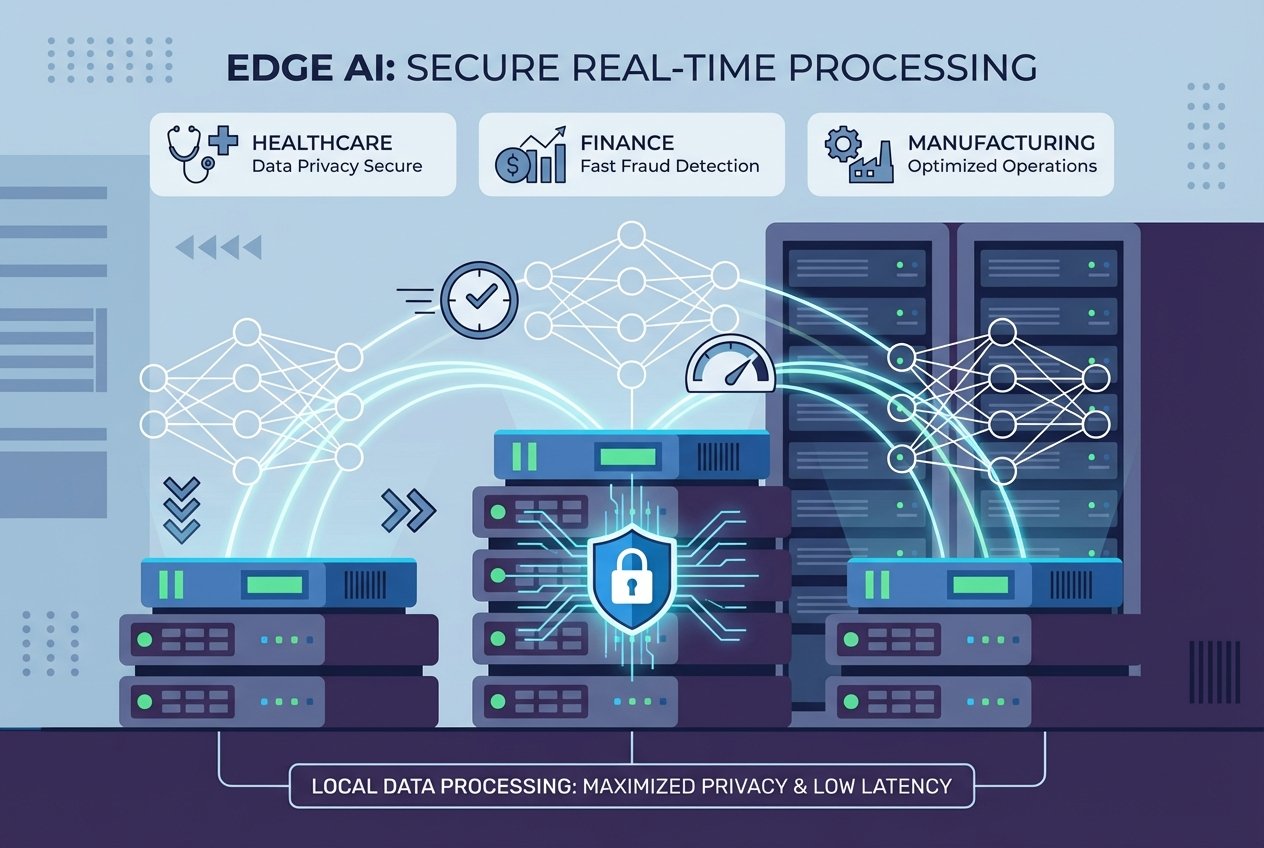
- Healthcare: Hospitals and clinics are deploying local AI to analyse diagnostic imaging, monitor patient vitals, and flag clinical risks, all without patient data leaving the secure hospital network. This supports NHS data governance frameworks and patient confidentiality.
- Financial Services: Banks and insurers are running on-premise AI models for fraud detection, risk assessment, and credit scoring. With 75% of UK financial firms already using AI, the drive to do so in a compliant, on-premise manner is accelerating.
- Manufacturing: Edge AI is transforming quality control, predictive maintenance, and supply chain optimisation. AI models run directly on factory floor equipment, enabling real-time adjustments without cloud dependency.
- Retail: Retailers are using local AI to power personalisation engines, inventory management systems, and customer behaviour analytics, all within their own infrastructure to avoid sharing commercially sensitive data with cloud providers.
- Legal and Professional Services: Law firms and consultancies are deploying on-premise AI for document review, contract analysis, and knowledge management, ensuring client confidentiality is never compromised by third-party data access.
The Role of Small Language Models in Making Local AI Accessible
One of the historical barriers to on-premise AI has been the sheer computational demand of large AI models. Training and running large language models (LLMs) traditionally required the kind of GPU infrastructure only hyperscale cloud providers could offer.
That barrier is now falling. The rise of small language models (SLMs), compact AI models optimised for efficient inference on modest hardware, is making local AI processing genuinely accessible to a much wider range of businesses. Dell Technologies’ 2026 edge AI predictions highlight SLMs as a dominant force, enabling powerful AI capabilities on devices and on-premise servers without requiring enterprise-grade GPU clusters.
Tools such as Ollama, LM Studio, and a growing ecosystem of open-source model formats (GGUF, ONNX, and others) are making it increasingly straightforward to run capable AI models on standard business hardware, from workstations to on-premise servers. This democratisation of local AI is a genuine game-changer for UK SMEs that previously felt priced out of meaningful AI adoption.
At Kaizen AI Consulting, we help UK businesses evaluate, select, and deploy the right on-premise AI architecture for their specific needs, whether that is a lightweight SLM running on existing hardware, a dedicated edge AI server, or a hybrid approach that combines local processing with selective cloud use. Our team understands both the technical landscape and the UK regulatory environment, ensuring your AI deployment is fast, compliant, and built to scale.
Edge AI vs Cloud AI: Choosing the Right Approach
It is worth noting that edge AI and cloud AI are not mutually exclusive. Many organisations adopt a hybrid strategy: sensitive, latency-critical workloads run locally, while training, heavy analytics, and less time-sensitive tasks leverage cloud infrastructure. This balanced approach captures the best of both worlds.
The key is matching the architecture to the use case. Questions to consider include:
- How sensitive is the data being processed?
- What latency is acceptable for this application?
- What are the regulatory requirements around data residency?
- What is the organisation’s existing hardware infrastructure?
- How critical is operational continuity if connectivity is lost?
Getting these decisions right from the outset can save significant cost and complexity down the line. It is also an area where professional guidance pays dividends. The team at Kaizen AI Consulting works with businesses across a range of UK sectors to design AI deployment strategies that are technically sound, commercially pragmatic, and fully aligned with UK data protection obligations.
The Regulatory Tailwind: Why UK GDPR Is Accelerating Edge AI Adoption
The UK’s post-Brexit data protection landscape continues to evolve, but the core principles of UK GDPR remain firmly in place: data minimisation, purpose limitation, storage limitation, and accountability. Each of these principles sits more comfortably with local AI processing than with cloud-based alternatives.
Data minimisation is naturally achieved when AI processes data locally and discards it immediately after use. Purpose limitation is easier to enforce when data never leaves the organisation’s own systems. Storage limitation becomes simpler when there is no cloud copy being retained by a third party. And accountability, perhaps the most critical principle of all, is demonstrably stronger when an organisation can point to complete, end-to-end control over its data processing activities.
As the ICO continues to scrutinise AI deployments and as AI-specific regulation matures in the UK, organisations that have invested in data privacy AI frameworks built around local processing will be considerably better positioned than those relying entirely on cloud-based AI solutions.
Getting Started with On-Premise AI: Practical Steps for UK Businesses
If your organisation is considering moving towards local AI processing, a structured approach will deliver the best results:
- Audit your current AI and data landscape: Understand what data you are currently sending to cloud AI services, what the regulatory implications are, and where latency or privacy issues are creating friction.
- Identify high-value edge AI use cases: Prioritise applications where local processing delivers the greatest benefit, whether through improved speed, reduced cost, or enhanced data privacy.
- Evaluate hardware options: From standard on-premise servers to purpose-built edge AI devices and NPU-equipped workstations, the hardware landscape has never been more varied or accessible.
- Select appropriate models: Choose AI models that are optimised for on-device inference, considering factors such as model size, accuracy requirements, and hardware compatibility.
- Design your data governance framework: Establish clear policies for data handling, model updating, and security monitoring within your local AI environment.
- Plan for hybrid integration: Where cloud AI remains appropriate for certain tasks, design clean interfaces between your local and cloud AI environments.
Ready to Bring AI Closer to Home?
The case for on-premise and edge AI has never been stronger. From the pressing demands of UK GDPR compliance and the real cost of data breaches, to the competitive advantage delivered by real-time AI processing and the growing accessibility of small language models, local AI processing is moving from cutting edge to business standard.
If you are ready to explore what edge AI and on-premise AI could look like for your organisation, we would love to help. Get in touch with the Kaizen AI Consulting team today to discuss your requirements, explore your options, and build an AI strategy that puts your data, your performance, and your competitive edge right where they belong, on your terms, in your control.