Artificial intelligence is no longer the preserve of large corporations. Across the UK, small businesses are integrating AI tools into their day-to-day operations at a remarkable pace. According to the UK SME AI Adoption Report 2026, approximately 35% to 39% of UK SMEs are now actively using AI-powered tools, up from just 25% in 2024. That is an extraordinary leap in a single year.
Yet with opportunity comes responsibility. As AI becomes embedded in business processes, from customer service chatbots to automated hiring tools and financial decision-making, the question of AI governance has moved from an enterprise concern to a small business priority. Getting it wrong is not simply a reputational risk. In 2026, non-compliance with AI-related data protection obligations can result in significant fines and lasting damage to customer trust.
This guide breaks down what AI governance means for small businesses in the UK, what the current regulatory landscape looks like, and how you can build a practical, proportionate framework that keeps your business protected and positions you as a trustworthy operator.
What Is AI Governance and Why Does It Matter for Small Businesses?
AI governance refers to the policies, processes, and accountability structures an organisation puts in place to ensure that its use of artificial intelligence is safe, fair, transparent, and legally compliant. For large enterprises, this might mean dedicated AI ethics boards and complex internal audit systems. For small businesses, it should be something far more accessible: clear guidelines on which AI tools are approved, how data is handled, who is responsible for AI outputs, and how affected individuals can raise concerns.
The UK government has established five core principles that define what trustworthy AI looks like in practice:
- Safety, security, and robustness – AI systems should function reliably and resist misuse or manipulation.
- Transparency and explainability – Businesses should be able to explain how their AI tools reach decisions.
- Fairness – AI must not produce discriminatory outcomes in hiring, pricing, marketing, or service delivery.
- Accountability and governance – There must be clear lines of responsibility for AI-driven decisions.
- Contestability and redress – People affected by AI decisions should be able to challenge them.
These principles, outlined in the government’s AI Opportunities Action Plan: One Year On, apply across sectors and are enforced by existing regulators rather than a new centralised AI authority. For small businesses, this means your existing obligations under the UK GDPR, the Equality Act 2010, and sector-specific rules from bodies such as the FCA already encompass much of what AI compliance demands.
The UK Regulatory Landscape in 2026
One of the most important things to understand about AI compliance in the UK is that there is currently no standalone AI Act equivalent to the EU legislation. Instead, the UK operates a principles-based, sector-led model where existing laws are applied to AI use cases. This is both good news and a potential trap.
The good news is that if your business is already broadly compliant with UK GDPR and sector regulations, you have a solid foundation. The potential trap is assuming that because there is no dedicated AI law, your AI tools do not need any governance oversight. They absolutely do.
Key regulatory developments affecting UK small businesses in 2026 include:
The Data (Use and Access) Act 2025
Enacted in June 2025 and with provisions effective from February 2026, this legislation simplifies certain aspects of data compliance while clarifying obligations around automated decision-making. For SMEs, it introduces a “recognised legitimate interests” basis that can streamline some data use decisions, while still demanding rigorous privacy protections for sensitive information.
ICO Guidance on Agentic AI (January 2026)
The Information Commissioner’s Office published its Tech Futures report on agentic AI systems in January 2026. This guidance makes clear that AI agents capable of making decisions with significant effects on individuals, such as filtering job applications or assessing creditworthiness, trigger Article 22 of the UK GDPR. This means affected individuals must have the right to human review, the right to contest decisions, and clear explanations of how those decisions were reached. Data Protection Impact Assessments (DPIAs) are mandatory where high-risk processing is involved.
The EU AI Act and Its Impact on UK Businesses
Despite Brexit, UK businesses that serve EU customers or use AI tools developed in the EU must pay close attention to the EU AI Act. The main compliance deadline for high-risk AI systems is August 2026. UK businesses operating in EU markets, or using EU-developed AI in high-risk contexts, will need to meet documentation, transparency, and human oversight requirements. A recent simplification package under the EU Digital Omnibus has reduced some documentation burdens for smaller operators, but the core obligations remain.
The Real Cost of Getting AI Governance Wrong
The consequences of poor AI compliance are not abstract. The ICO has demonstrated a clear appetite for enforcement action in 2026. Earlier this year, Reddit received a fine of £14.47 million for mishandling children’s data in AI training contexts, and penalties totalling £247,590 were issued to Imgur and MediaLab.AI for related privacy breaches. Under UK GDPR, fines can reach up to 4% of global annual turnover.
For small businesses, the reputational consequences can be equally damaging. Customers and clients are increasingly conscious of business AI ethics. A single data incident attributed to uncontrolled AI use can erode years of trust, particularly in sectors such as professional services, healthcare, and financial advice. Procurement processes are also tightening: larger organisations and public sector bodies are increasingly requiring suppliers to demonstrate evidence of responsible AI practices before awarding contracts.
Shadow AI, where employees use unapproved AI tools like consumer-grade chatbots with company data, is one of the most common and underappreciated risks facing SMEs today. Without a clear AI policy, sensitive client data can inadvertently end up in third-party AI training pipelines.
Building a Practical AI Governance Framework
The good news is that AI governance for small businesses does not need to be complex or expensive. It needs to be proportionate, documented, and consistently applied. Here is a practical framework you can begin implementing today.
Step 1: Conduct an AI Audit
Start by identifying every AI tool your business uses, including tools embedded in software you already subscribe to, such as AI writing assistants in productivity suites, automated scheduling tools, or AI-powered analytics. For each tool, document what personal data it processes, what decisions it influences, and what the lawful basis for that processing is. Classify each tool as low, medium, or high risk based on the sensitivity of the data involved and the significance of the decisions being made.
Step 2: Draft a One-Page AI Policy
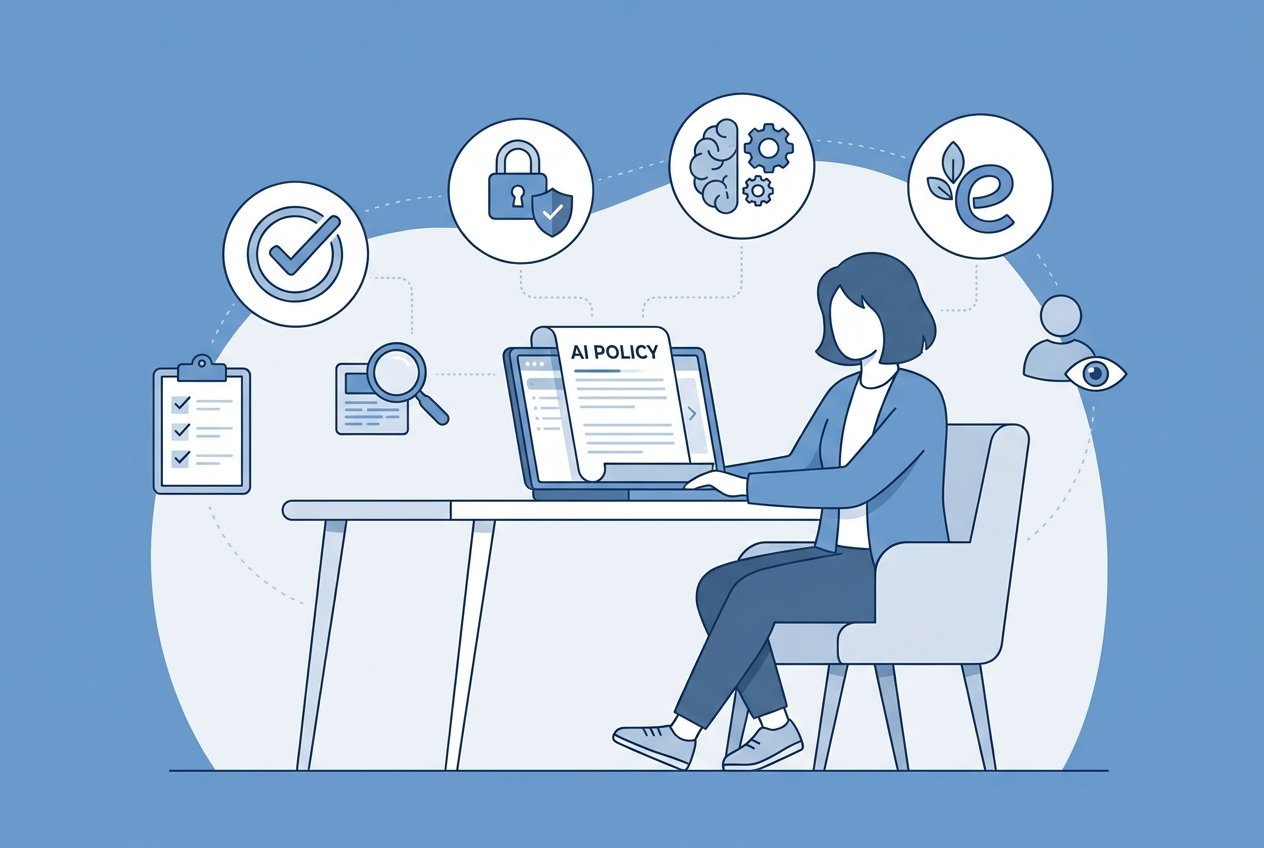
Every small business using AI should have a written AI policy, even a simple one. This document should cover which tools are approved for use, what data can and cannot be entered into AI systems, who is responsible for reviewing AI outputs, and how employees should report concerns. Integrate it into your staff handbook and make it part of onboarding for new team members.
Step 3: Update Your Privacy Notice
If your business uses AI tools that process personal data, your privacy notice must reflect this. Customers and clients have a right to know when AI is being used in ways that affect them. This is not just a legal requirement; it is a key component of building customer trust and demonstrating genuine commitment to trustworthy AI.
Step 4: Implement Human Oversight for High-Stakes Decisions
Any AI-generated output that significantly affects a person, such as a credit decision, a recruitment shortlist, or a personalised pricing offer, must be subject to human review. Document your review process and ensure employees understand when and how to override AI recommendations.
Step 5: Conduct Regular Risk Reviews
AI tools evolve, and so do the risks associated with them. Schedule quarterly reviews of your AI governance framework to assess whether new tools have been introduced, whether your risk classifications remain accurate, and whether any incidents or near-misses need to be documented and addressed.
At Kaizen AI Consulting, we work with small and medium-sized businesses across the UK to develop proportionate AI governance frameworks that protect against regulatory risk while enabling genuine innovation. Whether you are just beginning to explore AI or are looking to formalise the tools you already use, our team can help you build a foundation that is both compliant and commercially effective.
AI Ethics as a Competitive Advantage
It is easy to frame AI governance purely as a compliance burden. But the most forward-thinking small businesses are beginning to recognise that strong business AI ethics is actually a competitive differentiator. Customers increasingly choose to work with businesses they trust with their data. Demonstrating that you take AI governance seriously, that you have a clear policy, that you conduct regular audits, and that you use AI responsibly, signals professionalism and integrity.
This is particularly relevant in B2B contexts, where procurement teams increasingly include AI governance questions in supplier due diligence. Being able to point to a documented AI policy and compliance framework can be the difference between winning and losing a significant contract.
There is also a direct link between good AI governance and better AI outcomes. When businesses take the time to audit their AI tools, test for bias, and implement human oversight, they tend to get more reliable, more accurate, and more useful results from those tools. Governance is not the enemy of innovation; it is the foundation that makes sustainable innovation possible.
If you are considering how to position your business as a responsible AI user, explore our AI consulting services to see how we support UK businesses in building ethical, effective AI strategies from the ground up.
Key Compliance Checklist for UK Small Businesses
To help you get started, here is a concise AI compliance checklist based on ICO guidance and best practice for UK SMEs in 2026:
- Audit all AI tools in use, including embedded AI in existing software.
- Identify what personal data each tool processes and on what lawful basis.
- Complete a DPIA for any AI tool involved in high-risk processing.
- Draft and publish a written AI policy for staff.
- Update your privacy notice to reflect AI data processing.
- Ensure human review is in place for all AI-driven decisions that significantly affect individuals.
- Verify data processor agreements with all third-party AI vendors.
- Test AI outputs for bias, particularly in hiring, pricing, and marketing contexts.
- Establish a process for individuals to contest AI-driven decisions.
- Review and update your governance framework quarterly.
Taking the Next Step
AI governance does not have to be overwhelming. With the right guidance, even the smallest businesses can build frameworks that are robust, proportionate, and genuinely effective. The regulatory environment in the UK is designed to be supportive of innovation while protecting individuals, and small businesses are well-positioned to move quickly and decisively when they have a clear roadmap.
The team at Kaizen AI Consulting specialises in helping UK small businesses navigate the evolving world of AI compliance and governance. From conducting initial AI audits to developing bespoke policies and supporting ongoing compliance reviews, we provide practical, actionable support tailored to the realities of running a small business. Get in touch with our team today to arrange a free consultation and take the first step towards building an AI strategy you can be proud of.