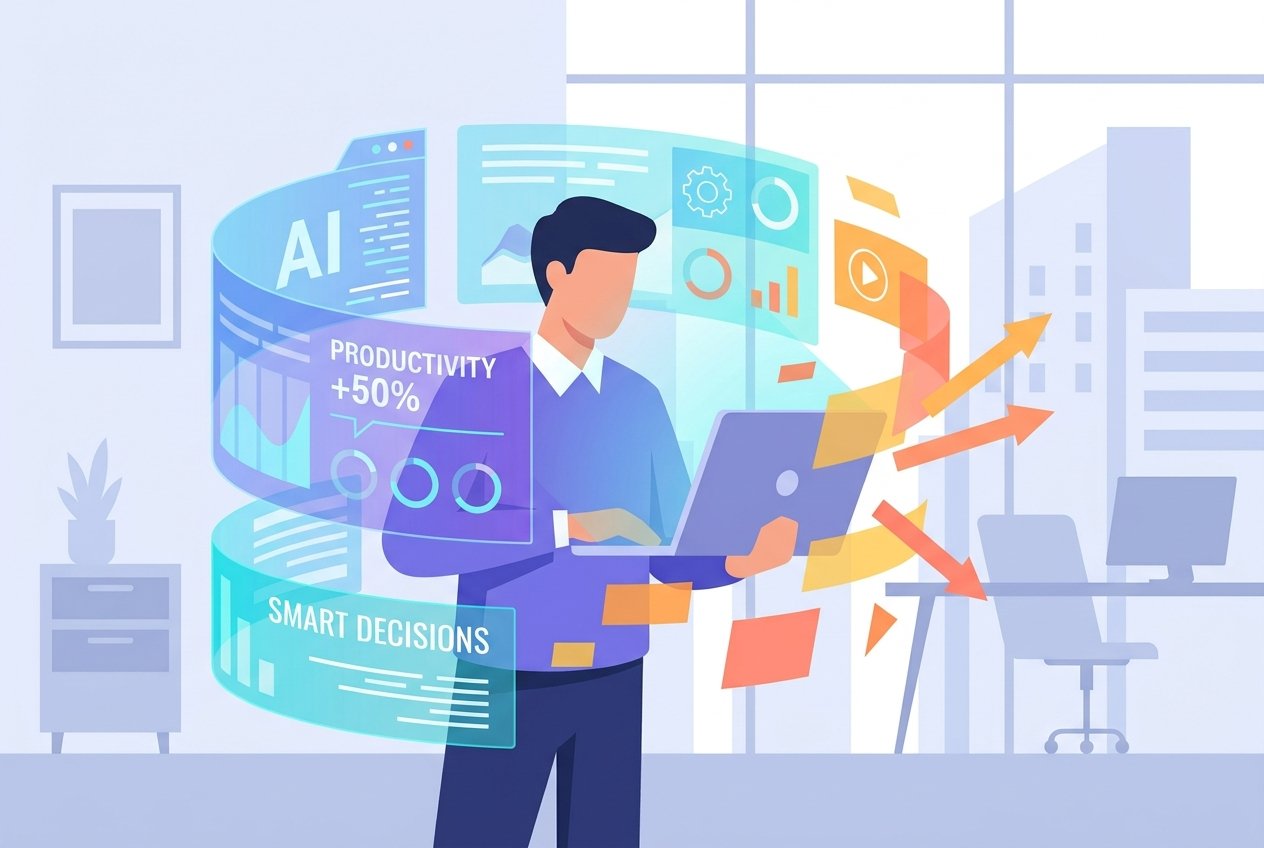
The nature of work is shifting faster than at any point in modern history. Across UK boardrooms, factory floors, and open-plan offices alike, a new kind of employee is emerging: the augmented worker. Empowered by artificial intelligence, these individuals are not simply doing the same job more quickly. They are operating at an entirely different level of capability, producing outputs once thought to require entire teams. In 2026, the superworker concept is no longer a futuristic idea – it is a present-day competitive advantage.
What Is an Augmented Worker?
An augmented worker is an employee whose natural capabilities have been significantly enhanced through the integration of AI tools, automation, and intelligent systems. Rather than replacing the human element, AI acts as a force multiplier – handling repetitive tasks, processing vast datasets in seconds, generating first drafts, flagging anomalies, and surfacing insights that would otherwise take days to uncover.
Industry analyst Josh Bersin, whose research firm coined the term “superworker” in early 2025, describes these individuals as employees who leverage AI for exponentially higher output through workflow redesign and continuous upskilling. His research found that AI-human collaboration can double output across industries, with productivity gains ranging from 30% to 400% depending on the sector and the depth of AI integration.
This is not automation in the traditional sense. It is augmentation: human judgement, creativity, and emotional intelligence paired with machine speed, precision, and scale.
The UK Workforce Context in 2026
The United Kingdom is at a pivotal moment in its AI journey. According to the UK Government’s Assessment of AI Capabilities and the Impact on the UK Labour Market (January 2026), OECD estimates suggest that UK labour productivity growth from AI could reach 0.4 to 1.2 percentage points annually over the next decade, placing the UK second only to the United States among G7 economies.
Critically, around 70% of UK workers are in occupations where AI could directly enhance or perform tasks – a figure higher than the US at 60%, reflecting the service-heavy nature of the British economy. AI adoption among UK small and medium-sized enterprises has surged to 54% in 2026, up from 35% in 2025, and a March 2026 report from the British Chambers of Commerce, Powering Productivity: AI and the Future of UK Work, highlights that businesses using AI are already mapping structured AI career paths for graduates and apprentices, embedding augmentation into workforce planning from day one.
For UK business owners and managers, this signals a clear imperative: those who invest in turning their people into augmented workers will pull ahead. Those who hesitate risk being outpaced by competitors who are already building their superworker cohorts.
The Superworker Concept: What It Looks Like in Practice
Understanding the superworker concept means moving beyond the abstract. Here is what AI workforce enhancement looks like across common UK business functions:
Marketing and Content
A single marketing executive using AI writing assistants, data analysis tools, and automated scheduling platforms can now produce the volume and quality of output that previously required a team of four or five. Campaign briefs, social content calendars, email sequences, performance reports, and competitor analyses can all be generated, refined, and published within hours rather than days.
Sales and Business Development
AI-augmented sales professionals use predictive lead scoring, real-time conversation intelligence, and automated CRM updates to focus their energy entirely on high-value human interactions. Research from McKinsey Global Institute found that top firms investing in AI-powered skills and internal mobility achieve 9% economic profit as a proportion of revenue – significantly outperforming peers.
Finance and Operations
Finance teams using AI for reconciliation, forecasting, anomaly detection, and regulatory reporting can redirect their analytical expertise toward strategic decision-making rather than manual number-crunching. A single finance manager augmented by AI can oversee processes that would once have required a team of analysts.
HR and People Management
Human Resources professionals are among the most affected by AI augmentation. AI tools now handle initial candidate screening, onboarding documentation, compliance monitoring, and personalised learning recommendations – enabling HR managers to focus on culture, leadership development, and retention strategy.
The Numbers Behind AI Productivity
The business case for creating augmented workers is compelling. A recent Harvard Business Review analysis (April 2026) found that approximately 62% of organisations now use AI to augment worker capabilities rather than pursue full automation, and those companies are positioning themselves for stronger long-term competitive performance.
Global research from the Josh Bersin Company found that 57% of organisations using AI report significant productivity gains, with those gains being reinvested into upskilling (38%), research and development (39%), and new AI capabilities (47%). Furthermore, workers with AI skills now command wages up to 56% higher than those without, creating a growing premium for AI-empowered professionals across the UK labour market.
The government’s own UK AI Opportunities Action Plan sets an ambition to upskill 10 million workers by 2030, recognising that AI augmentation – not replacement – is the primary growth lever available to British businesses and the broader economy. With AI potentially adding £232 billion to UK GDP by 2030, according to industry projections, the opportunity for businesses that move now is enormous.
Three Pillars of Building a Superworker Workforce
Creating a culture of AI-augmented productivity does not happen by simply purchasing software licences. It requires a deliberate, structured approach built around three key pillars:
1. Strategic AI Tool Selection
Not all AI tools are created equal, and the wrong investment can create confusion rather than capability. Businesses must audit their existing workflows, identify where human time is most consumed by low-value tasks, and select AI solutions that integrate cleanly with existing systems. The goal is seamless augmentation, not fragmented complexity. This is where working with an experienced AI consultancy at the outset can save significant time and cost – ensuring the right tools are matched to the right roles from day one.
At Kaizen AI Consulting, we work with UK businesses to identify precisely which AI tools and workflows will deliver the greatest productivity uplift for their specific teams, removing the guesswork and helping organisations build their augmented worker capability with confidence.
2. Continuous Upskilling and Human-AI Collaboration Training
The augmented worker is not simply handed an AI tool and left to figure it out. The most effective implementations pair new technology with structured training programmes that help employees understand how to direct AI effectively, how to evaluate AI-generated outputs critically, and how to apply their uniquely human skills – such as relationship management, strategic thinking, and ethical judgement – in combination with machine intelligence.
Gallup research highlights that declining employee engagement is one of the key risks in poorly managed AI transitions, with only 46% of employees reporting clear expectations and 39% feeling genuinely supported. Upskilling programmes that centre the human experience of AI adoption address this directly, turning potential anxiety into genuine competitive advantage.
3. Workflow Redesign Around Augmented Capability
Perhaps the most overlooked pillar: once AI tools are in place and employees are trained, the entire workflow needs to be reimagined. Processes designed for a pre-AI workforce will create bottlenecks and underutilise the new capabilities available. Organisations that redesign their workflows around what augmented workers can now achieve – rather than simply adding AI tools to old processes – are the ones generating the most dramatic productivity improvements.
Challenges to Watch: Avoiding the Augmentation Pitfalls
Building a superworker workforce is not without its challenges. UK businesses navigating AI workforce enhancement must be alert to several potential pitfalls:
Data privacy and GDPR compliance: AI tools that process employee or customer data must be implemented in full compliance with UK GDPR. Any AI deployment that handles personal data requires a clear lawful basis, appropriate data minimisation, and robust security controls.
Over-reliance on AI outputs: Augmented workers who fail to apply critical thinking to AI-generated content risk compounding errors at scale. Training employees to evaluate, challenge, and refine AI outputs is as important as the tools themselves.
Uneven adoption across seniority levels: Research from Stanford and ADP indicates that early-career workers in AI-exposed roles face greater disruption during transition periods. Thoughtful change management that includes junior staff in upskilling programmes – not just senior professionals – is essential for equitable and effective augmentation.
Tool fragmentation: Deploying multiple disconnected AI tools without a coherent integration strategy leads to workflow complexity rather than simplification. A unified AI strategy, ideally developed with specialist guidance, prevents this common and costly mistake.
The Competitive Advantage Is Being Built Right Now
The window for early-mover advantage in AI workforce enhancement is real, but it is narrowing. With 54% of UK SMEs now using AI in some form, the baseline is rising rapidly. The businesses that will define their sectors in the next three to five years are not merely adopting AI – they are systematically building augmented worker programmes that compound over time, creating productivity advantages that become increasingly difficult for competitors to close.
The augmented worker is not a threat to the human workforce. It is the evolution of it. Those who embrace this shift thoughtfully, with the right tools, the right training, and the right strategic framework, will find themselves operating at a level that simply was not possible even two years ago.
If your business is ready to explore how AI can transform your team into augmented workers and build a genuine superworker capability, the team at Kaizen AI Consulting is here to help. From initial AI readiness assessments through to full implementation and workforce training, we partner with UK businesses to make AI augmentation practical, measurable, and commercially impactful. Get in touch today to find out how we can help your people become the superworkers your business needs in 2026 and beyond.