AI for Cash Flow Forecasting: Practical Tools for Small Businesses
Cash flow remains the single biggest threat to small business survival in the UK. According to a report published in April 2026, around 60% of UK SMEs report that outflows surpass inflows for at least half the year, while 38% say they would need over 30 days to secure emergency finance if a sudden shortfall occurred. The average outstanding invoice balance per SME currently sits at a staggering £22,000, and more than 25% of small businesses hold cash reserves that would last fewer than two months.
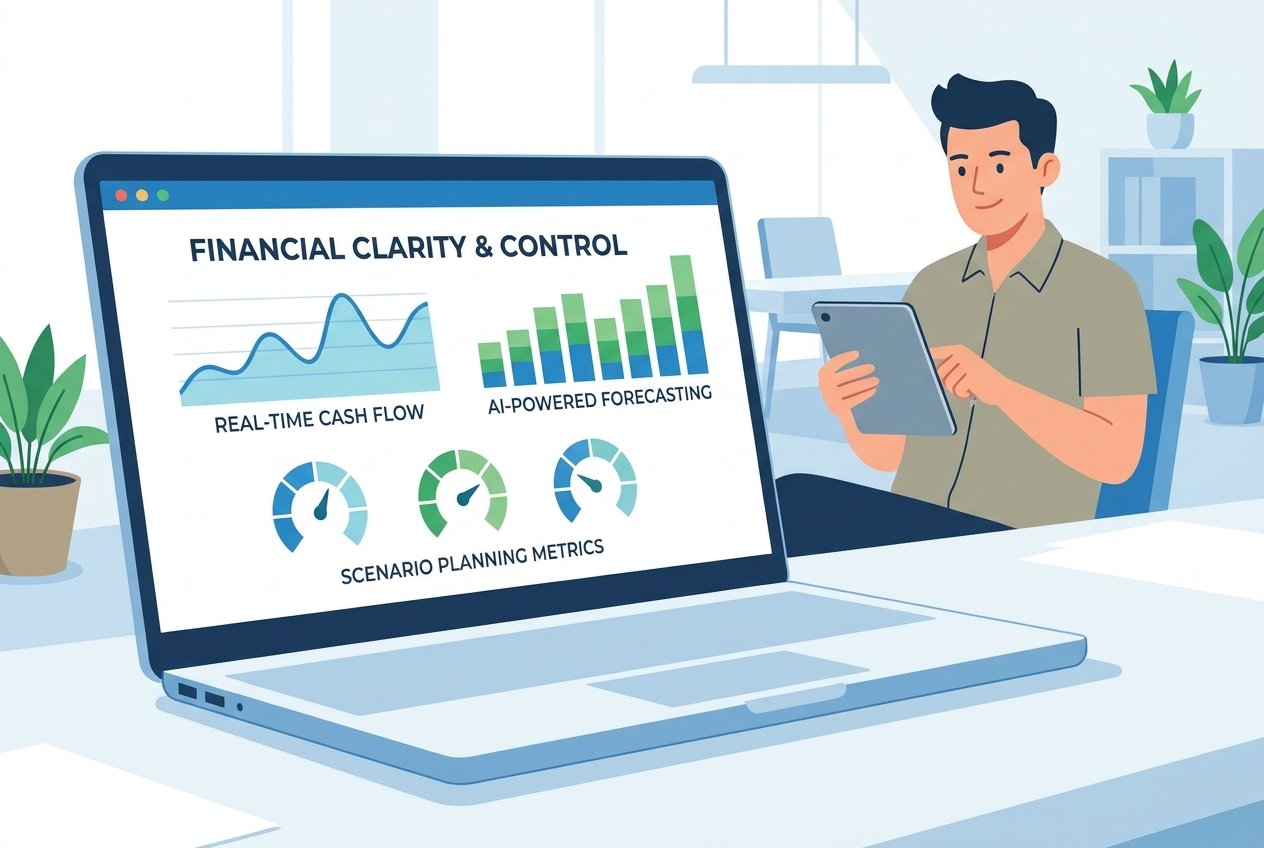
These figures paint a stark picture. Yet many business owners still rely on spreadsheets, gut instinct, or a backwards glance at last month’s bank statement to plan their finances. In 2026, that simply is not good enough. The rise of business finance AI and intelligent financial forecasting tools has changed the landscape entirely, putting the kind of precision once reserved for large corporations firmly within reach of even the smallest UK business. This guide walks you through what cash flow AI actually does, which tools are worth your attention, and how to get started without needing a finance degree.
Why Traditional Cash Flow Management Is Failing UK SMEs
Traditional cash flow management relies heavily on manual data entry, historical spreadsheets, and periodic reviews that are, by definition, out of date the moment they are produced. The Bibby Financial Services SME Confidence Tracker for Q1 2026 found that the SME Confidence Index dropped to just 51% in the first quarter of 2026, down from 66% in Q3 2025, driven largely by rising labour costs, elevated energy bills, and persistent cash flow pressure. Meanwhile, 50% of SMEs reported finding external finance harder to access, and 22% had recent credit applications rejected outright.
With wages inflating at around 5% year on year and macro-economic uncertainty continuing to weigh on demand, the margin for financial error has never been thinner. Static spreadsheets cannot account for seasonal fluctuations, delayed payments, or sudden cost spikes. That is precisely where cash flow AI and automated money management tools step in to provide a real competitive advantage.
What Is AI-Powered Cash Flow Forecasting?
At its core, financial forecasting powered by artificial intelligence uses machine learning algorithms to analyse your historical transaction data, identify patterns, and generate forward-looking projections with far greater accuracy than any human could achieve manually. Rather than asking “what happened last month?”, AI-driven tools ask “what is likely to happen next month, next quarter, or next year, and what variables should I be preparing for?”
Research consistently shows that AI forecasting tools achieve between 92% and 97% precision compared with the 60-70% accuracy rates typical of traditional spreadsheet-based approaches. One study found that a 15% improvement in forecast accuracy alone can deliver a 3% or higher pre-tax improvement in business performance – a material impact for any small business operating on tight margins. Businesses using automated cash forecasting also report up to a 30% accuracy improvement over manual methods, and a 35% reduction in emergency borrowing costs.
For UK businesses specifically, many of these tools also integrate with Making Tax Digital (MTD) compliant accounting platforms, meaning your forecasting can run in near real-time alongside your live bookkeeping data rather than as a separate, disconnected exercise.
The Top AI Cash Flow Forecasting Tools for UK Small Businesses in 2026
Here is a practical breakdown of the leading money management tools that UK small business owners are turning to this year:
1. Float
Float is widely regarded as one of the most accessible cash flow forecasting tools for small UK businesses. Designed as a dedicated add-on for Xero and QuickBooks, it pulls in your live accounting data and generates rolling cash flow projections of up to 36 months. Float supports up to eight different scenarios, making it straightforward to model best-case, worst-case, and expected outcomes side by side. Pricing starts at approximately £59 to £69 per month. It is particularly well suited to businesses that are already using Xero or QuickBooks and want a clean, simple forecasting layer on top of their existing setup.
2. Fathom
Fathom offers a more comprehensive suite that includes three-way forecasting: profit and loss, balance sheet, and cash flow modelling in a single integrated view. Its rolling horizon stretches up to three to five years, and scenario planning tools allow you to model specific events such as hiring a new team member, taking on a lease, or launching a new product line. Fathom integrates natively with Xero, QuickBooks, MYOB, and Sage. For businesses that want a polished, investor-ready reporting layer alongside their forecasting, Fathom is a strong choice.
3. Futrli (by Sage)
Acquired by Sage in 2022, Futrli has become a popular choice among UK accountants and their small business clients. It specialises in short-term cash flow visibility and daily scenario modelling, making it ideal for businesses that need granular week-by-week cash visibility rather than broad annual projections. Its direct forecasting method gives a highly accurate picture of day-to-day cash movements, and Sage integration means it fits naturally into an ecosystem that many UK SMEs already use.
4. QuickBooks Cash Flow Insights
For businesses already using QuickBooks, the built-in Cash Flow Insights feature delivers AI-enhanced forecasting without requiring a separate platform. It handles expense categorisation, invoice automation, tax estimate calculations, and forward-looking cash projections all within the same interface. For sole traders and micro-businesses in particular, this integration-free approach reduces friction and keeps all financial data in one place. QuickBooks is also MTD-compatible, a key consideration for UK businesses managing VAT digitally.
5. Xero Analytics Plus
Xero continues to develop its Analytics Plus feature, which uses AI to provide short-term cash flow projections based on live accounting data. Built directly into the Xero dashboard, it presents upcoming bills, predicted income, and cash position in an intuitive visual format. For small businesses that want simplicity and do not want to add another software subscription, Xero Analytics Plus is a logical starting point before exploring dedicated third-party tools like Float or Fathom.
At Kaizen AI Consulting, we work with UK small businesses to assess which combination of these tools best fits their existing workflows, accounting setup, and growth stage. Rather than recommending a one-size-fits-all solution, our approach is to map your specific financial challenges to the right technology, ensuring you get maximum value from day one.
How to Implement AI Cash Flow Forecasting in Your Business
Adopting business finance AI does not require a technical background or a large budget. The following practical steps will help you move from manual spreadsheets to intelligent forecasting quickly and effectively.
Step 1: Get Your Accounting Data Clean and Connected
AI forecasting tools are only as good as the data you feed them. Before you implement any tool, ensure your accounting software is up to date, your chart of accounts is well organised, and your bank feeds are reconciled. If you are not yet using cloud-based accounting software, this is the moment to make the switch. Both Xero and QuickBooks are MTD-compatible and provide the live data feeds that AI forecasting tools require.
Step 2: Define Your Forecasting Horizon
Different businesses need different forecasting windows. A retail business with tight seasonal cash cycles may need weekly 13-week rolling forecasts. A professional services firm with longer billing cycles might benefit more from monthly projections over 12 to 18 months. Being clear about your forecasting horizon before you select a tool will help you choose the right platform and configure it correctly from the outset.
Step 3: Build and Test Multiple Scenarios
One of the most powerful features of modern financial forecasting tools is scenario modelling. Build at least three scenarios: a base case based on current trends, an optimistic case, and a downside case that accounts for late payments, cost increases, or lost clients. The Flagstone 2026 business resilience report specifically highlights that more UK businesses are moving towards flexible, scenario-based cash management as a core resilience strategy.
Step 4: Review and Act on Forecasts Regularly
A forecast that is generated and then ignored provides no value. Build a regular rhythm of reviewing your cash flow projections, ideally weekly for the short-term view and monthly for the broader horizon. Use the insights to make proactive decisions: accelerating invoice collection, timing supplier payments strategically, or identifying the optimal moment to invest in new equipment or hire additional staff.
The Broader Picture: AI in Your Financial Strategy
Cash flow forecasting is often the entry point for small businesses beginning to explore business finance AI, but it is far from the only application. AI tools can also assist with credit risk assessment, automated debt chasing, pricing optimisation, and financial reporting. According to the UK SME Accounting and Finance Statistics 2026 report, SME borrowing reached an estimated £62.1 billion in 2024/2025, and only 1.5% of UK SMEs applied for bank loans in 2025, compared with 22% in the EU. This financing gap makes proactive, data-driven cash management even more critical for UK businesses that cannot rely on easy access to external credit.
If you are ready to move beyond reactive financial management and build a genuinely forward-looking picture of your business finances, our team at Kaizen AI Consulting is here to help. We specialise in helping UK SMEs identify, implement, and get the most from AI-powered financial and operational tools, including the full range of cash flow forecasting solutions covered in this article. Whether you are just starting your AI journey or looking to optimise a system you already have in place, we offer practical, jargon-free guidance tailored to your business.
Common Pitfalls to Avoid
Even the best cash flow AI tools will underdeliver if they are not used thoughtfully. Watch out for these common mistakes:
- Over-relying on automation without human oversight: AI forecasting is a decision-support tool, not a replacement for financial judgement. Always review outputs in the context of your specific business knowledge.
- Neglecting data quality: Garbage in, garbage out. Irregular reconciliation or miscategorised transactions will skew your forecasts and lead to poor decisions.
- Choosing the most complex tool rather than the most appropriate one: Enterprise-grade platforms like Anaplan or HighRadius are built for large organisations with complex treasury functions. Most UK SMEs are better served by Float, Fathom, or built-in Xero and QuickBooks features.
- Failing to update assumptions: Your forecasting tool needs your input to remain accurate. Update your assumptions regularly to reflect changes in pricing, headcount, contracts, or market conditions.
Take Control of Your Cash Flow Today
The data is clear: UK small businesses that adopt intelligent money management tools and AI-driven financial forecasting gain a measurable advantage in resilience, profitability, and growth capacity. With cash flow pressures intensifying across virtually every sector in 2026, there has never been a better time to upgrade your financial management approach.
Explore more about how AI is transforming small business operations on our Kaizen AI Consulting blog, or get in touch with our team directly to discuss how we can help you find and implement the right cash flow forecasting solution for your business. A short conversation could be the first step towards the financial clarity and confidence your business deserves.