How to Use AI for Competitive Research and Market Analysis
In today’s fast-moving commercial landscape, staying ahead of the competition is no longer just about intuition or periodic market reports. Businesses across the UK are increasingly turning to competitive research AI to gain real-time intelligence, anticipate market shifts, and make faster, evidence-based decisions. Whether you are a growing SME or an established enterprise, understanding how to leverage AI-powered tools for competitor tracking and market analysis has become a genuine strategic necessity.
According to a 2026 benchmark report on UK business AI adoption, UK businesses are spending an average of £15.94 million annually on AI, yet only 31% currently report a positive return on investment. The gap between investment and results often comes down to one thing: strategy. Knowing which AI tools to use, and how to deploy them purposefully, is what separates the businesses gaining a competitive edge from those simply keeping pace.
Why Competitive Research AI Is Transforming UK Businesses
Traditional competitive research was time-consuming, manual, and always at risk of being out of date. A competitor could change their pricing, launch a new product, or shift their marketing messaging overnight, and without the right systems in place, you would only discover it days or weeks later.
AI changes this entirely. Modern market analysis tools powered by artificial intelligence can monitor competitor websites, social media channels, pricing pages, job listings, and press releases continuously and in real time. According to UK Government AI adoption research, over 56% of businesses using AI reported an increase in employee productivity, with marketing and analytics teams benefitting most significantly.
For UK businesses navigating a competitive domestic market alongside global digital competition, the ability to gather, synthesise, and act on competitor intelligence faster than rivals is a decisive advantage.
The Core AI Tools for Competitive Intelligence
The AI-powered competitive research landscape has matured significantly. Below are the key categories of business intelligence AI tools that are delivering measurable results in 2026:
1. SEO and Traffic Intelligence Platforms
Tools such as SEMrush and SimilarWeb have integrated sophisticated AI layers that go far beyond basic keyword tracking. These platforms can now identify which content is driving a competitor’s growth, how their audience demographics are shifting, and where their traffic is originating. For UK businesses targeting local and national search rankings, these tools provide invaluable visibility into competitive positioning within British search results.
SimilarWeb is particularly effective for competitor tracking in terms of audience behaviour, whilst SEMrush excels in identifying keyword gaps, backlink profiles, and organic search opportunities that competitors are capitalising on.
2. Continuous Competitor Monitoring Tools
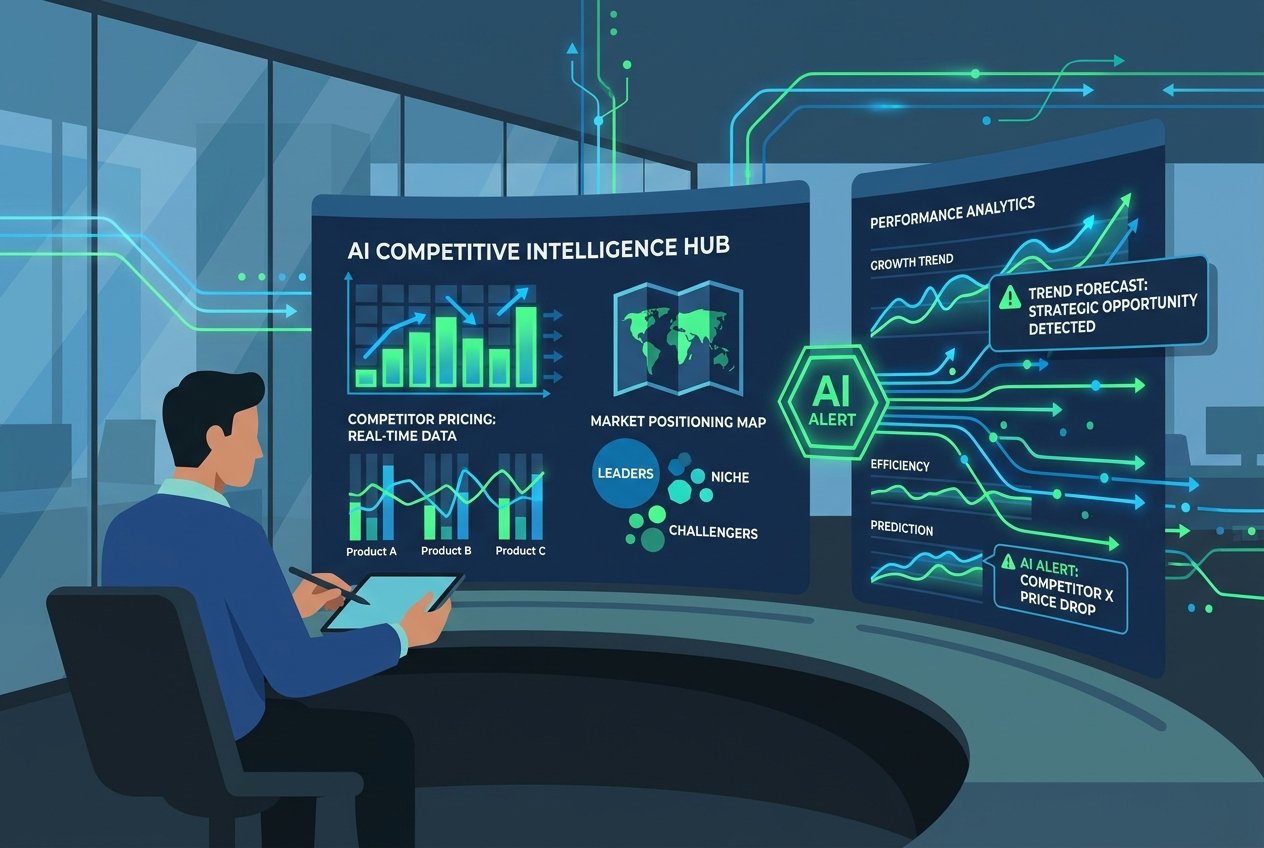
Platforms like Crayon specialise in ongoing competitive intelligence, automatically tracking changes across competitors’ websites, pricing structures, product features, and marketing materials. Rather than scheduling quarterly competitive reviews, these tools provide live alerts whenever a meaningful change occurs, allowing your team to respond proactively.
According to a recent guide to AI market research tools, combining a real-time monitoring platform with an AI synthesis tool such as Perplexity AI or ChatGPT enables businesses to not only capture competitive changes but interpret their strategic significance quickly and accurately.
3. Generative AI for Research Synthesis
Generative AI tools, including ChatGPT and Perplexity AI, have emerged as powerful research accelerators. Rather than spending hours reading competitor content and industry reports, analysts can prompt these tools to summarise key themes, identify market gaps, compare positioning strategies, and even generate hypothetical scenarios for strategic planning. Context-aware AI searches surged by 890% in 2025 according to MIT Sloan Review, demonstrating just how rapidly businesses are adopting this approach for nuanced competitor and market analysis.
A Step-by-Step Framework for AI-Powered Competitive Research
Understanding the tools is only part of the picture. To realise genuine value from competitive research AI, UK businesses need a structured approach. Here is a practical framework you can begin implementing today:
Step 1: Define Your Competitive Intelligence Objectives
Before selecting any tools, clarify what you need to know. Are you tracking competitor pricing? Monitoring their content strategy? Understanding their customer sentiment? Identifying whitespace opportunities in your market? Each objective will determine which AI tools and data sources are most relevant. Businesses that define clear objectives from the outset are far better positioned to demonstrate ROI from their AI investments.
Step 2: Conduct an AI Readiness Assessment
Audit your existing data sources and workflows. What customer data, market data, and competitive data do you already hold? Which systems will your AI tools need to integrate with? According to NCS London’s 2026 AI adoption roadmap, UK businesses that invest time in an AI readiness assessment before tool selection consistently achieve faster time-to-value than those who jump straight to implementation.
Step 3: Build Your AI Market Analysis Stack
A well-constructed market analysis tools stack typically includes three layers: a data gathering layer (tools like SimilarWeb or Crayon for raw intelligence), a synthesis layer (generative AI tools for interpretation), and a reporting layer (business intelligence dashboards for visualising insights and sharing them across your organisation). The most effective stacks are integrated via APIs so that data flows automatically without manual intervention.
At Kaizen AI Consulting, we work with UK businesses to design and implement bespoke AI tool stacks precisely suited to their competitive intelligence needs, ensuring each layer works in harmony and delivers actionable insights rather than raw data overload.
Step 4: Establish Ethical Data Governance
This step is non-negotiable for UK businesses. Any AI-driven competitive research must comply with GDPR and the UK’s evolving AI governance framework. Practically, this means limiting your data gathering to publicly available information, anonymising any personal data used in analysis, and ensuring your team understands the boundaries of ethical competitor tracking. Deloitte UK’s 2026 State of AI in the Enterprise report notes that worker access to AI rose 50% in 2025, making robust governance frameworks more important than ever to maintain compliance at scale.
Step 5: Train Your Team and Scale Gradually
The skills gap remains one of the most significant barriers to AI adoption in the UK, with over 60% of UK SMEs citing skills shortages as a primary challenge. Rather than hiring AI specialists immediately, the most effective approach is to upskill existing marketing, sales, and strategy teams on practical AI tool usage. Begin with two or three targeted use cases, demonstrate measurable results, and then scale outward across the organisation.
The Business Intelligence AI Opportunity: Key Statistics for UK Leaders
The case for investing in AI-driven competitive research is compelling when you examine the data:
- AI adoption in marketing boosts overall marketing ROI by an average of 38% through improved customer data analysis and targeting, according to SQ Magazine’s 2026 AI marketing statistics report.
- AI-driven marketing also reduces customer acquisition costs by an average of 23%.
- 72% of UK businesses are now applying AI constantly within their marketing and administrative functions.
- 82% of UK Chief Marketing Officers report increased confidence in their forecasting capabilities following AI adoption.
- High-performing organisations that redesign their workflows to embed AI enterprise-wide outperform point deployments by 3 to 5 times in measurable business outcomes.
Despite these impressive figures, only 31% of UK companies report a positive ROI from AI to date. The primary differentiator between those achieving results and those struggling is the presence of a clear strategy and expert implementation support.
Agentic AI: The Next Frontier in Competitor Tracking
One of the most significant developments in business intelligence AI for 2026 is the rise of agentic AI systems. Unlike traditional tools that require manual queries, agentic AI can autonomously perform multi-step research tasks, such as monitoring a competitor’s pricing page, cross-referencing it against their recent job listings, and generating a strategic briefing, all without human intervention.
According to the McKinsey Global AI Survey 2025, 62% of organisations are already experimenting with AI agents, with 64% reporting innovation improvements as a result. For competitive intelligence specifically, agentic AI represents a step change: rather than pulling insights on demand, your systems can proactively surface competitive threats and opportunities as they emerge.
If you are considering how agentic AI could be applied within your competitive research workflows, the team at Kaizen AI Consulting’s services includes specialists who can assess your current processes and identify where autonomous AI agents would deliver the greatest competitive advantage for your business.
Common Pitfalls to Avoid in AI-Powered Market Analysis
As with any powerful technology, there are important mistakes to avoid when deploying market analysis tools powered by AI:
- Over-relying on a single tool: No single platform provides a complete competitive picture. A layered approach combining multiple specialist tools always outperforms a single solution.
- Ignoring data quality: AI systems are only as accurate as the data they consume. Invest time in ensuring your data sources are reliable, current, and relevant to the UK market.
- Failing to act on insights: Many businesses generate competitive intelligence but lack the internal processes to translate it into strategic decisions quickly. Build a workflow that connects insights directly to action.
- Neglecting GDPR compliance: Particularly when using AI tools that may scrape or process external data, always verify that your practices comply with UK data protection law.
Getting Started: Your Competitive Intelligence Action Plan
The businesses gaining the most from AI-driven competitive research in 2026 are those that took deliberate, structured steps rather than adopting tools reactively. Start by identifying your top three competitive intelligence priorities, select two or three AI tools that directly address those priorities, establish your governance framework, and commit to a 90-day pilot with clear success metrics.
If you want expert guidance on building an AI-powered competitive research capability that is tailored to your industry and compliant with UK regulations, get in touch with the team at Kaizen AI Consulting today. We help UK businesses move from AI curiosity to AI-driven competitive advantage with a structured, results-focused approach.
The competitive intelligence landscape is evolving rapidly. The businesses investing in the right AI foundations now will be the ones defining their markets in the years ahead.