The conversation around AI agents small business adoption has shifted dramatically. In 2026, we are no longer asking whether autonomous tools belong in a small business toolkit. The question now is which implementations deliver measurable results, and which ones drain budget without return.
At Kaizen AI Consulting, we work with small and medium enterprises across the UK to identify practical applications of agentic AI and avoid the common pitfalls that waste both time and capital. This guide draws on the latest 2026 data and real-world deployments to show you what actually works, what does not, and where to start.
Understanding Agentic AI in the 2026 Small Business Landscape
Agentic AI differs from standard generative AI in one critical way: autonomy. Rather than simply responding to prompts, an AI agent can observe triggers, make decisions within defined parameters, and execute actions across multiple systems without constant human input. For a small business, this means a customer enquiry could be received, qualified, routed, and responded to while you focus on higher-value work.
Yet autonomy does not mean complete independence. The most successful deployments in 2026 share a common trait: narrow scope with clear boundaries.
According to March 2026 data from the SBE Council, the average small business now uses a median of five AI tools, with most owners planning to add more throughout the year. The most common use cases include general business research, marketing and content creation, customer service, sales support, administrative automation, and financial management forecasting. Read the full SBE Council report here.
This pattern tells us something important. Small businesses are moving away from searching for a single all-in-one solution and instead assembling an AI stack where each tool handles a specific, well-defined job.
What Actually Works: Proven AI Agent Examples
Customer Service and Lead Management
Customer-facing automation remains one of the strongest use cases. AI agents that handle incoming calls, website chat, text messages, email, and social media direct messages in real time are now reliable enough to operate around the clock. Platforms such as My AI Front Desk and Tidio have demonstrated consistent results in autonomous AI tools deployment for small businesses.
The key success factor is escalation. The best implementations automate routine enquiries while seamlessly transferring complex issues to human team members. This hybrid model protects customer relationships while maximising efficiency. See the latest efficiency data here.
Marketing and Content Production
Marketing continues to be the most common entry point for small businesses exploring AI. Beyond basic drafting with ChatGPT, Claude, and Gemini, dedicated marketing agents now operate with greater autonomy. Platforms such as NoimosAI function as autonomous marketing squads handling strategy, SEO, and social media scheduling. Relevance AI enables no-code multi-agent workflows for personalised outreach at scale.
However, a critical shift has occurred. Generic content generation without differentiation is proving less valuable. As AI-assisted search becomes the norm, content originality and authority are rewarded. Small businesses using agentic AI 2026 for marketing must therefore focus on quality and brand voice rather than volume alone.
Workflow Automation and System Integration
This is where agentic AI begins to transform operations. Tools such as Zapier Central, MindStudio, Gumloop, and CrewAI allow small businesses to build workflows triggered by real events, such as a new lead entering a system, an invoice becoming overdue, or inventory falling below threshold.
The agent then performs a sequence of actions: researching the lead, drafting personalised outreach, updating CRM records, scheduling follow-ups, and notifying the appropriate team member. All of this occurs without manual intervention.
The differentiator in 2026 is integration depth. Agents that connect directly to Shopify, HubSpot, Stripe, calendars, email systems, and shipping platforms deliver far greater value than isolated tools. Research shows businesses save 12 or more hours weekly with well-integrated automation.
Sales Support and Pipeline Management
When narrowly scoped, sales agents prove highly practical. Effective implementations focus on lead qualification, personalised outreach, meeting scheduling, and pipeline analysis. The pattern is the same: specific tasks, clear rules, and human oversight for exceptions.
What Does Not Work: Common Pitfalls to Avoid
For every successful deployment, there are failures. Understanding why certain approaches fail will protect your investment.
Overly Broad Autonomous Promises
The most significant risk in 2026 remains the over-promise of generalist agents that claim to replace multiple roles simultaneously. Without clearly defined task boundaries, these tools produce inconsistent results, miss contextual nuances, and create more work through error correction than they save.
Lack of System Integration
An agent that cannot access your existing systems is little more than a chat interface. The critical requirement for practical AI agents is end-to-end action capability. If your AI cannot update records, trigger processes, or communicate across platforms, the workflow remains manual.
Fully Hands-Off Customer Interactions
Despite advances in natural language processing, fully autonomous customer service without human escalation remains problematic. Customers still detect robotic interaction, and complex issues require judgment that current agents lack. The superior model is automation for the routine with seamless handoff for the complex.
Neglecting Data Security and Privacy
With the UK GDPR framework and increasing regulatory scrutiny, small businesses must consider where customer data travels. Platforms offering private cloud deployment, such as Lyzr, are gaining traction among businesses handling sensitive information.
The Winning Formula: A Practical AI Stack
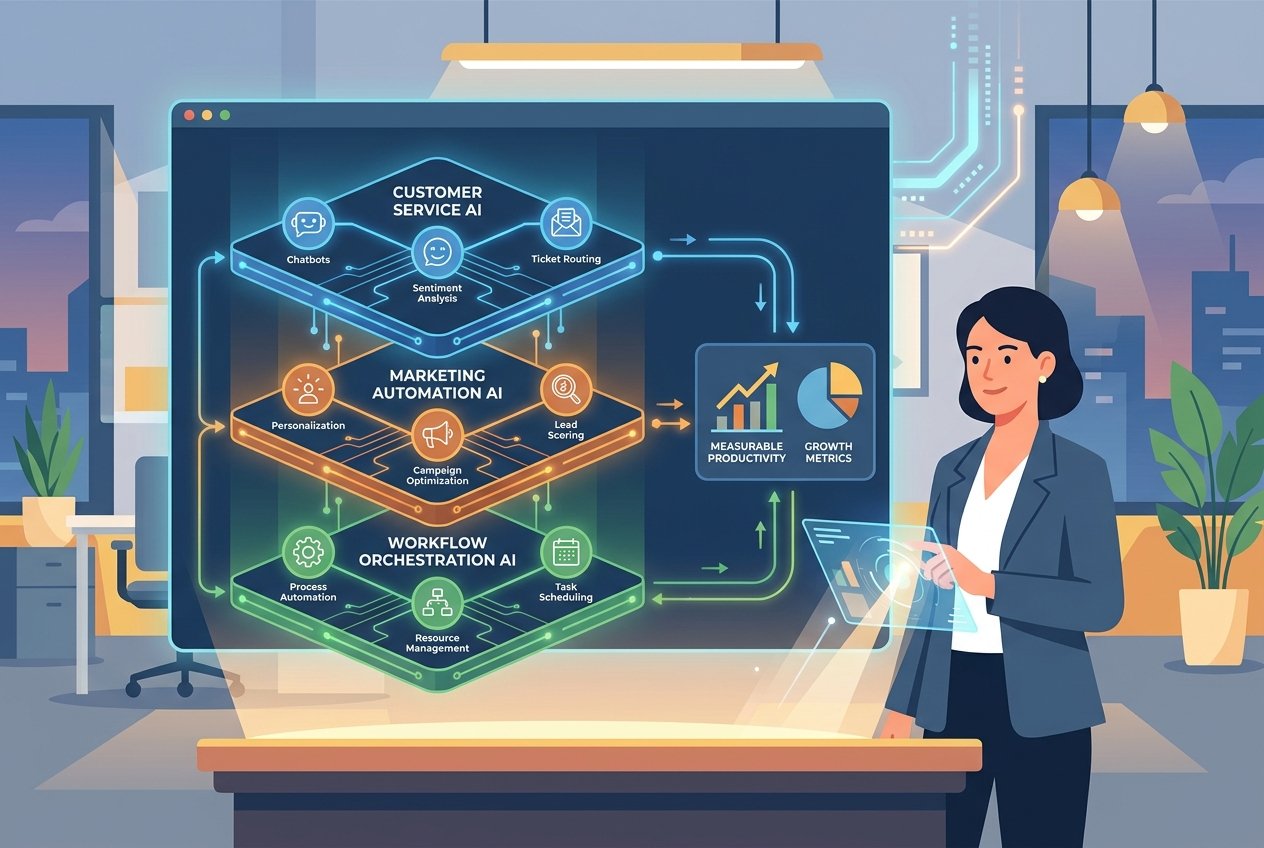
Based on 2026 adoption patterns, the most effective approach is not a single tool but a structured stack:
- One general assistant for research, drafting, and ideation
- One customer-facing agent for service, chat, and lead capture
- One automation or orchestration platform for connecting systems and managing workflows
This three-layer approach provides broad capability without overwhelming complexity or budget.
For businesses uncertain where to begin, our AI consulting services at Kaizen AI Consulting provide structured assessments to identify which applications will generate the highest return for your specific operations.
Steps to Implement AI Agents Successfully
Adoption should follow a deliberate sequence rather than reactive purchasing.
First, audit your highest-volume repetitive tasks. The best candidates for automation are frequent, rule-based, and time-consuming. These represent your quickest wins.
Second, evaluate integration requirements. Map your existing software stack and identify which platforms connect natively with available agents.
Third, start with one narrowly scoped deployment. Prove value in a single area before expanding. This reduces risk and builds organisational confidence.
Fourth, establish human oversight protocols. Define exactly when and how an agent escalates to your team. This protects quality and compliance.
Fifth, measure return on investment. Track time saved, response speed, lead conversion rates, and error rates. Data validates continuation or adjustment.
Our team at Kaizen AI Consulting regularly guides businesses through this exact process. Whether you need help selecting platforms, designing workflows, or training your team, contact us to discuss how we can accelerate your AI adoption with less risk and greater clarity.
Looking Ahead: Preparing for the Next Phase
AI agent capability will continue to expand throughout 2026 and beyond. Small businesses that establish disciplined foundations now, selecting the right autonomous AI tools with proper boundaries and integrations, will be positioned to adopt more advanced capabilities as they mature.
The businesses that struggle will be those that chase novelty without strategy. The winners will be those that treat AI as a lever for existing strengths, amplifying what already works rather than attempting to replace core competencies.
Conclusion
AI agents small business adoption in 2026 is not about finding a magic solution. It is about identifying practical applications, integrating them properly, and maintaining human oversight where judgment matters. With the average UK small business now running five AI tools and planning to expand, the competitive advantage belongs to those who deploy wisely rather than widely.
If you want expert guidance on building your AI stack, explore how Kaizen AI Consulting helps UK businesses implement agentic AI with measurable results. The right strategy turns artificial intelligence into genuine business advantage.