Every business owner knows the frustration: you spend hours crafting detailed standard operating procedures and training manuals, only to discover that nobody reads them. Documents gather digital dust in shared drives, new starters feel overwhelmed by walls of text, and experienced team members quietly develop their own workarounds. The result? Inconsistency, errors, and a constant cycle of retraining that drains time and money.
The good news is that AI SOP creation tools have fundamentally changed how UK businesses build, maintain, and distribute operational documentation. In 2026, the best teams are no longer trying to write more SOPs. They are building living process documentation that reflects how work actually happens, updated automatically as processes evolve. Here is how you can harness this technology to create training guides your team will genuinely use.
Why Traditional SOPs Fail (And Why It Matters for UK Businesses)
Before diving into solutions, it is worth understanding the scale of the problem. According to FirstHR’s 2026 onboarding report, 66% of small business employees feel undertrained after onboarding, often because documentation is outdated, unclear, or simply too long. Meanwhile, research from Swag Box reveals that the average cost-per-hire in the UK sits at around 3,000 pounds, with replacement costs reaching 33% of a departing worker’s annual salary when onboarding fails.
An IDC report referenced by GOV.UK found that new employees who do not understand their role cost US and UK companies approximately 28 billion pounds every year. Poor documentation is not merely an inconvenience; it is a significant financial liability.
Traditional SOPs fail for several predictable reasons:
- They are static: Written once and rarely updated, they quickly fall out of step with real workflows.
- They lack context: Text-heavy documents without visuals or step-by-step screenshots feel impersonal and hard to follow.
- They are created in isolation: Typically written by managers who may not perform the tasks daily, leading to gaps and inaccuracies.
- They are buried: Stored in folders nobody checks, with no integration into daily workflow tools.
How AI Is Transforming Standard Operating Procedures Automation
The emergence of standard operating procedures automation through AI represents a genuine step change. Rather than starting from a blank page, modern AI tools can generate, maintain, and even deliver SOPs in ways that traditional documentation simply cannot match.
1. Capture-First Documentation
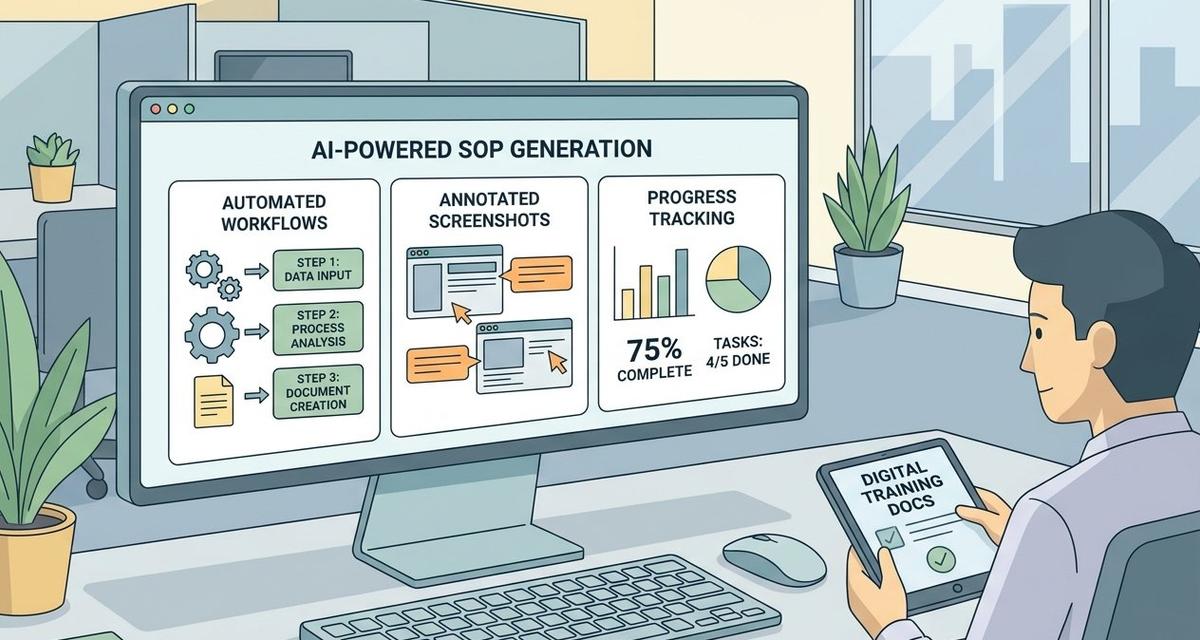
One of the most significant developments in employee documentation AI is the rise of capture-first tools. Platforms such as Scribe, Tango, and Guidde use browser extensions to record your clicks, keystrokes, and screen activity as you complete a task. The AI then automatically generates step-by-step guides complete with annotated screenshots, descriptive text, and logical formatting.
This approach solves two critical problems simultaneously. First, it captures the process as it is actually performed, not as someone remembers it. Second, it reduces documentation time from hours to minutes. According to AiDocX’s 2026 comparison, leading AI tools can generate 80% of a structured SOP in under 15 minutes.
2. Living Documentation That Updates Itself
Perhaps the most powerful feature of modern training manual AI tools is their ability to detect changes and update documentation automatically. As noted by StorytoDoc’s software comparison, AI is no longer just helping create SOPs faster; it is maintaining them automatically. When a software interface changes, a new compliance requirement is introduced, or a process step is modified, the AI flags the outdated section and suggests or implements updates.
For UK businesses navigating frequent regulatory changes, from GDPR updates to sector-specific compliance requirements, this capability alone can save dozens of hours each quarter.
3. Multi-Format, Multi-Language Output
Modern AI SOP generators produce documentation in multiple formats (PDF, Word, interactive web pages, video walkthroughs) and can translate content into multiple languages. For UK businesses with diverse teams or international operations, this removes a significant barrier to documentation adoption.
A Step-by-Step Guide to Creating AI-Powered SOPs
Ready to implement AI SOP creation in your business? Follow this practical framework to get started.
Step 1: Audit Your Existing Documentation
Before introducing any new tools, take stock of what you already have. Identify which SOPs are outdated, which processes lack documentation entirely, and which documents your team actively ignores. This audit will help you prioritise where AI can deliver the greatest immediate impact.
Focus on processes that are performed frequently, prone to errors, or critical for compliance. Common starting points include customer onboarding workflows, financial reconciliation procedures, IT setup guides for new starters, and health and safety protocols.
Step 2: Choose the Right AI Tools
The training manual AI landscape in 2026 offers a wide range of options. According to Whale’s 2026 review, the leading platforms include:
- AiDocX: Best for structured, multi-language SOPs with role assignments and e-signature capabilities.
- Whale: A unified SOP platform offering automated drafting from text prompts and screen recordings.
- Scribe: Ideal for software-based click-through workflows requiring annotated screenshots.
- Trainual: Best suited for businesses that also need an integrated Learning Management System.
- Process Street: Focuses on workflow automation and aligning process maps with SOPs.
The right choice depends on your specific needs. A small professional services firm might benefit most from Scribe’s simplicity, while a growing e-commerce business with a larger team might need Trainual’s built-in LMS features.
Step 3: Record Real Workflows
Rather than writing SOPs from memory, use your chosen tool to record processes as they happen. Have your most experienced team member perform the task while the AI captures every step. This approach, known as capture-first generation, ensures your documentation reflects reality rather than theory.
Step 4: Refine and Customise the Output
AI-generated drafts provide an excellent starting point, but they benefit from human review. Add context that only your team would know: common pitfalls, tips for efficiency, and explanations of why certain steps matter. This human layer transforms a functional document into a genuinely useful training resource.
Step 5: Integrate SOPs Into Daily Workflows
The final and most crucial step is making your documentation accessible where work actually happens. Embed SOPs into project management tools, link them from onboarding checklists, and set up automated reminders for periodic reviews. If your team needs to leave their workflow to find a document, they probably will not bother.
Using AI for Onboarding: A Game-Changer for UK Employers
Onboarding AI represents one of the highest-value applications of automated documentation. With UK hiring costs projected to rise by approximately 10% in 2026 according to industry analysis shared on LinkedIn, getting new employees productive quickly is more important than ever.
AI-powered onboarding documentation can:
- Personalise the experience: Generate role-specific training paths rather than one-size-fits-all manuals.
- Track progress: Monitor which sections new starters have completed and where they are struggling.
- Reduce time-to-competency: Interactive, visual guides help new team members learn faster than dense text documents.
- Scale effortlessly: Whether you are onboarding one person or twenty, the documentation remains consistent.
For businesses looking to implement onboarding AI effectively, the key is combining automated documentation with a structured human support system. AI handles the repeatable knowledge transfer, freeing managers to focus on relationship building and role-specific mentoring.
How Kaizen AI Consulting Can Help You Get Started
While the tools are increasingly accessible, many UK businesses find that the real challenge is not the technology itself but knowing how to implement it strategically. Selecting the right tools, mapping existing processes, training teams on new workflows, and integrating documentation into existing systems requires careful planning.
At Kaizen AI Consulting, we specialise in helping businesses identify the AI tools and strategies that deliver genuine operational improvements. Our AI Implementation and Integration service is designed to take you from initial assessment through to full deployment, ensuring your team adopts new systems confidently and effectively. Whether you need help selecting the right SOP platform, mapping your core processes, or building a complete employee documentation AI strategy, our team can guide you through every stage.
Best Practices for SOPs Your Team Will Actually Follow
Regardless of which tools you choose, these principles will help ensure your documentation gets used:
- Keep it visual: Use screenshots, screen recordings, and flowcharts wherever possible. People process visual information significantly faster than text.
- Write for the reader, not the writer: Use clear, simple language. Avoid jargon unless your audience expects it.
- Make updates easy: Choose tools that allow quick edits and version control. A document that is difficult to update will quickly become outdated.
- Assign ownership: Every SOP should have a named owner responsible for keeping it current.
- Gather feedback: Ask the people who use your documentation what is working and what is not. Their insights are invaluable.
- Review regularly: Set quarterly review cycles as a minimum. AI can automate much of this, but human oversight remains essential.
The Bottom Line
The gap between businesses that document well and those that do not is widening. AI has made it faster, cheaper, and more effective to create SOPs and training guides that people genuinely use. For UK businesses facing rising employment costs and increasing competition for talent, investing in standard operating procedures automation is no longer optional; it is a competitive necessity.
The best time to start was yesterday. The second-best time is now. If you are ready to transform how your business creates, manages, and delivers operational documentation, get in touch with Kaizen AI Consulting today for a free consultation. We will help you identify the quickest wins and build a documentation strategy that scales with your business.


