Case Study: How a Nottingham Plumbing Company Built an AI Receptionist That Books Jobs 24/7
When you are elbow-deep in pipework under a kitchen sink, the last thing you can do is answer the phone. Yet for plumbing businesses across the East Midlands, every unanswered call is a customer lost to a competitor. Research from 2026 shows that 62 per cent of calls to home-service businesses go unanswered during working hours, and 78 per cent of customers simply choose whichever company picks up first.
This is the story of how one Nottingham-based plumbing firm turned that problem into its biggest competitive advantage by deploying a plumbing AI receptionist that never clocks off, never calls in sick, and books jobs around the clock.
The Problem: Missed Calls, Missed Revenue
Our case study centres on a five-person domestic plumbing and heating team operating across Nottingham and surrounding areas such as Arnold, Beeston, and West Bridgford. Like many trades businesses in the East Midlands, the company relied on a mix of personal mobiles and a shared office line managed by an office administrator who worked Monday to Friday, 9 am to 5 pm.
The team knew they were missing calls but had no idea how many. After installing basic call tracking for a single month, the results were stark:
- 37 per cent of weekday calls went to voicemail
- 100 per cent of evening and weekend calls were missed entirely
- Of callers who reached voicemail, fewer than one in three left a message
That final point is critical. According to industry data, 86 per cent of callers will not leave a voicemail, meaning the vast majority of missed calls simply vanish, along with the revenue they represent. For a plumbing company where a typical boiler repair or emergency call-out is worth between 180 and 300 pounds, even five missed calls a week can add up to more than 24,000 pounds in lost annual revenue.
Why Traditional Solutions Were Not Working
The company had tried several approaches before exploring voice AI for trades:
Hiring a second receptionist: At an annual cost north of 25,000 pounds including employer National Insurance contributions, this only covered weekday hours and did nothing for the 35 per cent of enquiries that arrived between 6 pm and 9 am.
Traditional answering services: These provided a human voice but lacked the ability to check diary availability, quote estimated arrival windows, or distinguish between an emergency leak and a routine tap replacement. Messages were emailed through, often hours later, by which time the customer had already booked elsewhere.
Call-back forms on the website: Conversion rates were low. Customers with a burst pipe at 11 pm want to speak to someone, not fill in a form and hope for a response the next morning.
The business needed 24/7 booking automation that could handle calls intelligently, capture job details, and slot appointments into the live schedule without human intervention.
The Solution: Building an AI Phone Answering System
Working with Kaizen AI Consulting, the company designed and deployed a custom AI receptionist tailored to its specific workflows. Rather than opting for a generic off-the-shelf product, the team chose a bespoke approach that could be trained on the exact language, pricing structures, and service areas relevant to a Nottingham plumbing business.
How the AI Receptionist Works
The system was built around four core capabilities:
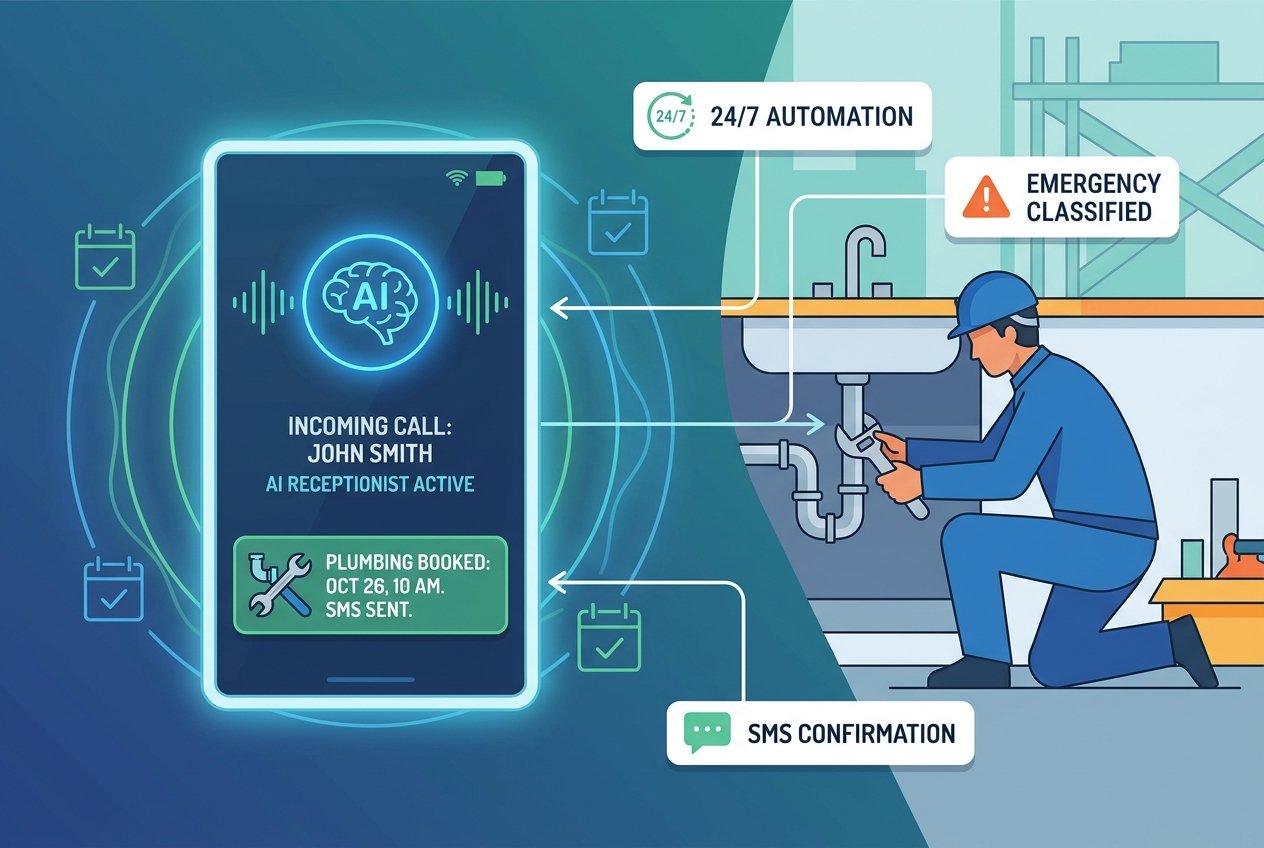
1. Natural conversation in a UK voice: The AI answers in a friendly, natural-sounding British accent. It greets callers by the company name, asks qualifying questions about the nature of the job, and captures essential details including postcode, property type, and urgency level.
2. Intelligent job classification: The AI was trained to distinguish between emergency call-outs (burst pipes, gas leaks, no hot water) and routine work (dripping taps, radiator replacements, bathroom installations). Emergency calls trigger an immediate SMS alert to the on-call engineer, while routine enquiries are booked into the next available slot.
3. Live calendar integration: The AI connects directly to the company scheduling system. It can see real-time availability, offer callers a choice of appointment slots, and confirm bookings on the spot. No more playing phone tag or double-booking engineers.
4. Post-call follow-up: After each call, the system sends a WhatsApp or SMS confirmation to the customer with the appointment details, the engineer name, and an estimated arrival window. It also logs every interaction in the CRM for the office team to review each morning.
The Implementation Process
From initial scoping to go-live, the project took just under four weeks. The process followed a structured approach:
Week 1 – Discovery: Mapping existing call flows, identifying the twenty most common call scenarios, and documenting the business rules for pricing, availability, and service area boundaries.
Week 2 – Build and training: Creating the AI voice agent, training it on real call transcripts, and integrating it with the scheduling and CRM platforms the company already used.
Week 3 – Testing: Running the AI alongside the human receptionist in a shadow mode, comparing its responses and booking accuracy against the human baseline.
Week 4 – Go-live and optimisation: Switching the AI to primary answering, monitoring call quality daily, and fine-tuning responses based on real-world performance data.
The total setup cost was a fraction of what the company had been spending on its combination of part-time receptionist and outsourced answering service.
The Results: Six Months On
After six months of operation, the numbers tell a compelling story:
| Metric | Before AI | After AI |
|---|---|---|
| Calls answered | 63% | 100% |
| After-hours bookings per month | 0 | 34 |
| Average booking confirmation time | 4.2 hours | Under 2 minutes |
| Monthly revenue from new bookings | Up baseline | Up 41% |
| Customer satisfaction (post-job survey) | 4.1 out of 5 | 4.6 out of 5 |
| Monthly cost of call handling | Approx. 1,800 pounds | Approx. 250 pounds |
The most striking figure is the after-hours bookings. Thirty-four additional jobs per month that previously would have gone to competitors are now being captured automatically. At an average job value of 220 pounds, that represents roughly 7,480 pounds in additional monthly revenue from a system costing around 250 pounds to run.
This aligns with broader industry findings showing that trades businesses using AI call handling see a 30 to 50 per cent increase in booked jobs, while reducing call-handling costs by 60 to 85 per cent compared to traditional answering services.
Lessons for Other Trades Businesses
The success of this Nottingham business offers several practical takeaways for plumbers, electricians, builders, and other trades considering AI phone answering:
1. Start With Your Biggest Pain Point
For this company, the pain point was after-hours calls. For another business it might be managing high call volumes during the morning rush or filtering emergency jobs from routine enquiries. Identifying the specific problem ensures the AI is configured to deliver immediate, measurable value.
2. Train the AI on Your Business, Not Generic Scripts
The reason this system outperforms generic solutions is that it was trained on the company’s actual call data. It knows that NG postcodes are in the service area. It knows the difference between a combi boiler and a system boiler. It understands that a customer saying “there is water coming through the ceiling” needs an emergency response, not a next-week appointment.
3. Keep Humans in the Loop
The AI does not replace the team. It handles the initial call, captures the information, and books the job. The office administrator still reviews bookings each morning, manages complex queries that the AI escalates, and handles customer relationships. The AI simply ensures that no opportunity is lost while the team is busy doing what they do best: fixing pipes.
4. Measure Everything From Day One
Without the initial month of call tracking, this company would never have known it was losing 37 per cent of weekday calls. Data drives decisions. Set up tracking before you deploy any solution so you can measure the true impact.
The Nottingham Business Context
This case study is particularly relevant given the current state of the trades sector in the East Midlands. The UK plumbing, heating, and air conditioning installation industry now comprises over 45,400 businesses with a market size of 23.6 billion pounds. Plumbing is the most in-demand trade in the country, generating an average of 180,370 monthly searches.
In Nottingham specifically, demand continues to grow as the city expands and housing stock ages. With companies across Derby and the wider East Midlands actively expanding to meet rising demand, competition for every customer call is fiercer than ever. The businesses that answer first will win the job. It really is that simple.
Meanwhile, AI adoption among UK trades has surged from fewer than 100 businesses in 2024 to over 1,000 by mid-2026. Early adopters are gaining a significant first-mover advantage, capturing revenue that competitors are still leaving on the table.
Is an AI Receptionist Right for Your Trades Business?
Based on industry benchmarks, a plumbing AI receptionist or voice AI for trades solution is likely to deliver a strong return if your business meets any of the following criteria:
- You receive 20 or more calls per week
- You miss calls regularly because your team is on site
- You receive enquiries outside standard office hours
- Your average job value exceeds 150 pounds
- You operate in a competitive local market like Nottingham where response time matters
If even two of those apply, the maths is straightforward. An AI receptionist costing between 60 and 250 pounds per month pays for itself by capturing just one extra job every fortnight.
How Kaizen AI Consulting Can Help
At Kaizen AI Consulting, we specialise in designing and deploying custom AI implementation and integration solutions for businesses across the UK. Unlike off-the-shelf products, we build AI receptionists that are trained on your specific business processes, service areas, and customer language.
Whether you are a sole-trader plumber in Nottingham or a multi-van operation covering the East Midlands, we can help you capture every call, book more jobs, and grow your revenue without adding headcount. Our approach follows the same structured methodology outlined in this case study: discovery, build, test, and optimise.
Ready to stop losing customers to missed calls? Get in touch with Kaizen AI Consulting today for a free consultation and find out how a 24/7 AI receptionist could transform your trades business.