What actually happened to Sora
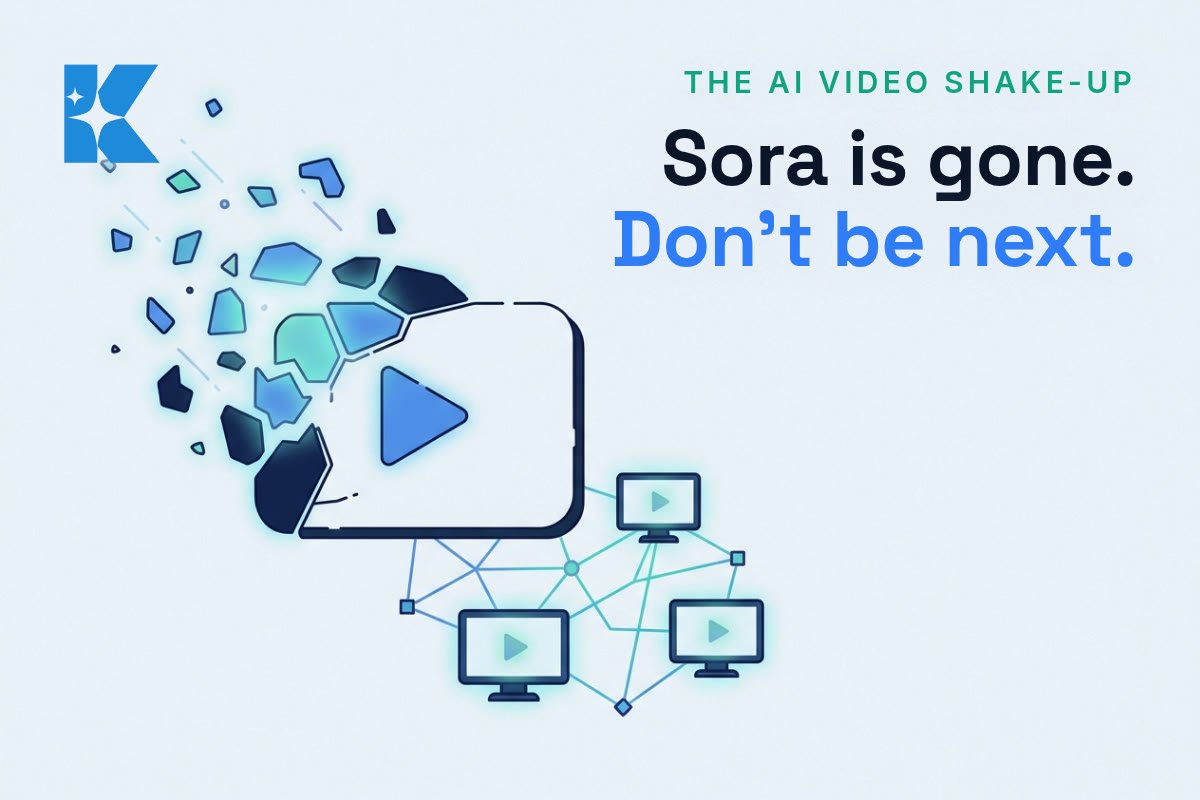
In March 2026, OpenAI posted a short goodbye to Sora on X. By 26 April, the app and web experience were switched off entirely, with the developer API following on 24 September 2026. Six months earlier, Sora had topped the iOS App Store and passed a million downloads in its first week. That is not a slow fade. That is a product going from the most downloaded app in the country to switched off in under two hundred days.
The headline casualty was OpenAI’s reported £1 billion partnership with Disney, which was meant to bring licensed characters into Sora-generated video and onto Disney Plus. Disney walked away as part of the wind-down, and the deal ended with it, according to eMarketer’s reporting on the shutdown.
The number that should worry you
Here is the figure we keep coming back to. Sora reportedly cost OpenAI around one million dollars a day to run, against total lifetime revenue of about £1.6 million (roughly $2.1 million). Active users, meanwhile, had fallen below 500,000 from that first week peak of over a million downloads, according to TechXplore’s breakdown of the shutdown economics. A tool that popular still could not cover its own compute bill. That is the part worth sitting with if your business has built any part of its marketing workflow around a single AI video app: popularity and longevity are not the same thing, and neither is guaranteed by a famous name behind the product.
Why this matters even if you never touched Sora
We build video content for a living, and the lesson from Sora is not “avoid AI video.” Video keeps earning its place in the marketing mix. 91% of UK businesses now include video in their marketing plans, and 82% of marketers say it delivers good ROI, per Educational Voice’s 2026 UK video marketing statistics. The lesson is narrower and more practical: do not let your content pipeline depend on one vendor’s product roadmap, especially a consumer app with no obligation to exist next quarter.
Small businesses are the ones most exposed to this, because they are the least likely to notice a shutdown coming. A larger marketing team might have three or four tools already in rotation and simply drop the dead one. A sole trader or small team that learned one app, built a content rhythm around it, and pointed a season’s ad spend at it loses the whole workflow overnight, not just one tool from a shelf of many.
What has filled the gap
The current AI video landscape has consolidated around a small set of serious contenders rather than one dominant app. Kling 3.0 leads on physical realism and native 4K output. Veo 3.1 currently has the strongest built-in audio generation. Seedance 2.0 is often the pick for brand-consistent, reference-heavy marketing work, taking up to twelve reference files into a single generation. None of these is a like-for-like Sora replacement, and that is rather the point: the market moved from “one app that does everything” to “a handful of specialist models, each good at a different job,” a shift Higgsfield’s own comparison of Sora alternatives lays out in detail.
We run our own daily video content on exactly this kind of stacked approach, not a single app. When one image-to-video generation model has a bad day, or a balance runs low, or a vendor changes its pricing overnight, the pipeline keeps producing because it was never wired to just one supplier in the first place.
Cost is also friendlier than most small business owners assume. Sora was free to use, which is part of why so many businesses leaned on it without a fallback plan, but the paid alternatives are not expensive. Kling 3.0’s standard tier runs to a few pounds a month, well inside what most small businesses already spend on far less useful software subscriptions. Free was never the reason to build a whole content strategy on Sora, and it should not be the reason to build one on whatever replaces it either. Pick tools on reliability and fit, and treat the price as a rounding error against the marketing budget as a whole.
What we would do in your position
If your business has any AI video habit at all, three checks are worth thirty minutes this week.
First, list every AI tool your content depends on and ask what you would do if any single one vanished tomorrow with no warning, the way Sora effectively did. If the honest answer is “stop posting for a month while we figure it out,” that is the risk Sora just made visible.
Second, keep your source assets, brand illustrations, footage, brand guidelines, outside the tool itself. Sora users who treated the app as their only asset library lost access to everything they had made there the moment it closed. A tool should be a step in your pipeline, never the pipeline’s only home.
Third, resist locking your whole visual identity to whichever model happens to be cheapest or most fashionable this month. 67% of UK small and medium businesses already use AI somewhere in their marketing, and that number is only going up, which means the tools underneath it will keep changing fast. Build the workflow to survive that churn, not to depend on today’s leaderboard staying still.
None of this is a reason to slow down on AI video. It clearly still works, the ROI numbers above show that plainly. It is a reason to build the underlying pipeline the way you would build anything else load-bearing in the business: with more than one supplier, and with the assets living somewhere you actually control.