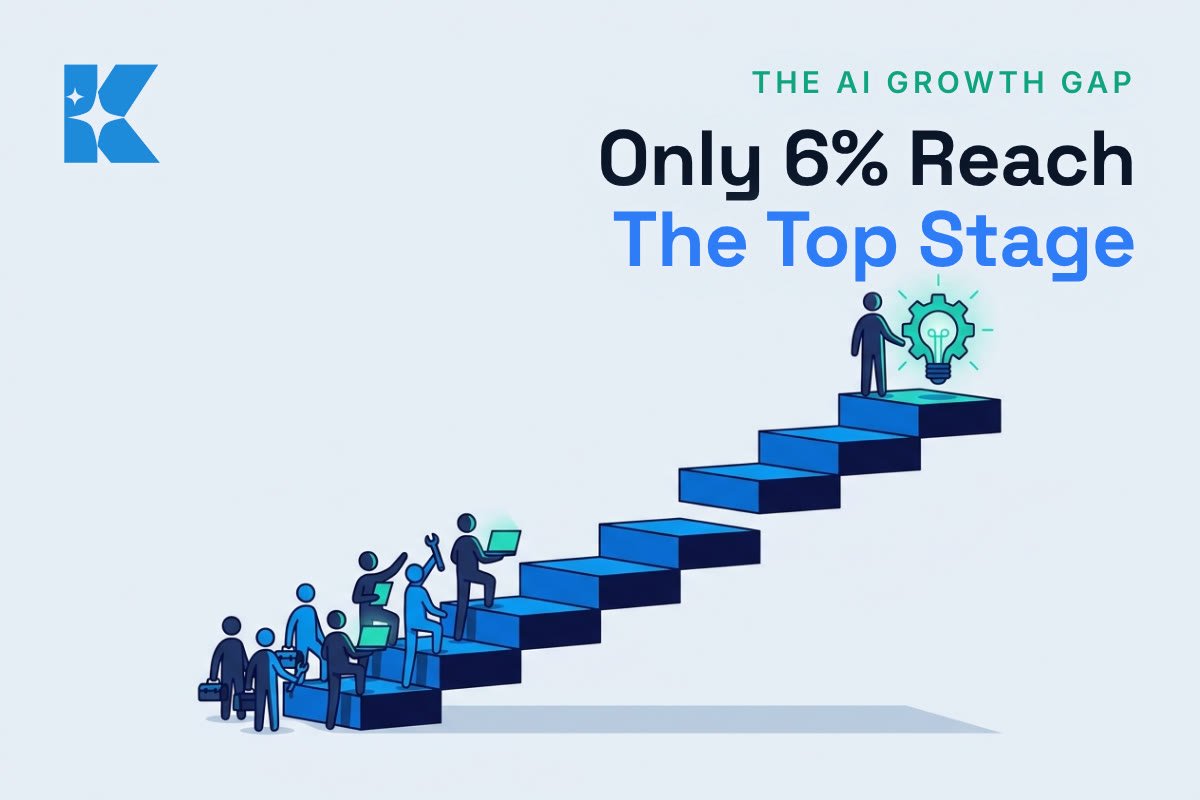
Only 6% of UK businesses that use AI have reached what NatWest calls the transforming stage. That is the headline from the bank’s first AI Adoption Report, which surveyed 1,400 UK small and mid-sized firms, and it should change how you judge your own progress. Using AI is no longer the achievement. Almost half the market has done that. The question worth asking is whether anything in your business actually works differently because of it.
What NatWest actually found
According to NatWest’s press release, 44% of the firms surveyed already use AI, and a further 41% expect to adopt it within the next five years. So the adoption story is largely told. The gap is in what happens next.
The research sorts firms into stages, from exploring through to transforming. Only 6% of users have reached the top one. Most are still somewhere near the start, trying a chatbot for emails, summarising the odd document, and stopping there.
Size matters far more than location. Firms with more than 100 employees are nearly twice as likely to use AI as smaller ones, 67% compared with 36%. NatWest warns of a growing divide, with smaller businesses facing greater barriers in specialist expertise, skills and investment. If you run a firm with ten people, that is a description of your position, not a verdict on it.
The number that should make you pause
The report puts a figure on what separates the stages. Businesses at the earliest, exploring stage typically report saving 1% to 10% of working time. Those at the transforming stage often report average savings of 61% to 70%. On revenue, 95% of businesses at the transforming stage report an increase, against fewer than 29% at the earliest stage.
We would be careful with those numbers, and you should be too. They are self-reported, and they describe firms that were probably well run before AI arrived. Success may be a cause of the deeper adoption as much as a result of it. Nobody should read this as a promise that a given tool will hand you 60% of your week back. What the gap does show is that shallow use and deep use are very different things, and that the first earns very little.
Other surveys tell a different story, and that is useful
You may have seen a higher figure. The British Chambers of Commerce and Atos reported that 54% of firms now actively use AI, up from 35% a year earlier, and that 95% of those using it saw no change in headcount. The two studies counted different samples and defined use differently, which is why the headline percentages do not match.
The point they share is more interesting than the difference. Whichever survey you pick, a large share of businesses have started, and a very small share have changed how they work. Adoption has become cheap. Redesigning a process around it has not.
What we would tell a client about this
If a business owner showed us this report, we would not start by recommending another tool. We would start with one question: which single job in your week would you be glad never to do again? Then we would build around that job, not around the technology.
That is the practical difference between the exploring stage and the transforming one. At the early stage AI sits beside your work, and you ask it things. At the later stage it sits inside a process, with defined inputs, a defined output and a person checking the result. The second is harder to set up and much easier to measure.
Here are the moves we would make in order.
- Pick one repeatable job. Quotes, invoice chasing, enquiry replies, rota changes, job write-ups. Choose something you do at least weekly, with a clear start and finish.
- Time it before you touch it. Write down how long it takes now. Without a starting figure you cannot tell the 1% savings from the 60% ones, and neither can anyone else.
- Write the steps down. If you cannot describe the job in six lines, an AI tool cannot do it reliably either. Fixing the description often saves time on its own.
- Keep a person at the checking step. Let the tool draft, sort or summarise. You approve anything that goes to a customer or touches money.
- Measure again after a month. If the job did not get faster or better, change the process or drop the tool. Do not just add another one.
The trade-offs nobody puts in the headline
Going deeper has costs. A process built around AI depends on that tool continuing to exist, to stay at a price you can afford, and to behave the same way next month. It also puts more of your customer or financial data through a third party, which makes your UK GDPR obligations more real, not less. The Information Commissioner’s Office has guidance on this, and it is worth reading before you connect anything to your customer records.
There is also a skills cost. NatWest says it will deliver 5,000 AI learning and adoption engagements over the next 12 months, which tells you the bank sees the bottleneck as confidence and know-how as much as software. If nobody in your team feels able to own the process, it will quietly fall back to being done by hand.
Where this leaves a small business
The comforting reading of this report is that you are in the majority. Most firms are still exploring, so you are not behind. The more useful reading is that the gap between the 44% who use AI and the 6% who have changed their business with it is where nearly all the value sits, and almost nobody has crossed it yet.
That is an opening for a small firm. A ten-person business can change one process in a fortnight. A large organisation takes a year to agree who owns it. If you pick one job, time it, rebuild it and check the result, you could be ahead of most of the market without spending a great deal.
If you would like a second pair of eyes on which job to start with, we offer a free 30 minute AI audit. We will look at your week with you and tell you honestly where AI is worth the effort and where it is not.