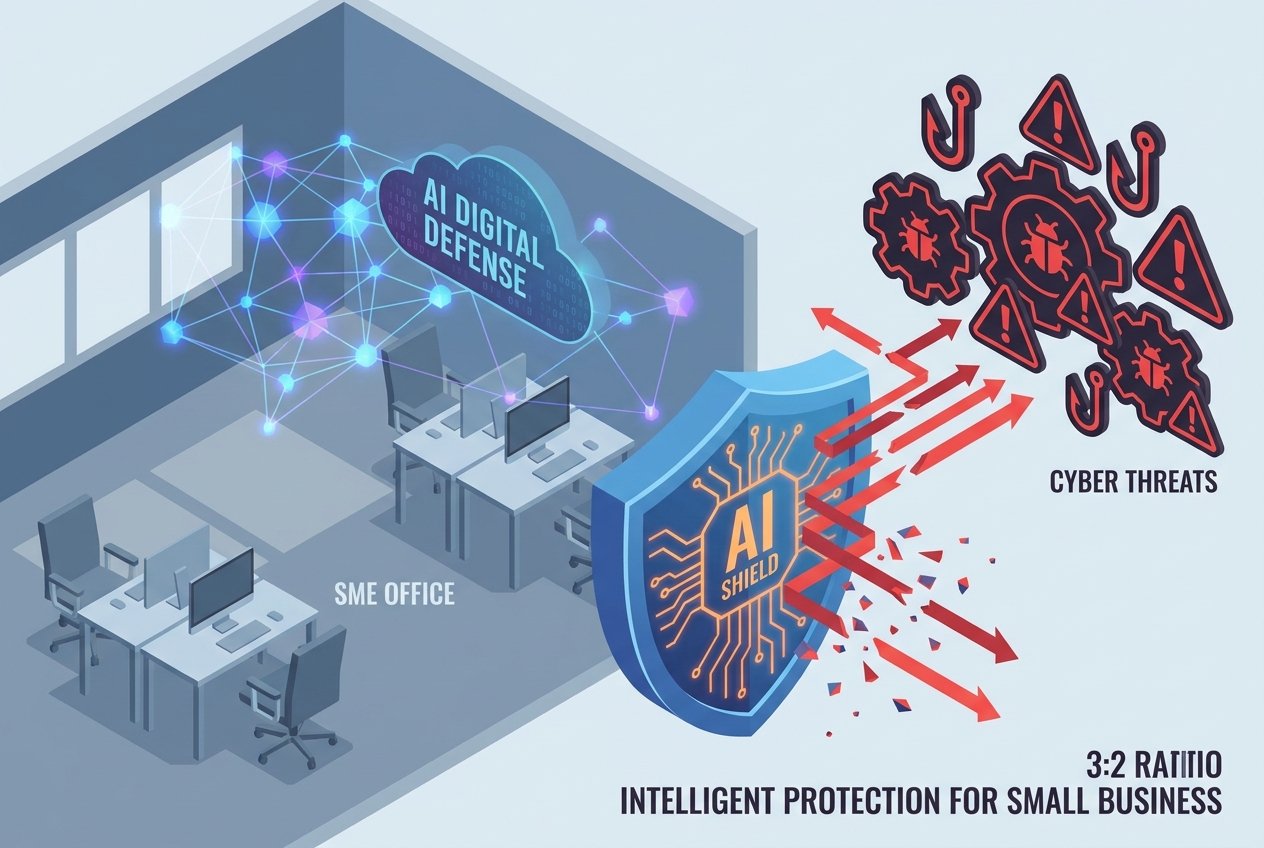
Artificial intelligence was meant to level the playing field for small businesses. Instead, it has become a powerful weapon in the hands of cyber criminals. In 2026, AI cyber threats are evolving faster than ever, and small firms across the United Kingdom are finding themselves on the front line of a digital war they never signed up for. Understanding these cybersecurity risks 2026 is no longer optional. It is essential for survival.
The New Face of AI Cyber Threats
For years, cyber criminals relied on brute force and basic social engineering. Today, generative AI has transformed the threat landscape entirely. Attackers now use machine learning to craft convincing phishing emails, clone voices, and even write polymorphic malware that adapts in real time. According to the World Economic Forum Global Cybersecurity Outlook 2026, 30% of chief executives now identify data leaks as the top generative AI security concern, whilst 28% cite the advancement of adversarial capabilities as their second-largest worry.
The scale of the problem is staggering. CrowdStrike reports an 89% increase in attacks by AI-enabled adversaries. Meanwhile, Proofpoint research highlighted by Hornetsecurity reveals that half of global organisations have experienced a confirmed or suspected AI-related security incident. Even more concerning, 63% of organisations that reported having AI security controls in place still fell victim to such incidents.
Trend Micro predicts that in 2026, attackers will use AI to discover and weaponise vulnerabilities faster than defenders can respond, with threats becoming faster, more automated, and more coordinated. For small business owners who already juggle countless responsibilities, this represents a frightening new reality.
Why Small Businesses Are Prime Targets
Many entrepreneurs mistakenly believe that cyber criminals only target large corporations with deep pockets. The truth is far more troubling. Small businesses are increasingly attractive to attackers precisely because they often lack the robust security infrastructure of bigger enterprises.
The UK Government’s Cyber Security Breaches Survey 2025/2026 found that 43% of UK businesses experienced a cyber security breach or attack in the last twelve months. Among small businesses specifically, that figure rises to 46%. Micro businesses fare little better, with 42% reporting breaches. These are not abstract statistics. They represent hundreds of thousands of real British firms dealing with stolen data, disrupted operations, and financial losses.
Email remains the most common entry point. The same survey notes that phishing was the most prevalent breach type, reported by 38% of respondent businesses. Among those that experienced cyber crime, a remarkable 93% were hit by phishing attacks. With AI now enabling criminals to craft messages that mimic tone, style, and even internal company language, distinguishing legitimate communications from malicious ones has become extraordinarily difficult.
The Most Dangerous AI-Powered Attacks in 2026
Understanding the specific nature of AI-powered attacks is the first step toward defending against them. Here are the three most pressing threats facing British SMEs today.
AI-Generated Phishing
Traditional phishing emails were often riddled with spelling errors and awkward phrasing. AI has eliminated these tell-tale signs. Large language models can now generate flawless, contextually aware messages that reference real colleagues, current projects, and recent company news. Criminals use these tools to conduct spear-phishing campaigns at scale, personalising each message without the painstaking manual effort previously required.
The results are devastating. Research indicates that AI scam activity surged by 1,210% in 2025, and deepfake-related fraud has grown by 3,000% since 2022. For small businesses with limited IT resources, the volume and sophistication of these campaigns can overwhelm even cautious employees.
Deepfake CEO Fraud
Perhaps the most chilling development in small business hacking is the rise of deepfake executive impersonation. Using publicly available video and audio clips from social media, conferences, or interviews, criminals can create convincing voice clones for under five dollars. These synthetic voices are then used in urgent phone calls to finance teams, authorising fraudulent wire transfers or revealing sensitive credentials.
According to recent analysis, deepfakes now drive 40% of business email compromise incidents in 2026. CEO fraud targets at least 400 companies per day. Real cases have shown losses of £25 million or more from a single deepfake video call. For a small business operating on thin margins, one successful attack can be catastrophic.
Autonomous Malware and Adaptive Threats
Beyond social engineering, AI is also powering a new generation of self-modifying malware. These programmes can analyse a target’s defences, identify weaknesses, and alter their own code to evade detection. Unlike traditional malware that follows static patterns, autonomous threats learn and adapt, making signature-based antivirus solutions increasingly ineffective.
Trend Micro warns that the AI-fication of cyberthreats represents a fundamental shift. Defenders can no longer rely on yesterday’s playbooks when attackers are using intelligent systems that evolve faster than human analysts can track.
The Real Cost of Small Business Hacking
The financial impact of cyber attacks on SMEs extends far beyond any ransom payment or immediate theft. The average cost of a successful breach for smaller businesses now exceeds £25,000. For many, this represents months of profit wiped out in an afternoon.
Yet the direct costs are only part of the story. Reputational damage, loss of customer trust, regulatory fines under GDPR, and operational downtime all compound the misery. Some studies suggest that 60% of small businesses close within six months of a major cyberattack. The threat is not merely inconvenient. It is existential.
Furthermore, the UK Cyber Security Breaches Survey reveals that whilst the mean direct cost of cyber crime is £1,970, the median cost is £600. These figures may seem modest, but they mask enormous variation. A single serious incident can cost tens of thousands, particularly when legal fees, notification requirements, and recovery efforts are included.
How to Strengthen Your SME Security
Faced with these cybersecurity risks 2026, what can small business owners actually do? The good news is that effective protection does not require enterprise-level budgets. It requires smart priorities and consistent execution.
Invest in Continuous Employee Training
Your staff are both your greatest vulnerability and your strongest defence. Regular, engaging training sessions that simulate real AI-generated phishing attempts can dramatically improve recognition rates. Make sure employees understand that voice calls, video messages, and even seemingly internal emails can be fabricated. Establish clear verification protocols for any unusual payment requests or credential resets.
Implement Multi-Factor Authentication Everywhere
Multi-factor authentication remains one of the most effective barriers against account compromise. Ensure it is enabled on all business email, banking, cloud storage, and customer relationship management systems. Passwords alone, no matter how complex, are no longer sufficient against AI-powered credential-stuffing attacks.
Deploy AI-Powered Defensive Tools
Just as criminals use AI, defenders must fight fire with fire. Modern email security platforms use machine learning to detect subtle anomalies in message tone, sender behaviour, and link destinations. Endpoint detection and response solutions can identify suspicious activity patterns that traditional antivirus software misses. Investing in these tools is an investment in business continuity.
For businesses unsure where to begin, Kaizen AI Consulting offers tailored assessments that identify vulnerabilities and recommend practical, cost-effective security measures suited to your specific industry and risk profile.
Develop a Clear Incident Response Plan
Preparation is everything. Every small business should have a written incident response plan that outlines who to contact, how to isolate affected systems, and what steps to take to preserve evidence. The UK National Cyber Security Centre provides excellent free resources, but having a plan is only useful if your team knows it exists and understands their roles.
Only about one-third of organisations globally say they are fully prepared to investigate an AI-related security incident. Do not let your business be among the unprepared majority.
When to Seek Professional Guidance
There comes a point when DIY security is no longer adequate. If your business handles sensitive customer data, processes significant payment volumes, or operates in regulated sectors such as finance or healthcare, professional cybersecurity support is not a luxury. It is a necessity.
Engaging with specialists who understand both the technical landscape and the unique pressures facing small businesses can save enormous costs in the long run. Kaizen AI Consulting works with SMEs across the United Kingdom to implement robust security frameworks, train staff, and ensure that AI works for your business rather than against it. Whether you need a one-time security audit or ongoing managed protection, expert guidance can mean the difference between resilience and ruin.
Building a secure business is a journey, not a destination. As we explored in our article on growing from startup to success, sustainable growth requires protecting what you have built. Cybersecurity is now an inseparable part of that equation.
Conclusion: Act Before It Is Too Late
The democratisation of AI has brought remarkable opportunities for small businesses, from automated customer service to predictive analytics. Unfortunately, it has also democratised cyber crime. The tools that help you compete are the same tools that criminals use to exploit you.
AI cyber threats are not a distant concern for large corporations. They are here, they are growing, and they are targeting British SMEs every single day. The businesses that survive and thrive in 2026 and beyond will be those that take SME security seriously today.
Do not wait for a breach to force your hand. Review your defences, train your people, and invest in the right protections now. If you would like expert support in securing your business against AI-powered attacks, contact Kaizen AI Consulting today for a confidential discussion about your security needs. Your business deserves nothing less than complete peace of mind.